
#binanceblockchainweekevolutionisyours
binanceblockchainweekevolutionisyours
Просмотров: 54
2 обсуждают
Популярные
Новые


·
--
Статья
Next Evolution of Blockchain: When Technology Stops Working in Isolation & Starts Connecting WorldBinance Blockchain Week 2026 || Bangkok, November 28 to 29 .
By Fatima (#LearnWithFatima )
#BinanceBlockchainWeekEvolutionIsYours
Quick read
→ The Evolve Test: one question I ask in every section→ Eight themes: from stablecoins and tokenization to AI agents and humanitarian aid→ A scorecard: five signals I'll track in Bangkok
I've been thinking about the word "Evolve" a lot this week. In crypto we usually attach it to something shiny: a faster chain, a new token standard, a protocol that promises to change everything. But when I went through the official agenda for Binance Blockchain Week 2026, I noticed something different. The sessions cover traditional capital markets, 24/7 trading, stablecoin payments, AI agents, tokenization, cybersecurity, DeFi infrastructure and even humanitarian aid. That's not one technology race. That's a lot of separate systems standing in the same room.
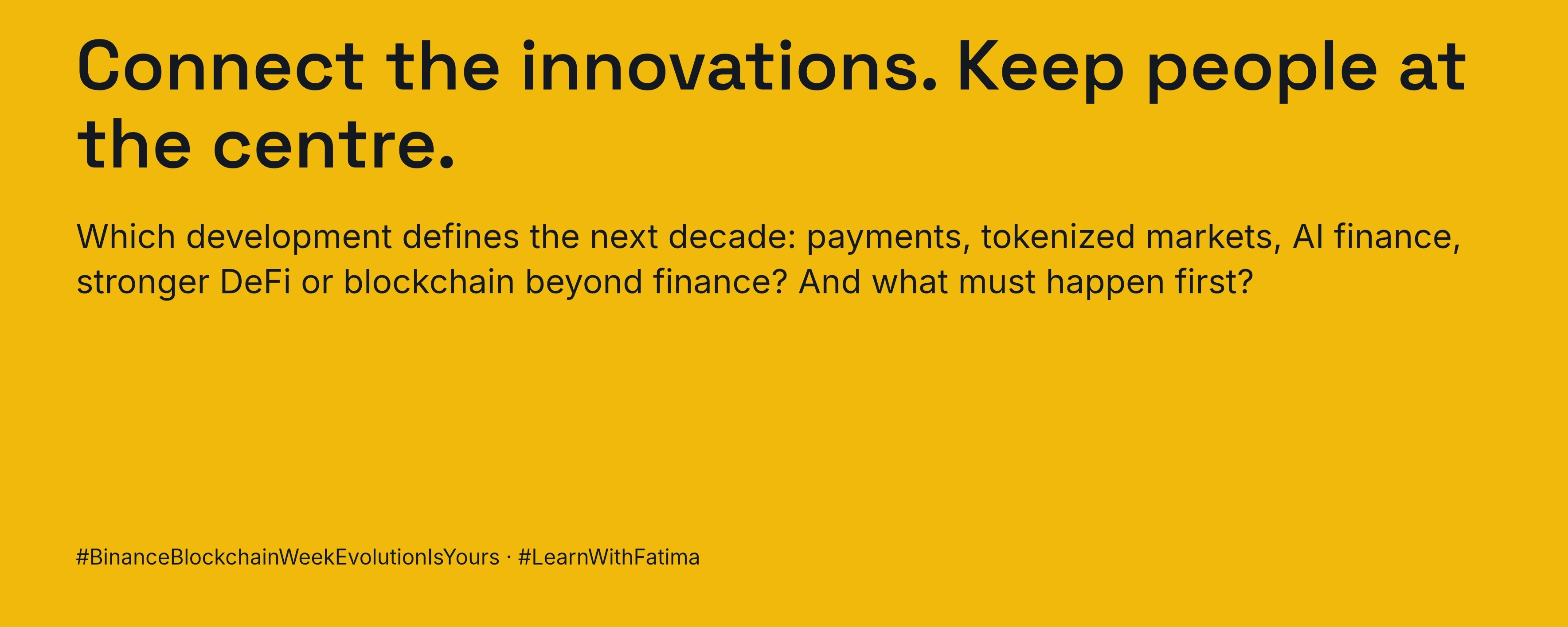
So here's my argument. The next real breakthrough probably won't come from building yet another isolated technology. It'll come from making the things we already have work together in ways that used to be hard, expensive or out of reach for normal people.
To keep myself honest, I'm going to use one simple test through this whole article. I call it the Evolve Test: does this development make a real process easier for a real person, or does it only look good inside crypto? Every section ends with that question.
1. Wallets Are Not Wins: The Metric Shift Crypto Needs
For years the big question was when more people would enter the market. It still matters, but it's no longer the whole story. Millions of wallets don't automatically mean millions of people benefiting. A high transaction count can hide very little real economic activity. And a protocol can pull in liquidity without being useful to anyone outside its own community.
I think we need better scoreboards. Instead of only asking how many people use blockchain, I'd ask these:
→ Speed and cost: did a financial process actually get faster or cheaper?→ Borders: can value cross one without silly friction?→ Simplicity: can a business use blockchain without forcing every customer to learn how it works?
I've been a beginner myself, starting with zero capital and almost no technical knowledge, so I know how quickly a "simple" app turns into a wall of jargon.
Mass adoption, to me, means people benefit without ever having to think about the blockchain underneath.
"Evolve Test: would a first-time user even notice the blockchain was there?"
2. The Handshake Problem: When TradFi Meets Blockchain
One of the biggest themes on the agenda is how traditional markets and digital assets fit together. They grew up on different assumptions. Traditional markets run on regulated intermediaries, custody arrangements and settlement cycles. Blockchains bring shared ledgers, programmable transfers and a different idea of ownership.
I don't think the point is to crown a winner. The point is to see where each side fixes the other's weak spot. Picture an investor in Karachi or Bangkok who doesn't have to wait for a distant exchange to open just because infrastructure was built around office hours.
But 24/7 trading raises questions that don't go away on their own:
→ Liquidity: who provides it at 3 a.m.?→ Pricing: how do prices stay fair while traditional markets are closed?→ Settlement: what happens when custodians, settlement systems and venues all run on different clocks?
Continuous access only has value when liquidity, pricing and risk management keep up with it. So the real conversation isn't about longer trading hours. It's about redesigning the plumbing that global markets run on.
"Evolve Test: is round-the-clock trading backed by real liquidity, or is it just a longer window for thin markets?"
3. From Transfers to Payments: The Stablecoin Reality Check
Stablecoins might be the clearest case of blockchain doing something practical. Think about someone sending money abroad. The traditional route can involve several institutions, banking hours, layered fees and waiting time. A stablecoin transfer can skip much of that.
Still, a transaction recorded on a blockchain isn't automatically a good payment system. For stablecoins to become dependable infrastructure, five things have to line up:
→ Trust: people believe the coin holds its value and can be redeemed→ Depth: markets are deep enough that converting doesn't move the price→ Rules: issuers follow clear standards on reserves, compliance and consumer protection→ Safe movement: switching networks doesn't add security holes→ Simplicity: someone who has never touched a private key can still use it
That's the part I'm watching. The future of payments won't be decided by how many stablecoins exist. It'll be decided by how safely and consistently people can use them for ordinary things like paying a supplier, sending family support or receiving freelance income.
"Evolve Test: could a regular person use this every week without fear of getting it wrong?"
4. A Token Is Not a Title Deed: The Ownership Gap
Real-world asset tokenization deserves attention beyond the headline. At its simplest, a token represents an asset or a financial claim: a fund, a bond, a security. The appeal is easy to see. Ownership and transfer become more programmable, fractional access gets easier in some structures, and settlement could get more efficient.
But one question gets skipped too often: what exactly does holding this token give me? A token isn't automatically enforceable ownership. Before I trust any tokenized asset, I check four things:
→ Legal structure: what claim does the holder actually have?→ Issuer duties: what does the issuer owe, and to whom?→ Custody and redemption: who holds the real asset, and can I exit?→ Market: is there a functioning market, or just a nicely formatted promise?
This is why I don't judge tokenization by how many assets get converted. I judge it by whether people get clearer rights, better transparency and an easier way to own and transfer things.
"Evolve Test: if something goes wrong, what can the holder actually enforce?"
5. Agents With Guardrails: Who Holds the Wallet Keys?
The AI and blockchain overlap is probably the most thought-provoking part of the agenda. Most of us still do everything manually: pick an asset, check the data, approve the transaction. An agent could take over parts of that, like monitoring conditions, comparing payment routes or carrying out a task you've authorized, with blockchain acting as the programmable settlement layer.
I like the idea, but it creates a new kind of risk. An agent can misread an instruction or act on manipulated information. A smart contract can run exactly as written and still produce a result nobody wanted. Give an automated system too much access and one small error becomes a serious loss.
That's why I'd want these basics in place before trusting any agent with money:
→ Limited permissions: never open wallet access→ Human approval: required for large or sensitive transactions→ Spending limits: clear execution rules the agent can't bend→ Readable records: what the agent did and why→ Contract checks: screening before it touches anything unfamiliar
The future I find exciting isn't one where humans disappear from financial decisions. It's one where automation handles the repetitive work and people keep real control.
"Evolve Test: if the agent gets it wrong, who is accountable and how much can it lose?"
6. After the Rewards Stop: DeFi's Durability Test
DeFi has already shown that lending, trading and other services can run through smart contracts. But building a protocol isn't the same as building lasting infrastructure. I've seen platforms attract huge liquidity during a reward campaign and lose most of it when the rewards faded. A lending market can grow fast while quietly taking on more collateral risk. A decentralized exchange can process plenty of activity and still suffer from liquidity scattered across networks.
Three things matter most to me here:
→ Liquidity quality: is it organic, or is it rented?→ Risk design: are collateral rules, liquidations and exposure limits built to survive stress, not just calm markets?→ Cross-chain coordination: can assets and apps move between networks without piling on bridge and settlement risk?
Growth is easy to celebrate when conditions are good. Resilience is what you find out about when they aren't.
"Evolve Test: what's left in this protocol the day the rewards stop?"
7. Security Is the Product: Trust as Infrastructure
As more financial activity moves onto digital rails, security failures hurt more people at once. One smart contract flaw, one compromised key, one manipulated oracle or one weak bridge can ripple across an entire ecosystem. Add AI-powered systems and the surface for mistakes gets even bigger.
Security can't be a patch added after launch. It has to sit in the architecture from day one:
→ Independent reviews before anything goes live→ Careful access controls and live monitoring→ Honest incident reports when things break→ Recovery plans that exist before they're needed
Compliance matters as well, especially where blockchain apps touch regulated markets. The industry has to find a workable balance between innovation, privacy, user protection and accountability.
Decentralization shouldn't be an excuse to dodge responsibility. A mature industry understands both the freedom this technology creates and the duty that comes with putting financial tools in people's hands.
"Evolve Test: does the team communicate openly when things break?"
8. Beyond the Price Chart: Blockchain's Humanitarian Proof
The agenda item that stayed with me most is how blockchain could change humanitarian aid. It's a good reminder that this technology shouldn't only be measured through markets. Aid operations are messy in four places:
→ Moving funds across borders and partners→ Verifying recipients without exposing their data→ Showing clearly where the money went→ Coordinating organizations around shared records
Blockchain-based systems might make transactions easier to trace and give clearer records of how resources move.
Technology alone won't fix this. Reliable identity, data privacy, accessibility and local infrastructure decide whether any system actually reaches people. Still, if blockchain can make assistance more transparent and cut administrative friction, its value shows up somewhere much more meaningful than a trading chart.
"Evolve Test: does it make help arrive faster and more accountably?"
9. The Evolve Scorecard: Five Signals I'm Tracking in Bangkok
While everyone else chases announcements, I'll be watching how these pieces connect. Here's the scorecard I'm taking with me.
Announcements create attention overnight, but infrastructure takes time. The real evidence of evolution is what's still working after the conference ends.
Final Take: Connect the Systems, Centre the Human
I don't think blockchain needs another cycle of promises about changing everything. It needs to show where it makes a measurable difference. Here's what I want to see:
→ Networks that talk to each other→ Products people can actually understand→ Payments that cross borders→ Tokenized assets with real rights→ AI tools that respect user control→ Infrastructure that holds up under pressure
And we should keep the end user at the center. A technology can be brilliant and still fail if ordinary people can't reach it, understand it or trust it.
So for me, the biggest question around Binance Blockchain Week 2026 isn't what the next innovation will be. It's whether the industry is ready to connect its innovations into something people can genuinely depend on. The next chapter shouldn't be defined only by what we build, but by what becomes possible because we built it.
This article is my own analysis and not financial advice. Please do your own research.
#BinanceBlockchainWeekEvolutionIsYours #LearnWithFatima @BinanceBlockchainWeek #币安区块链周进化由你
Next Evolution of Blockchain: When Technology Stops Working in Isolation & Starts Connecting World
Binance Blockchain Week 2026 || Bangkok, November 28 to 29 .
By Fatima (#LearnWithFatima )
#BinanceBlockchainWeekEvolutionIsYours
Quick read
→ The Evolve Test: one question I ask in every section→ Eight themes: from stablecoins and tokenization to AI agents and humanitarian aid→ A scorecard: five signals I'll track in Bangkok
I've been thinking about the word "Evolve" a lot this week. In crypto we usually attach it to something shiny: a faster chain, a new token standard, a protocol that promises to change everything. But when I went through the official agenda for Binance Blockchain Week 2026, I noticed something different. The sessions cover traditional capital markets, 24/7 trading, stablecoin payments, AI agents, tokenization, cybersecurity, DeFi infrastructure and even humanitarian aid. That's not one technology race. That's a lot of separate systems standing in the same room.
So here's my argument. The next real breakthrough probably won't come from building yet another isolated technology. It'll come from making the things we already have work together in ways that used to be hard, expensive or out of reach for normal people.
To keep myself honest, I'm going to use one simple test through this whole article. I call it the Evolve Test: does this development make a real process easier for a real person, or does it only look good inside crypto? Every section ends with that question.
1. Wallets Are Not Wins: The Metric Shift Crypto Needs
For years the big question was when more people would enter the market. It still matters, but it's no longer the whole story. Millions of wallets don't automatically mean millions of people benefiting. A high transaction count can hide very little real economic activity. And a protocol can pull in liquidity without being useful to anyone outside its own community.
I think we need better scoreboards. Instead of only asking how many people use blockchain, I'd ask these:
→ Speed and cost: did a financial process actually get faster or cheaper?→ Borders: can value cross one without silly friction?→ Simplicity: can a business use blockchain without forcing every customer to learn how it works?
I've been a beginner myself, starting with zero capital and almost no technical knowledge, so I know how quickly a "simple" app turns into a wall of jargon.
Mass adoption, to me, means people benefit without ever having to think about the blockchain underneath.
"Evolve Test: would a first-time user even notice the blockchain was there?"
2. The Handshake Problem: When TradFi Meets Blockchain
One of the biggest themes on the agenda is how traditional markets and digital assets fit together. They grew up on different assumptions. Traditional markets run on regulated intermediaries, custody arrangements and settlement cycles. Blockchains bring shared ledgers, programmable transfers and a different idea of ownership.
I don't think the point is to crown a winner. The point is to see where each side fixes the other's weak spot. Picture an investor in Karachi or Bangkok who doesn't have to wait for a distant exchange to open just because infrastructure was built around office hours.
But 24/7 trading raises questions that don't go away on their own:
→ Liquidity: who provides it at 3 a.m.?→ Pricing: how do prices stay fair while traditional markets are closed?→ Settlement: what happens when custodians, settlement systems and venues all run on different clocks?
Continuous access only has value when liquidity, pricing and risk management keep up with it. So the real conversation isn't about longer trading hours. It's about redesigning the plumbing that global markets run on.
"Evolve Test: is round-the-clock trading backed by real liquidity, or is it just a longer window for thin markets?"
3. From Transfers to Payments: The Stablecoin Reality Check
Stablecoins might be the clearest case of blockchain doing something practical. Think about someone sending money abroad. The traditional route can involve several institutions, banking hours, layered fees and waiting time. A stablecoin transfer can skip much of that.
Still, a transaction recorded on a blockchain isn't automatically a good payment system. For stablecoins to become dependable infrastructure, five things have to line up:
→ Trust: people believe the coin holds its value and can be redeemed→ Depth: markets are deep enough that converting doesn't move the price→ Rules: issuers follow clear standards on reserves, compliance and consumer protection→ Safe movement: switching networks doesn't add security holes→ Simplicity: someone who has never touched a private key can still use it
That's the part I'm watching. The future of payments won't be decided by how many stablecoins exist. It'll be decided by how safely and consistently people can use them for ordinary things like paying a supplier, sending family support or receiving freelance income.
"Evolve Test: could a regular person use this every week without fear of getting it wrong?"
4. A Token Is Not a Title Deed: The Ownership Gap
Real-world asset tokenization deserves attention beyond the headline. At its simplest, a token represents an asset or a financial claim: a fund, a bond, a security. The appeal is easy to see. Ownership and transfer become more programmable, fractional access gets easier in some structures, and settlement could get more efficient.
But one question gets skipped too often: what exactly does holding this token give me? A token isn't automatically enforceable ownership. Before I trust any tokenized asset, I check four things:
→ Legal structure: what claim does the holder actually have?→ Issuer duties: what does the issuer owe, and to whom?→ Custody and redemption: who holds the real asset, and can I exit?→ Market: is there a functioning market, or just a nicely formatted promise?
This is why I don't judge tokenization by how many assets get converted. I judge it by whether people get clearer rights, better transparency and an easier way to own and transfer things.
"Evolve Test: if something goes wrong, what can the holder actually enforce?"
5. Agents With Guardrails: Who Holds the Wallet Keys?
The AI and blockchain overlap is probably the most thought-provoking part of the agenda. Most of us still do everything manually: pick an asset, check the data, approve the transaction. An agent could take over parts of that, like monitoring conditions, comparing payment routes or carrying out a task you've authorized, with blockchain acting as the programmable settlement layer.
I like the idea, but it creates a new kind of risk. An agent can misread an instruction or act on manipulated information. A smart contract can run exactly as written and still produce a result nobody wanted. Give an automated system too much access and one small error becomes a serious loss.
That's why I'd want these basics in place before trusting any agent with money:
→ Limited permissions: never open wallet access→ Human approval: required for large or sensitive transactions→ Spending limits: clear execution rules the agent can't bend→ Readable records: what the agent did and why→ Contract checks: screening before it touches anything unfamiliar
The future I find exciting isn't one where humans disappear from financial decisions. It's one where automation handles the repetitive work and people keep real control.
"Evolve Test: if the agent gets it wrong, who is accountable and how much can it lose?"
6. After the Rewards Stop: DeFi's Durability Test
DeFi has already shown that lending, trading and other services can run through smart contracts. But building a protocol isn't the same as building lasting infrastructure. I've seen platforms attract huge liquidity during a reward campaign and lose most of it when the rewards faded. A lending market can grow fast while quietly taking on more collateral risk. A decentralized exchange can process plenty of activity and still suffer from liquidity scattered across networks.
Three things matter most to me here:
→ Liquidity quality: is it organic, or is it rented?→ Risk design: are collateral rules, liquidations and exposure limits built to survive stress, not just calm markets?→ Cross-chain coordination: can assets and apps move between networks without piling on bridge and settlement risk?
Growth is easy to celebrate when conditions are good. Resilience is what you find out about when they aren't.
"Evolve Test: what's left in this protocol the day the rewards stop?"
7. Security Is the Product: Trust as Infrastructure
As more financial activity moves onto digital rails, security failures hurt more people at once. One smart contract flaw, one compromised key, one manipulated oracle or one weak bridge can ripple across an entire ecosystem. Add AI-powered systems and the surface for mistakes gets even bigger.
Security can't be a patch added after launch. It has to sit in the architecture from day one:
→ Independent reviews before anything goes live→ Careful access controls and live monitoring→ Honest incident reports when things break→ Recovery plans that exist before they're needed
Compliance matters as well, especially where blockchain apps touch regulated markets. The industry has to find a workable balance between innovation, privacy, user protection and accountability.
Decentralization shouldn't be an excuse to dodge responsibility. A mature industry understands both the freedom this technology creates and the duty that comes with putting financial tools in people's hands.
"Evolve Test: does the team communicate openly when things break?"
8. Beyond the Price Chart: Blockchain's Humanitarian Proof
The agenda item that stayed with me most is how blockchain could change humanitarian aid. It's a good reminder that this technology shouldn't only be measured through markets. Aid operations are messy in four places:
→ Moving funds across borders and partners→ Verifying recipients without exposing their data→ Showing clearly where the money went→ Coordinating organizations around shared records
Blockchain-based systems might make transactions easier to trace and give clearer records of how resources move.
Technology alone won't fix this. Reliable identity, data privacy, accessibility and local infrastructure decide whether any system actually reaches people. Still, if blockchain can make assistance more transparent and cut administrative friction, its value shows up somewhere much more meaningful than a trading chart.
"Evolve Test: does it make help arrive faster and more accountably?"
9. The Evolve Scorecard: Five Signals I'm Tracking in Bangkok
While everyone else chases announcements, I'll be watching how these pieces connect. Here's the scorecard I'm taking with me.
Announcements create attention overnight, but infrastructure takes time. The real evidence of evolution is what's still working after the conference ends.
Final Take: Connect the Systems, Centre the Human
I don't think blockchain needs another cycle of promises about changing everything. It needs to show where it makes a measurable difference. Here's what I want to see:
→ Networks that talk to each other→ Products people can actually understand→ Payments that cross borders→ Tokenized assets with real rights→ AI tools that respect user control→ Infrastructure that holds up under pressure
And we should keep the end user at the center. A technology can be brilliant and still fail if ordinary people can't reach it, understand it or trust it.
So for me, the biggest question around Binance Blockchain Week 2026 isn't what the next innovation will be. It's whether the industry is ready to connect its innovations into something people can genuinely depend on. The next chapter shouldn't be defined only by what we build, but by what becomes possible because we built it.
This article is my own analysis and not financial advice. Please do your own research.
#BinanceBlockchainWeekEvolutionIsYours #LearnWithFatima @Binance Blockchain Week #币安区块链周进化由你
2
355
Войдите, чтобы посмотреть больше материала
Присоединяйтесь к пользователям криптовалют по всему миру на Binance Square
⚡️ Получайте новейшую и полезную информацию о криптоактивах.
💬 Нам доверяет крупнейшая в мире криптобиржа.
👍 Получите достоверные аналитические данные от верифицированных создателей контента.
Эл. почта/номер телефона
В тренде
1
#CanMarketsReboundAfterThanksgiving?
Просмотров: 123,392
1,573 обсуждают
2
#CouldSpaceX’sOrbitalDataCentersBoostAIChipDemand?
Просмотров: 60,586
963 обсуждают
3
#SouthKoreaProposesMandatoryDigitalAssetTransactionDisclosure
Просмотров: 966
37 обсуждают
4
#EvolveAtBinanceBlockchainWeek
Просмотров: 768,300
9,552 обсуждают
5
#KoreaFSCSeeksPowerToSuspendCryptoListings
Просмотров: 11,603
220 обсуждают
6
#SouthKoreaPlansToRequireTetherCircleLocalReserves
Просмотров: 10,572
162 обсуждают
7
#UKFCAReportedlyPlansDeFiAuthorizationRules
Просмотров: 7,923
105 обсуждают
8
#ZcashDevelopersUrgeZECMoveToIronwood
Просмотров: 16,359
102 обсуждают
9
#TetherGoldFaces$2.55BUnrealizedLoss
Просмотров: 1,885
11 обсуждают
10
#CorePCEBeatLiftsFedHikeOdds
Просмотров: 262,880
1,755 обсуждают