
#atoshihack
atoshihack
Просмотров: 1
2 обсуждают
Популярные
Новые

·
--
Another bridge, another private key — and this time the attacker walked away with just $60,000 after crashing the token 94% in an hour.
Atoshi's Ethereum routing proxy was drained on Friday after a private-key leak, security firm Blockaid flagged. The attacker upgraded the live proxy to a malicious implementation that only allows funds out, swept every $ATOS held by the contract into a fresh wallet, then dumped around 201 million tokens across about six Kyber trades.
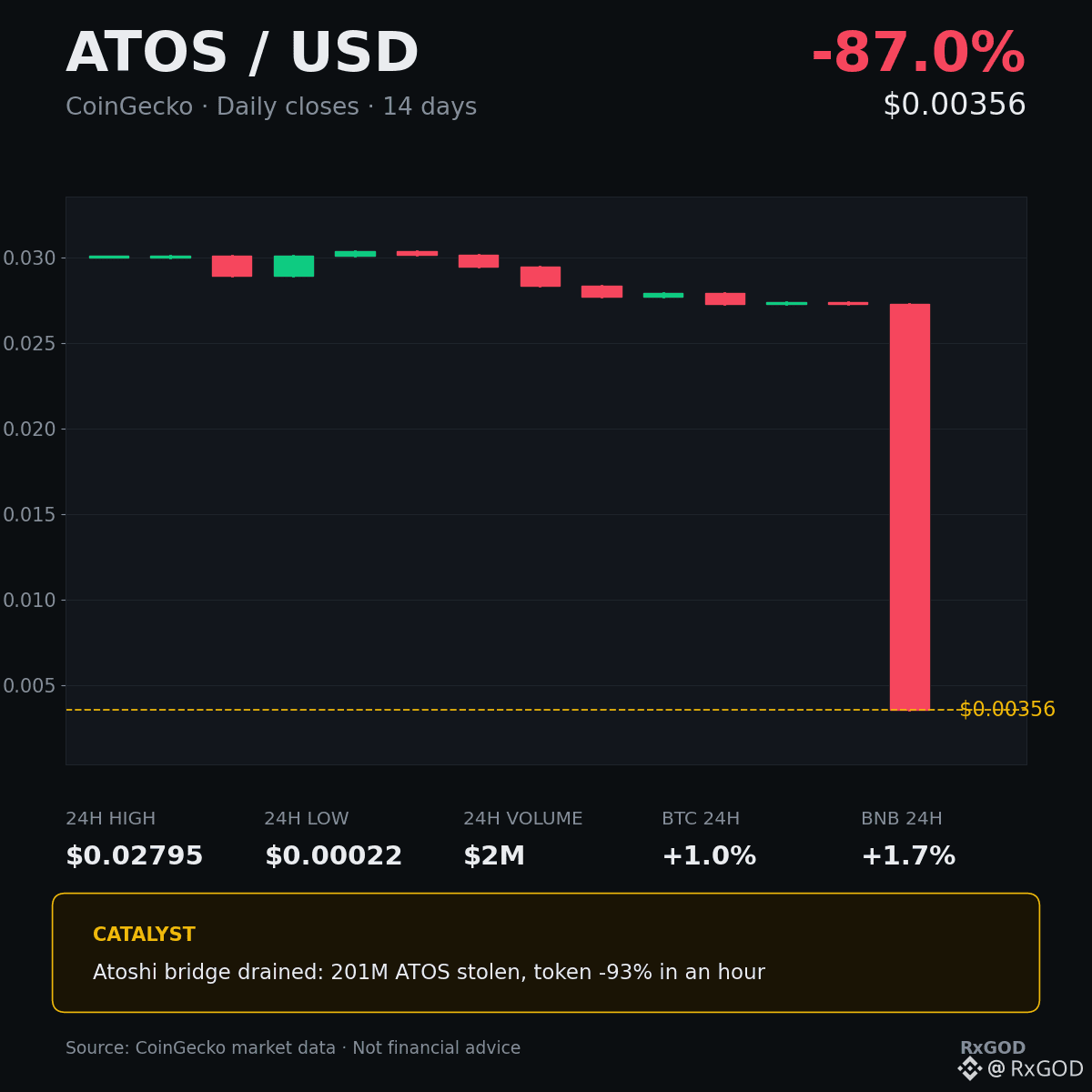
Those 201 million tokens fetched only about $60,300 in USDC. $ATOS collapsed roughly 94% within an hour across two Uniswap pools, to about $0.0018, as the sell order hit thin liquidity. CoinGecko now shows it at $0.0036, still down 87% in 24 hours, with a 24-hour range of $0.00022 to $0.02795 and a market cap of just $3.2 million. Blockaid warned the attack was still ongoing when it raised the alert.
This is not a clever smart-contract bug. It is the oldest failure in crypto: whoever holds the upgrade key holds the money. The same pattern sat behind this month's biggest bridge incidents — leaked keys and admin permissions, not zero-days. No audit can save a protocol whose proxy admin key is compromised.
Meanwhile $BTC holds $61,497, up 0.9% in 24 hours but down 10% over 14 days, as the market shrugs off another small-cap exploit — but the lesson scales to every protocol with an upgradeable proxy.
Should a single-key upgradeable proxy be a red flag by default, or is that too harsh on small teams? Would you hold a token whose funds sit behind one leaked key?
Not financial advice — DYOR.
#AtoshiHack #BridgeHack #ExtremeFear #CryptoNews
1
Войдите, чтобы посмотреть больше материала
Присоединяйтесь к пользователям криптовалют по всему миру на Binance Square
⚡️ Получайте новейшую и полезную информацию о криптоактивах.
💬 Нам доверяет крупнейшая в мире криптобиржа.
👍 Получите достоверные аналитические данные от верифицированных создателей контента.
Эл. почта/номер телефона
В тренде
1
#EvolveAtBinanceBlockchainWeek
Просмотров: 1.5M
16,089 обсуждают
2
#ChainflipVaultTheftHaltsProtocol
Просмотров: 6,735
129 обсуждают
3
#VitalikWantsWalletChipDesignsOpened
Просмотров: 14,295
239 обсуждают
4
#AnzaUrgesSolanaNodesUpgradeAgave
Просмотров: 6,149
129 обсуждают
5
#ColdcardFlawLeadsToTheftOfAtLeast1789BTC
Просмотров: 3,143
21 обсуждают
6
#DowJonesAdds591.99Points
Просмотров: 4,944
30 обсуждают
7
#ECBOfficialsHintAtMoreTightening
Просмотров: 705
30 обсуждают
8
#MalaysiaFirstBitcoinETFToListOnDecember2
Просмотров: 4,190
40 обсуждают
9
#ClaudeAccusedOfDroppingUserPreferences
Просмотров: 4,699
60 обсуждают
10
#ChinaBlockchainIDRulesEffectMarch2027
Просмотров: 16,954
250 обсуждают