
#006
006
Просмотров: 560
8 обсуждают
Популярные
Новые

·
--
⚔️ ANIME QUOTE QUIZ #006 ⚔️
“If you don't fight, you can't win. Fight. Fight.”
🧠 Can you guess which visionary and a force of nature said this iconic anime quote?
In crypto trading, finding success isn't just about passive holding—it's about an active, relentless pursuit. To move forward and achieve freedom from market cycles, you mumust fight for your position, adapt to the chaos, and protect your portfolio. Complacency is the enemy. True strength lies in your conviction.
Drop your answers in the comments below! 👇
(Hint: The image might hold the key! 😉)
$AIOT $ESPORTS $EVAA
Answer 👉 Eren Yeager
#AnimeQuiz #Ayush4155 #DevTeasers

2.7k
18
121
2.7k

·
--
【结构观察 #006|$ZEC 4H】高点抬高、低点下移,箱体在扩张
20:01 现价 1,137,24 小时 +0.68%,成交额 18.21 亿 U,日内 1,048–1,191。
① 结构:近 30 根高点抬高、低点降低,扩张三角。箱体 1,055–1,320,宽度 25.1%,现价落在 31% 分位,箱体下半区。MA25 在 1,160,位于现价上方,近 5 根斜率 +0.49%,均线还在慢慢往上蹭。
② 量价:近 10 根对前 30 根是 0.78 倍,量能与前期接近,没放大也没缩下去。近 10 根里 4 根收红。价格在上沿和下沿之间来回甩,量却没跟上,这种扩张更像是波动先走了一步。
③ 共振:上方 1,156–1,160 一带同时压着 Fib 0.618(1,156)和 MA25(1,160),两个来源叠在一起。下方只有 1,055–1,127 一个来源,可信度要打折。
④ 资金面:资金费率 +0.0100%,多头付费;持仓 7 根 4H 变化 -1.02%,基本没动;多空账户比 0.76,账户端偏空一侧,价格却还在高位区间里磨。
观察区间:上方 1,156–1,170,下方 1,055–1,127。
1H 视角:近 12 小时在 1,127–1,191 之间走,最新收盘分位 16%,贴着这段区间的下沿。
失效条件:4H 收盘站上 1,170 或跌破 1,055,这组判断作废。
上方那条 1,156–1,160 是我这次盯得最紧的一带,两个来源刚好撞在一起;你画出来的 MA25 会不会跟我这条差几个点?
以上是公开数据的结构记录,不构成操作建议,盈亏自负。
$ZEC
#技术分析 #合约交易 #比特币
12

·
--
Статья
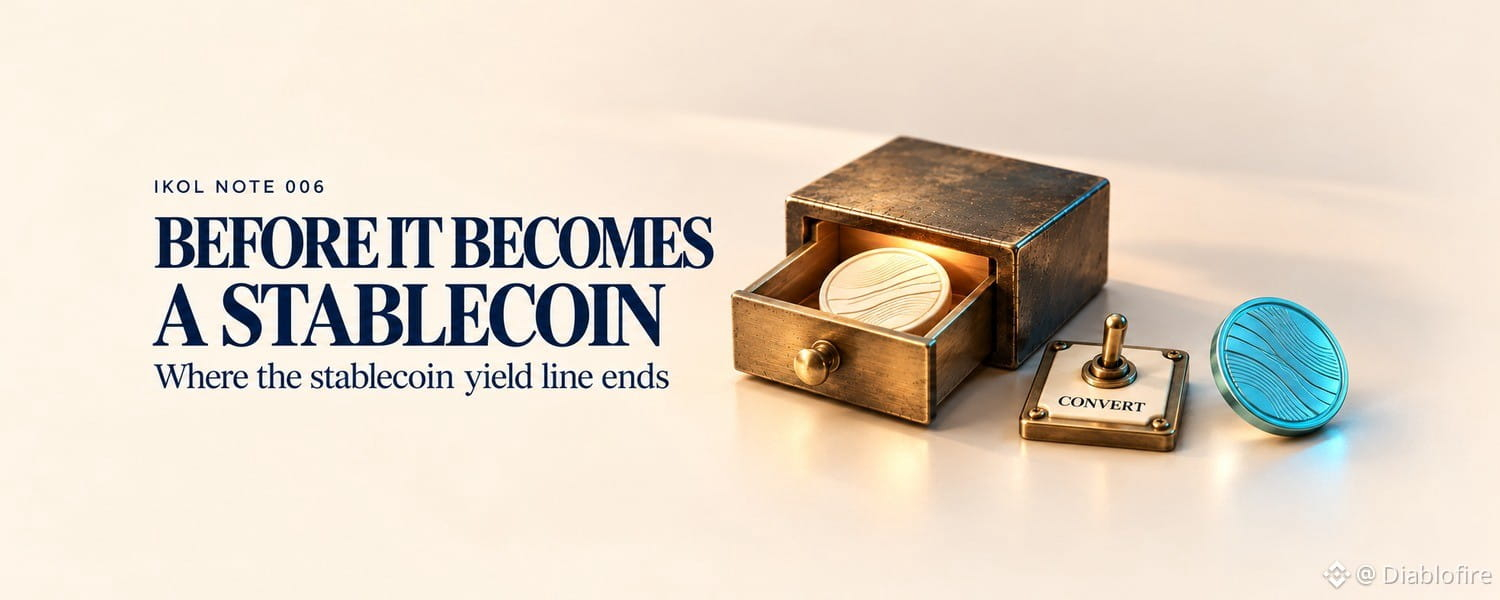
Before It Becomes a Stablecoin: SoFi's 4.40% DepositIKOL Note #006 · Follow-up to Note #005: where the stablecoin yield line ends
Short answer: On October 22, SoFi Bank began rolling out SoFi Earn (SOFIE), a tokenized deposit paying a variable 4.40% APY, FDIC-insured up to applicable limits, that customers can convert one-for-one into SoFi's payment stablecoin, SoFiUSD. What lets it pay interest is not a new name but a different legal product: SOFIE is a bank deposit. The OCC's final GENIUS Act rule, published a day earlier and effective January 18, 2027, confirms that the Act's yield prohibition "does not apply to deposits," including deposits in tokenized form. SoFi's own account agreement draws the line at the conversion step: converting redeems the deposit, ends its deposit-insurance coverage, and issues a separate legal instrument.
【A choice before the trade】
[Analysis] Picture a hypothetical crypto user with cash set aside for a trade that hasn't happened yet. Where does that money wait? SoFi's answer: hold it as a bank deposit, and convert it into a stablecoin when you need to move it. The interesting question is what changes when you press "convert." It is not just the label on the dollar. It changes the legal claim you hold and the protections attached to it.
【What SoFi built】
[Documented] According to SoFi's release (Oct 22):
· SOFIE is "a tokenized deposit representing a deposit liability of SoFi Bank, N.A., Member FDIC," and is "not a payment stablecoin." Each SOFIE represents $1 on deposit at SoFi Bank.
· The 4.40% APY is "variable and subject to change at any time," current as of October 20; fees may reduce earnings. There is no minimum balance.
· Deposits are FDIC-insured up to $250,000 per depositor, per insured bank, for each account ownership category. SoFi's own disclosure: digital assets other than SOFIE are not FDIC insured.
· Members can convert SOFIE 1:1 into SoFiUSD, then buy crypto in the app or send SoFiUSD to "a supported external wallet over blockchain rails 24/7."
· Rollout to SoFi Crypto members runs "now through November."
[Documented] SoFi's tokenized deposit account agreement adds the legal structure. SOFIE "is a tokenized deposit of SoFi Bank" and is "separate from SoFiUSD (or SOFID), which is a payment stablecoin and is not a deposit." Any conversion between them "involves the redemption of one product and the separate issuance or acquisition of the other product." (Account Agreement, p. 1)
【Why the deposit can pay】
[Documented] The GENIUS Act bars a permitted stablecoin issuer from paying holders interest or yield solely for holding, using or retaining its payment stablecoin (see Note #005). A commenter asked the OCC whether that ban reaches interest on deposits, "including tokenized deposits." The OCC's answer in its final rule:
「"The OCC confirms that the GENIUS Act's yield prohibition does not apply to deposits." (p. 99)」
The Act's definition of payment stablecoin "explicitly excludes deposits, regardless of whether the deposit is recorded using distributed ledger technology," so the prohibition "does not extend to paying interest on deposits, including deposits in tokenized form." (p. 99; see also p. 27)
[Analysis] So this is not a workaround. A deposit is a different legal product from a payment stablecoin: a bank's liability to a depositor, insured up to applicable limits, rather than an issuer's obligation to redeem a stablecoin. The yield ban was written for the second. SoFi's launch makes that boundary visible in one app, with a conversion step between the two.
【The conversion step】
[Documented] SoFi CEO Anthony Noto, in the release: "We believe your money should keep working for you until the moment you need it."
[Documented] The account agreement spells out what happens at that moment. A conversion from SOFIE to SoFiUSD consists of redeeming the deposit, canceling the corresponding SOFIE, and separately issuing SoFiUSD. "The applicable amount ceases to be a deposit represented by SOFIE when the Redemption component is completed in the Bank Records. From that time, the amount is no longer eligible for FDIC deposit insurance as part of the Account." The SoFiUSD that results "is not the same legal instrument as the Redeemed SOFIE." (Account Agreement, pp. 18–19) SoFi says it will not convert SOFIE into SoFiUSD without the customer's instruction. (p. 20)
[Documented] The rate sheet sets the interest mechanics: interest accrues daily on the end-of-day balance, is compounded and credited monthly, and funds "earn interest through the day before withdrawal." Interest "is paid by SoFi Bank on the deposit balance. It is not a staking reward, blockchain reward, protocol reward, investment return, or payment from a third-party network." (Rate Sheet, effective Oct 20; Account Agreement, p. 25) The fee sheet lists a $0 fee for converting between SOFIE and SoFiUSD on SoFi's platform; third-party charges such as network fees, if any, are shown before the customer authorizes a transaction. (Fee Sheet, effective Oct 5)
[Analysis] So the conversion is not a relabeling. It is a redemption of one product and the issuance of another, with deposit insurance ending at a defined point in the bank's records. That is where the yield line sits in practice.
【What it could mean for deposits】
[Documented] Much of the fight over the OCC rule was about deposits. Commenters who wanted a broad yield ban warned that stablecoin rewards paid through partners could draw deposits out of banks, especially community banks; many cited estimates that deposits could fall by trillions of dollars. (OCC final rule, pp. 102, 111) The OCC stressed that any such estimate depends on assumptions, including how much the industry grows and where issuers hold their deposits. (p. 114)
[Reported] SoFi's release cites a Federal Reserve research estimate that about $64 billion, or 21.2% of the stablecoin market, sits in idle or inactive wallets.
[Documented] The research is a Kansas City Fed briefing by Franklin Noll (April 10, 2026). It estimates that about 21.2% of stablecoins were idle, using mostly November 2025 data. That is the author's estimate, adjusted from earlier estimates rather than a wallet count, and "idle" includes coins that are forgotten or lost. (Our arithmetic: 21.2% of the roughly $300 billion market at the time is about $64 billion.)
[Analysis] Because SOFIE cannot leave SoFi directly, the design keeps the deposit inside the bank until the customer converts or redeems it. It could keep some funds in bank deposits for longer before they are converted. That is a possible effect, not an observed reversal of deposit outflows; we have not reviewed adoption or funding-source data for SOFIE. And the idle estimate is not a pool any bank can simply capture: some of it is lost, and all of it is an estimate.
【What is not settled】
· Where SOFIE itself can go, later. For now, customers "may not directly send, transfer, withdraw, or deliver SOFIE" to an external wallet, another person, or another trading platform; value leaves as dollars or as SoFiUSD. SoFi may add such features but "does not promise that any future functionality will be offered." (Account Agreement, p. 14)
· Which chain. The agreement refers only to "the public distributed ledger designated by SoFi Bank" (p. 2); neither it nor the release names it.
· How long the rate lasts. The APY is variable and can change at any time.
· Who follows. SoFi calls SOFIE the "first and only" national-bank-issued tokenized deposit for consumers. Whether other banks offer the same choice is open.
· The rest of the rulebook. The OCC rule takes effect January 18, 2027. This note covers only what it says about deposits.
If you were holding cash for your next trade, would you keep it as a bank deposit and convert when needed? What would make you choose otherwise?
—————
Evidence: strong for what SOFIE is and what the OCC rule says about deposits (SoFi's own release; the OCC final rule at the cited pages); strong for the conversion, interest, fee and transfer terms (SoFi's account agreement, rate sheet and fee sheet); the idle-stablecoin figure is a single researcher's estimate; none on adoption or where the money comes from. Not investment or legal advice; no view on the rate or the product.
Sources
1. SoFi, "SoFi Launches SoFi Earn (SOFIE), the First and Only National Bank-Issued Tokenized Deposit for Consumers" (Oct 22, 2026) — https://www.sofi.com/newsroom/sofi-launches-sofi-earn-sofie-the-first-and-only-national-bank-issued-tokenized-deposit-for-consumers/
2. OCC, final rule implementing the GENIUS Act (Oct 21, 2026), pp. 27, 99, 102, 111, 114 — https://www.occ.gov/news-issuances/news-releases/2026/nr-occ-2026-92a.pdf
3. Federal Reserve Bank of Kansas City, Franklin Noll, "What Are Stablecoins Used for Today? Estimating the Distribution of Stablecoins" (Apr 10, 2026) — https://www.kansascityfed.org/research/payments-system-research-briefings/what-are-stablecoins-used-for-today-estimating-the-distribution-of-stablecoins/
4. SoFi Bank, Tokenized Deposit Account Agreement (pp. 1, 2, 14, 18–20, 25); Tokenized Deposit Rate Sheet (eff. Oct 20, 2026); Tokenized Deposit Fee Sheet (eff. Oct 5, 2026) — https://www.sofi.com/crypto/legal/tokenized-deposit-account-agreement/
5. IKOL Note #005 — https://x.com/2425247/status/2113155622208418105
IKOL · AI-assisted research, human-edited. We label what is documented, reported and analyzed — and publish our corrections.
Before It Becomes a Stablecoin: SoFi's 4.40% Deposit
IKOL Note #006 · Follow-up to Note #005: where the stablecoin yield line ends
Short answer: On October 22, SoFi Bank began rolling out SoFi Earn (SOFIE), a tokenized deposit paying a variable 4.40% APY, FDIC-insured up to applicable limits, that customers can convert one-for-one into SoFi's payment stablecoin, SoFiUSD. What lets it pay interest is not a new name but a different legal product: SOFIE is a bank deposit. The OCC's final GENIUS Act rule, published a day earlier and effective January 18, 2027, confirms that the Act's yield prohibition "does not apply to deposits," including deposits in tokenized form. SoFi's own account agreement draws the line at the conversion step: converting redeems the deposit, ends its deposit-insurance coverage, and issues a separate legal instrument.
【A choice before the trade】
[Analysis] Picture a hypothetical crypto user with cash set aside for a trade that hasn't happened yet. Where does that money wait? SoFi's answer: hold it as a bank deposit, and convert it into a stablecoin when you need to move it. The interesting question is what changes when you press "convert." It is not just the label on the dollar. It changes the legal claim you hold and the protections attached to it.
【What SoFi built】
[Documented] According to SoFi's release (Oct 22):
· SOFIE is "a tokenized deposit representing a deposit liability of SoFi Bank, N.A., Member FDIC," and is "not a payment stablecoin." Each SOFIE represents $1 on deposit at SoFi Bank.
· The 4.40% APY is "variable and subject to change at any time," current as of October 20; fees may reduce earnings. There is no minimum balance.
· Deposits are FDIC-insured up to $250,000 per depositor, per insured bank, for each account ownership category. SoFi's own disclosure: digital assets other than SOFIE are not FDIC insured.
· Members can convert SOFIE 1:1 into SoFiUSD, then buy crypto in the app or send SoFiUSD to "a supported external wallet over blockchain rails 24/7."
· Rollout to SoFi Crypto members runs "now through November."
[Documented] SoFi's tokenized deposit account agreement adds the legal structure. SOFIE "is a tokenized deposit of SoFi Bank" and is "separate from SoFiUSD (or SOFID), which is a payment stablecoin and is not a deposit." Any conversion between them "involves the redemption of one product and the separate issuance or acquisition of the other product." (Account Agreement, p. 1)
【Why the deposit can pay】
[Documented] The GENIUS Act bars a permitted stablecoin issuer from paying holders interest or yield solely for holding, using or retaining its payment stablecoin (see Note #005). A commenter asked the OCC whether that ban reaches interest on deposits, "including tokenized deposits." The OCC's answer in its final rule:
「"The OCC confirms that the GENIUS Act's yield prohibition does not apply to deposits." (p. 99)」
The Act's definition of payment stablecoin "explicitly excludes deposits, regardless of whether the deposit is recorded using distributed ledger technology," so the prohibition "does not extend to paying interest on deposits, including deposits in tokenized form." (p. 99; see also p. 27)
[Analysis] So this is not a workaround. A deposit is a different legal product from a payment stablecoin: a bank's liability to a depositor, insured up to applicable limits, rather than an issuer's obligation to redeem a stablecoin. The yield ban was written for the second. SoFi's launch makes that boundary visible in one app, with a conversion step between the two.
【The conversion step】
[Documented] SoFi CEO Anthony Noto, in the release: "We believe your money should keep working for you until the moment you need it."
[Documented] The account agreement spells out what happens at that moment. A conversion from SOFIE to SoFiUSD consists of redeeming the deposit, canceling the corresponding SOFIE, and separately issuing SoFiUSD. "The applicable amount ceases to be a deposit represented by SOFIE when the Redemption component is completed in the Bank Records. From that time, the amount is no longer eligible for FDIC deposit insurance as part of the Account." The SoFiUSD that results "is not the same legal instrument as the Redeemed SOFIE." (Account Agreement, pp. 18–19) SoFi says it will not convert SOFIE into SoFiUSD without the customer's instruction. (p. 20)
[Documented] The rate sheet sets the interest mechanics: interest accrues daily on the end-of-day balance, is compounded and credited monthly, and funds "earn interest through the day before withdrawal." Interest "is paid by SoFi Bank on the deposit balance. It is not a staking reward, blockchain reward, protocol reward, investment return, or payment from a third-party network." (Rate Sheet, effective Oct 20; Account Agreement, p. 25) The fee sheet lists a $0 fee for converting between SOFIE and SoFiUSD on SoFi's platform; third-party charges such as network fees, if any, are shown before the customer authorizes a transaction. (Fee Sheet, effective Oct 5)
[Analysis] So the conversion is not a relabeling. It is a redemption of one product and the issuance of another, with deposit insurance ending at a defined point in the bank's records. That is where the yield line sits in practice.
【What it could mean for deposits】
[Documented] Much of the fight over the OCC rule was about deposits. Commenters who wanted a broad yield ban warned that stablecoin rewards paid through partners could draw deposits out of banks, especially community banks; many cited estimates that deposits could fall by trillions of dollars. (OCC final rule, pp. 102, 111) The OCC stressed that any such estimate depends on assumptions, including how much the industry grows and where issuers hold their deposits. (p. 114)
[Reported] SoFi's release cites a Federal Reserve research estimate that about $64 billion, or 21.2% of the stablecoin market, sits in idle or inactive wallets.
[Documented] The research is a Kansas City Fed briefing by Franklin Noll (April 10, 2026). It estimates that about 21.2% of stablecoins were idle, using mostly November 2025 data. That is the author's estimate, adjusted from earlier estimates rather than a wallet count, and "idle" includes coins that are forgotten or lost. (Our arithmetic: 21.2% of the roughly $300 billion market at the time is about $64 billion.)
[Analysis] Because SOFIE cannot leave SoFi directly, the design keeps the deposit inside the bank until the customer converts or redeems it. It could keep some funds in bank deposits for longer before they are converted. That is a possible effect, not an observed reversal of deposit outflows; we have not reviewed adoption or funding-source data for SOFIE. And the idle estimate is not a pool any bank can simply capture: some of it is lost, and all of it is an estimate.
【What is not settled】
· Where SOFIE itself can go, later. For now, customers "may not directly send, transfer, withdraw, or deliver SOFIE" to an external wallet, another person, or another trading platform; value leaves as dollars or as SoFiUSD. SoFi may add such features but "does not promise that any future functionality will be offered." (Account Agreement, p. 14)
· Which chain. The agreement refers only to "the public distributed ledger designated by SoFi Bank" (p. 2); neither it nor the release names it.
· How long the rate lasts. The APY is variable and can change at any time.
· Who follows. SoFi calls SOFIE the "first and only" national-bank-issued tokenized deposit for consumers. Whether other banks offer the same choice is open.
· The rest of the rulebook. The OCC rule takes effect January 18, 2027. This note covers only what it says about deposits.
If you were holding cash for your next trade, would you keep it as a bank deposit and convert when needed? What would make you choose otherwise?
—————
Evidence: strong for what SOFIE is and what the OCC rule says about deposits (SoFi's own release; the OCC final rule at the cited pages); strong for the conversion, interest, fee and transfer terms (SoFi's account agreement, rate sheet and fee sheet); the idle-stablecoin figure is a single researcher's estimate; none on adoption or where the money comes from. Not investment or legal advice; no view on the rate or the product.
Sources
1. SoFi, "SoFi Launches SoFi Earn (SOFIE), the First and Only National Bank-Issued Tokenized Deposit for Consumers" (Oct 22, 2026) — https://www.sofi.com/newsroom/sofi-launches-sofi-earn-sofie-the-first-and-only-national-bank-issued-tokenized-deposit-for-consumers/
2. OCC, final rule implementing the GENIUS Act (Oct 21, 2026), pp. 27, 99, 102, 111, 114 — https://www.occ.gov/news-issuances/news-releases/2026/nr-occ-2026-92a.pdf
3. Federal Reserve Bank of Kansas City, Franklin Noll, "What Are Stablecoins Used for Today? Estimating the Distribution of Stablecoins" (Apr 10, 2026) — https://www.kansascityfed.org/research/payments-system-research-briefings/what-are-stablecoins-used-for-today-estimating-the-distribution-of-stablecoins/
4. SoFi Bank, Tokenized Deposit Account Agreement (pp. 1, 2, 14, 18–20, 25); Tokenized Deposit Rate Sheet (eff. Oct 20, 2026); Tokenized Deposit Fee Sheet (eff. Oct 5, 2026) — https://www.sofi.com/crypto/legal/tokenized-deposit-account-agreement/
5. IKOL Note #005 — https://x.com/2425247/status/2113155622208418105
IKOL · AI-assisted research, human-edited. We label what is documented, reported and analyzed — and publish our corrections.
16

·
--
# 广场运营手记 #006:热门话题是东风,但只吹有数据帆的船
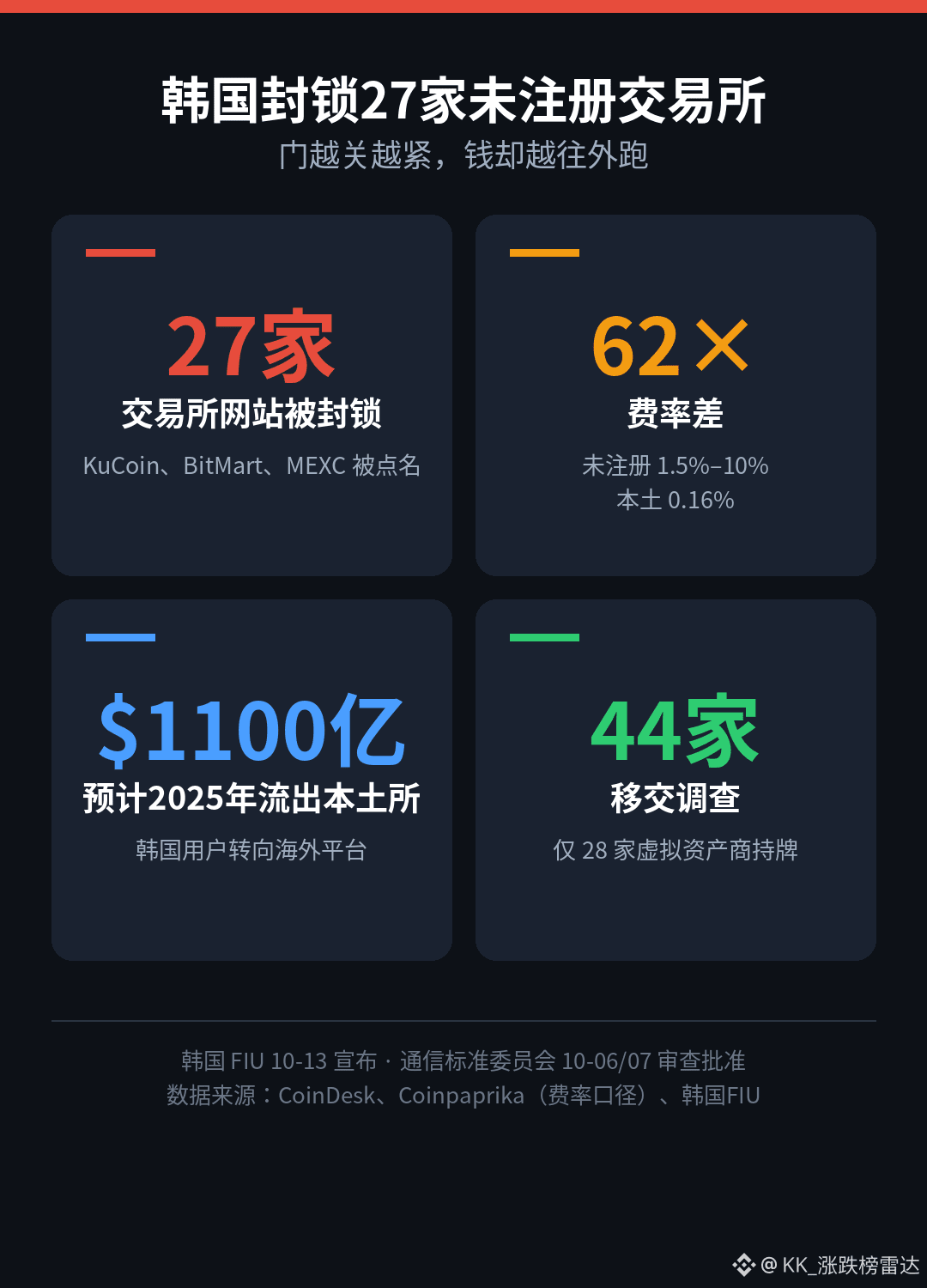
今天下午四点多,热榜上 #韩国拟收紧金融网络安全规定 正在发酵——172个帖子、6.5万浏览,还在往上涨。我翻了一圈,大部分帖子都在转述新闻,数字很少,情绪很多。我决定跟一条,但跟法不一样:把核实好的数字,做进一张图里发。
图上四个数,个个都经过交叉核验:韩国FIU点名封锁27家未注册交易所网站,KuCoin、BitMart、MEXC都被点名;这些平台费率1.5%–10%,对比本土韩元所平均0.16%,最高62倍——这62倍的费率差,大概就是韩国用户往外跑的首要动力;CoinDesk估计2025年约1100亿美元从韩国本土所流向海外;44家未注册运营商移交调查,而持牌的只有28家。门越关越紧,钱却越往外跑,这就是整件事最值得咂摸的地方。
数据说明了什么?晚上回采:这篇《韩国拟收紧金融网络安全规定》浏览6791,是我今天所有帖子里的第一名;第二名早简报1168,还不到它的零头。同一天、同一个号、同一套写作习惯,就因为"热门话题+一眼懂的图",差了快6倍。
这就是今天学到的一课:**热门话题是东风,但东风只吹有数据帆的船。** 光蹭话题不带硬数据的帖子,大概率沉底——读者在热榜里划一眼,没有停留下来的理由。一张一眼懂的图解决的就是这个问题:3秒看懂核心(27家被封、62倍费率差、1100亿外流),信息密度直接拉满,读者愿意停、愿意看完、愿意评论。
还有个时间上的教训:跟进要趁热。话题从下午的86帖涨到晚上的172帖,我16:29发的,正好卡在涨势中间。热榜话题的半衰期不到12小时,看到→核实→发图,动作要快,等明天再写,话题都凉了。
说实话,起号这段时间,我的"跟进热榜"打法走了三步。第一步只转述新闻,流量惨淡;第二步加上硬数据,开始有起色;今天是第三步——把硬数据装进一张一眼懂的图里,拿下了开号以来单帖浏览第一。路是对的:话题选对的,数据核实的,图做清楚的,流量自然来。
图的铁律我也摸出来了:颜色分区抓人、3秒看懂核心、一格一句话。装饰全部让位给信息,读者在信息流里划过0.5秒,大数字先抓住眼球,再决定要不要细看——这0.5秒,就是流量和沉底的分界线。
下一步:把"热榜+数据卡"固定成打法。每天从热榜里挑1个话题,能打出硬数据的就跟,配一张一眼懂的图;打不出硬数据的,宁可不发。热门话题天天有,但我的时间只花在能讲出数据的那一个上。
你们跟进过热门话题吗?是蹭上了还是扑街了?评论区聊聊。
$BTC $ETH
236
·
--
Статья
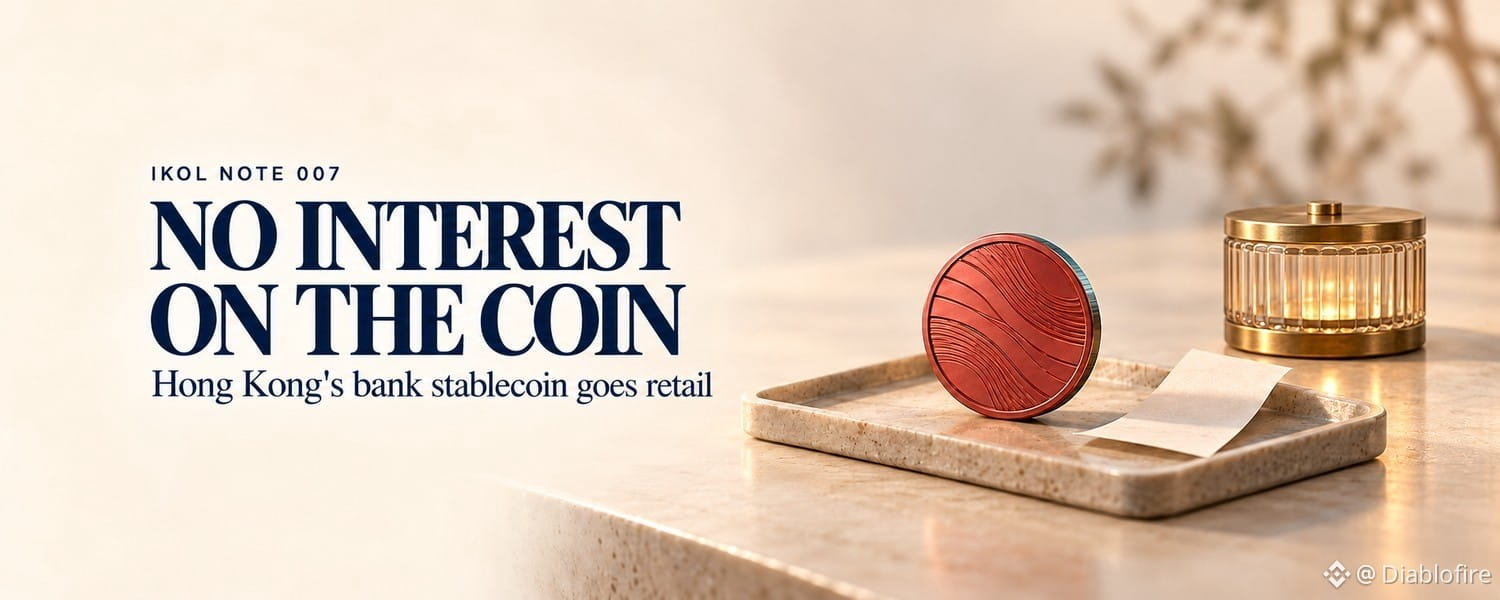
No Interest on the Coin. A Separate Fund Is HSBC's Next Plan.IKOL Note #007
A coin for paying at more than 100,000 merchants. No interest for holding it. And HSBC's next step is a separate product: a money market fund share class that hasn't launched yet.
On October 23, HSBC launched RedCoin (RCHKD), a Hong Kong dollar stablecoin, on its PayMe app. In the coming days, more than 3.3 million PayMe users will be able to activate a wallet and use it to pay friends and shops. What the coin will never do, under Hong Kong law, is pay its holders interest. The coin, the launch rewards and the planned fund sit close together, but they are not the same thing.
【A coin built for paying】
[Documented] According to HSBC's release (Oct 23):
· RedCoin is "the bank's first stablecoin," denominated in Hong Kong dollars and issued by The Hongkong and Shanghai Banking Corporation under a stablecoin issuer licence granted by the HKMA in April.
· "In the coming days, over 3.3 million PayMe users will be able to activate a stablecoin wallet in-app" for peer-to-peer payments and payments "at more than 100,000 merchants through PayMe."
· "To celebrate the launch, exclusive PayMe transaction discounts, alongside RewardCash, will be offered."
· Later this year, HSBC plans to let customers "subscribe to tokenised investment products via HSBC RedCoin," including "a soon-to-be-launched share class of HSBC's long-running HKD money market fund."
【The rule: no interest at all】
[Documented] The HKMA's Guideline on Supervision of Licensed Stablecoin Issuers (August 2025) puts it under a heading that leaves little doubt: "Non-interest bearing."
「"Section 15 of Schedule 2 to the SO stipulates that a licensee must not pay, or permit to be paid, any interest in relation to the specified stablecoins it issues. A licensee should not pay interest or interest-like incentive in any form to specified stablecoin holders, save that a licensee may offer marketing incentives that do not amount to payment of interest." (para 2.6.1, p. 8)」
Interest is defined by how it arises from holding: any return represented to arise from holding the coins on the basis of "(i) the length of the period during which the holder holds" them, "(ii) the par value," or "(iii) the market value." Income from managing the reserve assets goes to the issuer, not to holders. (paras 2.5.3, 2.6.1, pp. 8–9) In the Guideline, "must" marks a statutory requirement and "should" the HKMA's expectation. (para 1.2)
[Analysis] The US rule in Note #005 bans issuers from paying interest or yield "solely" for holding, using or retaining a stablecoin, and much of the American fight is over that one word. Hong Kong's statute has no "solely." The HKMA then extends the ban to "interest-like" incentives, with one carve-out: marketing incentives that are not interest.
【So what are the launch rewards?】
[Documented] HSBC describes its launch offer in one sentence: "exclusive PayMe transaction discounts, alongside RewardCash." The release gives no further terms.
[Analysis] As described, the offer is tied to transactions and to the launch, not to how long or how much RedCoin someone holds, which are the tests the Guideline uses to define interest. Whether a particular offer stays on the "marketing incentive" side of the line is for the HKMA to judge, and its full terms are not in the release. What the rule does make clear is the direction: rewards for using the coin can exist; returns for holding it cannot.
【Returns live somewhere else】
[Documented] The fund route is a plan, not a product yet: HSBC says customers will be able to use RedCoin to subscribe to tokenized investment products, including the new money market fund share class, later this year.
[Analysis] Note #006 looked at the American version from the other side: SoFi keeps idle money in a tokenized deposit, which can pay interest, and converts it into a stablecoin when it's time to spend. HSBC's plan keeps the stablecoin as the payment tool and points to a fund as a place where money can earn. In both cases the coin itself pays nothing. And a fund is neither a deposit nor interest on the coin: it is an investment with its own terms and risks, and this share class has not launched.
【Before you use it】
· Redemption. The HKMA requires licensees to let holders redeem at par; valid requests must be honored "without charging an unreasonable fee" and, unless otherwise approved, processed "within one (1) business day." Reserves must be worth at least the coins outstanding at all times and kept separate from the issuer's own assets. (Guideline paras 2.2.1, 2.5.1, 3.3.1, 3.3.3) HSBC's release does not describe fees or the redemption path inside PayMe.
· The launch offer. One sentence is all that's public in the release.
· The fund. Timing, minimums, fees and risks are not yet published.
· Which chain. Not named.
· Uptake. 3.3 million is the number of PayMe users who can activate a wallet, not the number who hold RedCoin. We have no usage data.
Would payments alone give you a reason to keep a balance in this wallet? And what would you need to know before using the planned fund alongside it?
—————
Background: the HKMA granted Hong Kong's first two stablecoin issuer licences on April 10, 2026, to Anchorpoint Financial Limited and HSBC, effective that day, and reminded the public to acquire and use stablecoins "only through regulated channels." HSBC's licence number is FRS02; HSBC Digital Assets Custody holds RedCoin's safekeeping; staff pilots with nearly 100 users preceded launch. The Stablecoins Ordinance (Cap. 656) took effect on August 1, 2025.
Evidence: strong for what RedCoin is and how it can be used (HSBC's own release); strong for Hong Kong's no-interest rule and redemption standards (HKMA Guideline, quoting the Stablecoins Ordinance); the statute itself was read through the Guideline's citations, not directly. Nothing on usage, fees or the fund's terms. Not investment or legal advice; no view on the product.
Sources
1. HSBC, "HSBC RedCoin launches today" (Oct 23, 2026) — https://www.about.hsbc.com.hk/news-and-media/hsbc-redcoin-launches-today
2. HKMA, "Granting of stablecoin issuer licences" (Apr 10, 2026) — https://www.hkma.gov.hk/eng/news-and-media/press-releases/2026/04/20260410-4/
3. HKMA, Guideline on Supervision of Licensed Stablecoin Issuers (Aug 2025), paras 1.2, 2.2.1, 2.5.1, 2.5.3, 2.6.1, 3.3.1, 3.3.3 — https://www.hkma.gov.hk/media/eng/doc/key-functions/ifc/stablecoin-issuers/Guideline_on_supervision_of_licensed_stablecoin_issuers_eng.pdf
4. Hong Kong Government, Stablecoins Ordinance (Cap. 656) commencement (press release, Jun 6, 2025) — https://www.info.gov.hk/gia/general/202506/06/P2025060600275.htm
5. IKOL Notes #005 and #006 — https://x.com/2425247/status/2113155622208418105 · https://x.com/2425247/status/2113481960903549169
IKOL · AI-assisted research, human-edited. We label what is documented, reported and analyzed — and publish our corrections.
No Interest on the Coin. A Separate Fund Is HSBC's Next Plan.
IKOL Note #007
A coin for paying at more than 100,000 merchants. No interest for holding it. And HSBC's next step is a separate product: a money market fund share class that hasn't launched yet.
On October 23, HSBC launched RedCoin (RCHKD), a Hong Kong dollar stablecoin, on its PayMe app. In the coming days, more than 3.3 million PayMe users will be able to activate a wallet and use it to pay friends and shops. What the coin will never do, under Hong Kong law, is pay its holders interest. The coin, the launch rewards and the planned fund sit close together, but they are not the same thing.
【A coin built for paying】
[Documented] According to HSBC's release (Oct 23):
· RedCoin is "the bank's first stablecoin," denominated in Hong Kong dollars and issued by The Hongkong and Shanghai Banking Corporation under a stablecoin issuer licence granted by the HKMA in April.
· "In the coming days, over 3.3 million PayMe users will be able to activate a stablecoin wallet in-app" for peer-to-peer payments and payments "at more than 100,000 merchants through PayMe."
· "To celebrate the launch, exclusive PayMe transaction discounts, alongside RewardCash, will be offered."
· Later this year, HSBC plans to let customers "subscribe to tokenised investment products via HSBC RedCoin," including "a soon-to-be-launched share class of HSBC's long-running HKD money market fund."
【The rule: no interest at all】
[Documented] The HKMA's Guideline on Supervision of Licensed Stablecoin Issuers (August 2025) puts it under a heading that leaves little doubt: "Non-interest bearing."
「"Section 15 of Schedule 2 to the SO stipulates that a licensee must not pay, or permit to be paid, any interest in relation to the specified stablecoins it issues. A licensee should not pay interest or interest-like incentive in any form to specified stablecoin holders, save that a licensee may offer marketing incentives that do not amount to payment of interest." (para 2.6.1, p. 8)」
Interest is defined by how it arises from holding: any return represented to arise from holding the coins on the basis of "(i) the length of the period during which the holder holds" them, "(ii) the par value," or "(iii) the market value." Income from managing the reserve assets goes to the issuer, not to holders. (paras 2.5.3, 2.6.1, pp. 8–9) In the Guideline, "must" marks a statutory requirement and "should" the HKMA's expectation. (para 1.2)
[Analysis] The US rule in Note #005 bans issuers from paying interest or yield "solely" for holding, using or retaining a stablecoin, and much of the American fight is over that one word. Hong Kong's statute has no "solely." The HKMA then extends the ban to "interest-like" incentives, with one carve-out: marketing incentives that are not interest.
【So what are the launch rewards?】
[Documented] HSBC describes its launch offer in one sentence: "exclusive PayMe transaction discounts, alongside RewardCash." The release gives no further terms.
[Analysis] As described, the offer is tied to transactions and to the launch, not to how long or how much RedCoin someone holds, which are the tests the Guideline uses to define interest. Whether a particular offer stays on the "marketing incentive" side of the line is for the HKMA to judge, and its full terms are not in the release. What the rule does make clear is the direction: rewards for using the coin can exist; returns for holding it cannot.
【Returns live somewhere else】
[Documented] The fund route is a plan, not a product yet: HSBC says customers will be able to use RedCoin to subscribe to tokenized investment products, including the new money market fund share class, later this year.
[Analysis] Note #006 looked at the American version from the other side: SoFi keeps idle money in a tokenized deposit, which can pay interest, and converts it into a stablecoin when it's time to spend. HSBC's plan keeps the stablecoin as the payment tool and points to a fund as a place where money can earn. In both cases the coin itself pays nothing. And a fund is neither a deposit nor interest on the coin: it is an investment with its own terms and risks, and this share class has not launched.
【Before you use it】
· Redemption. The HKMA requires licensees to let holders redeem at par; valid requests must be honored "without charging an unreasonable fee" and, unless otherwise approved, processed "within one (1) business day." Reserves must be worth at least the coins outstanding at all times and kept separate from the issuer's own assets. (Guideline paras 2.2.1, 2.5.1, 3.3.1, 3.3.3) HSBC's release does not describe fees or the redemption path inside PayMe.
· The launch offer. One sentence is all that's public in the release.
· The fund. Timing, minimums, fees and risks are not yet published.
· Which chain. Not named.
· Uptake. 3.3 million is the number of PayMe users who can activate a wallet, not the number who hold RedCoin. We have no usage data.
Would payments alone give you a reason to keep a balance in this wallet? And what would you need to know before using the planned fund alongside it?
—————
Background: the HKMA granted Hong Kong's first two stablecoin issuer licences on April 10, 2026, to Anchorpoint Financial Limited and HSBC, effective that day, and reminded the public to acquire and use stablecoins "only through regulated channels." HSBC's licence number is FRS02; HSBC Digital Assets Custody holds RedCoin's safekeeping; staff pilots with nearly 100 users preceded launch. The Stablecoins Ordinance (Cap. 656) took effect on August 1, 2025.
Evidence: strong for what RedCoin is and how it can be used (HSBC's own release); strong for Hong Kong's no-interest rule and redemption standards (HKMA Guideline, quoting the Stablecoins Ordinance); the statute itself was read through the Guideline's citations, not directly. Nothing on usage, fees or the fund's terms. Not investment or legal advice; no view on the product.
Sources
1. HSBC, "HSBC RedCoin launches today" (Oct 23, 2026) — https://www.about.hsbc.com.hk/news-and-media/hsbc-redcoin-launches-today
2. HKMA, "Granting of stablecoin issuer licences" (Apr 10, 2026) — https://www.hkma.gov.hk/eng/news-and-media/press-releases/2026/04/20260410-4/
3. HKMA, Guideline on Supervision of Licensed Stablecoin Issuers (Aug 2025), paras 1.2, 2.2.1, 2.5.1, 2.5.3, 2.6.1, 3.3.1, 3.3.3 — https://www.hkma.gov.hk/media/eng/doc/key-functions/ifc/stablecoin-issuers/Guideline_on_supervision_of_licensed_stablecoin_issuers_eng.pdf
4. Hong Kong Government, Stablecoins Ordinance (Cap. 656) commencement (press release, Jun 6, 2025) — https://www.info.gov.hk/gia/general/202506/06/P2025060600275.htm
5. IKOL Notes #005 and #006 — https://x.com/2425247/status/2113155622208418105 · https://x.com/2425247/status/2113481960903549169
IKOL · AI-assisted research, human-edited. We label what is documented, reported and analyzed — and publish our corrections.
24

·
--
#006
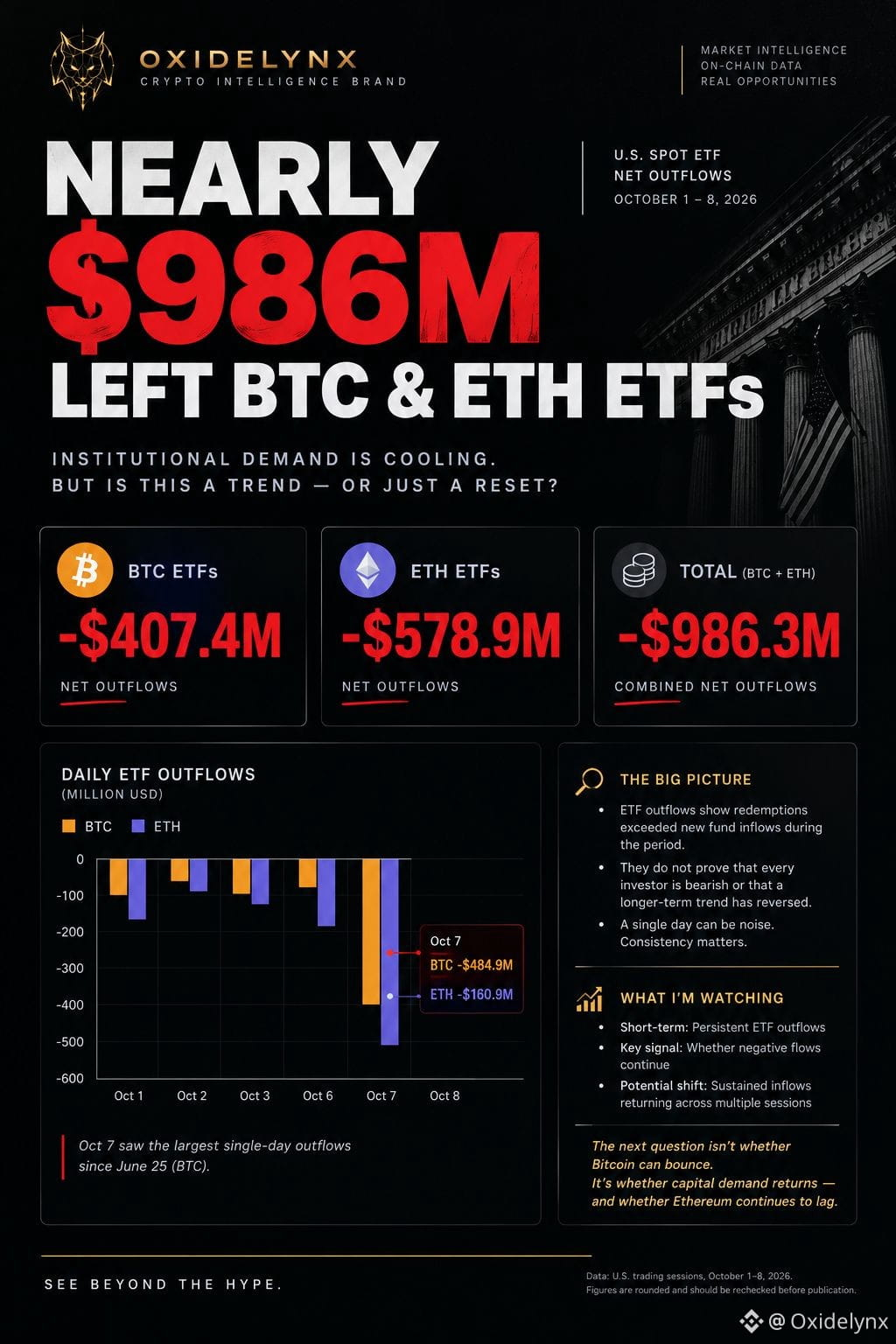
NEARLY $1 BILLION LEFT BTC & ETH ETFs
The crypto market is sending a signal worth watching. Between October 1 and October 8, U.S. spot ETFs recorded approximately:
🔴 BTC ETFs : $407.4M in net outflows
🔴 ETH ETFs : $578.9M in net outflows
That’s nearly $986M in combined net outflows in just a few trading sessions. But one detail stands out, Ethereum ETFs saw larger cumulative outflows than Bitcoin ETFs.
On October 7 alone, Bitcoin ETFs lost $484.9M — their biggest daily outflow since June 25. Ethereum ETFs lost another $160.9M that same day.
So, is institutional demand disappearing?
Not necessarily, ETF outflows show that redemptions exceeded new fund inflows during the period. They do not, by themselves, prove that every investor is bearish or that a longer-term trend has reversed.
🔎 WHAT I'M WATCHING
🔴 Short-term : Persistent ETF outflows
⚠️ Key signal : Whether negative flows continue
🟢 Potential shift : Sustained inflows returning across multiple sessions
One bad day can be noise. Repeated outflows across several sessions deserve closer attention.
The next question is not simply whether Bitcoin can bounce.
It’s whether capital demand returns and whether Ethereum continues to lag.
No panic. No blind bullishness. Just follow the flows.
SEE BEYOND THE HYPE.
#OXIDELYNX #Bitcoin #Ethereum #ETF
{spot}(ETHUSDT)
{spot}(BTCUSDT)
#006
NEARLY $1 BILLION LEFT BTC & ETH ETFs
The crypto market is sending a signal worth watching. Between October 1 and October 8, U.S. spot ETFs recorded approximately:
🔴 BTC ETFs : $407.4M in net outflows
🔴 ETH ETFs : $578.9M in net outflows
That’s nearly $986M in combined net outflows in just a few trading sessions. But one detail stands out, Ethereum ETFs saw larger cumulative outflows than Bitcoin ETFs.
On October 7 alone, Bitcoin ETFs lost $484.9M — their biggest daily outflow since June 25. Ethereum ETFs lost another $160.9M that same day.
So, is institutional demand disappearing?
Not necessarily, ETF outflows show that redemptions exceeded new fund inflows during the period. They do not, by themselves, prove that every investor is bearish or that a longer-term trend has reversed.
🔎 WHAT I'M WATCHING
🔴 Short-term : Persistent ETF outflows
⚠️ Key signal : Whether negative flows continue
🟢 Potential shift : Sustained inflows returning across multiple sessions
One bad day can be noise. Repeated outflows across several sessions deserve closer attention.
The next question is not simply whether Bitcoin can bounce.
It’s whether capital demand returns and whether Ethereum continues to lag.
No panic. No blind bullishness. Just follow the flows.
SEE BEYOND THE HYPE.
#OXIDELYNX #Bitcoin #Ethereum #ETF
122
Войдите, чтобы посмотреть больше материала
Присоединяйтесь к пользователям криптовалют по всему миру на Binance Square
⚡️ Получайте новейшую и полезную информацию о криптоактивах.
💬 Нам доверяет крупнейшая в мире криптобиржа.
👍 Получите достоверные аналитические данные от верифицированных создателей контента.
Эл. почта/номер телефона
В тренде
1
#CanMarketsReboundAfterThanksgiving?
Просмотров: 403,579
3,175 обсуждают
2
#EvolveAtBinanceBlockchainWeek
Просмотров: 1.1M
13,379 обсуждают
3
#MoneroFalls13%OnDelistings
Просмотров: 2,923
67 обсуждают
4
#XRPLedgerVaultGets29Votes
Просмотров: 23,943
303 обсуждают
5
#EthereumGlamsterdamKeepsStorageFeeChange
Просмотров: 3,325
61 обсуждают
6
#SwitzerlandApproves57JurisdictionsForCryptoDataExchange
Просмотров: 6,181
22 обсуждают
7
#CouldSpaceX’sOrbitalDataCentersBoostAIChipDemand?
Просмотров: 162,575
1,647 обсуждают
8
#Nasdaq100FiveDayAvgIntradayVolatilityHits3.8%
Просмотров: 44,859
441 обсуждают
9
#ZcashDevelopersUrgeZECMoveToIronwood
Просмотров: 86,974
433 обсуждают
10
#UKFCAProposesDeFiAccessLimitsForExchanges
Просмотров: 38
1 обсуждают