
Bitcoin, the world's first and most valuable cryptocurrency, has had a tumultuous journey since its inception in 2008. Created by an anonymous individual or group of individuals under the pseudonym Satoshi Nakamoto, Bitcoin was designed to be a decentralized, peer-to-peer digital currency that would allow users to transact without the need for intermediaries such as banks. Since its creation, Bitcoin has gone through several highs and lows, and its price has fluctuated wildly. In this article, we will explore the rise and fall of Bitcoin and examine its history from 2008 to now.
The early years (2008-2010)
Bitcoin was first introduced to the world in a white paper published by Satoshi Nakamoto in 2008. The paper, titled "Bitcoin: A Peer-to-Peer Electronic Cash System," described a decentralized digital currency that would allow for secure, peer-to-peer transactions without the need for intermediaries. The first Bitcoin transaction took place in January 2009, when Satoshi Nakamoto sent 10 bitcoins to Hal Finney, a computer programmer, and early Bitcoin enthusiast.
In the early years, Bitcoin was not widely known or used. Its value was negligible, and it was mainly used by a small community of enthusiasts and tech-savvy individuals. However, this changed in 2010 when the first real-world Bitcoin transaction took place. Laszlo Hanyecz, a programmer, paid 10,000 bitcoins for two Papa John's pizzas, making it the first known real-world transaction using Bitcoin.
The Rise of Bitcoin (2011-2017)
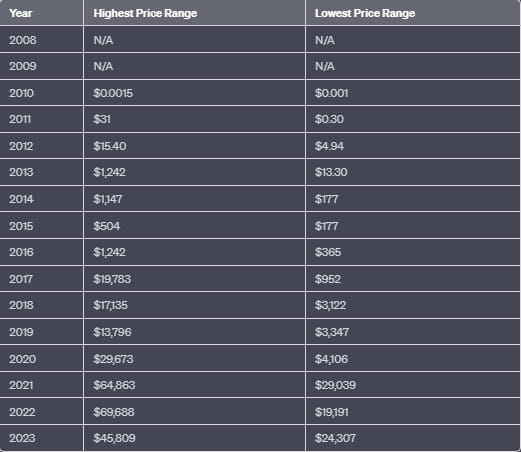
Bitcoin's popularity began to grow in 2011 when it was featured on several mainstream news outlets, including CNN and The New York Times. The attention helped to fuel a surge in demand for Bitcoin, and its price began to rise. By the end of 2011, the price of Bitcoin had reached $30, up from just a few cents a year earlier.
Bitcoin's price continued to rise over the next few years, driven by a combination of factors, including increased adoption, improved infrastructure, and growing interest from investors. In 2013, Bitcoin's price surpassed $1,000 for the first time, driven by increased adoption in China. However, the price quickly fell back down, and by the end of 2014, Bitcoin was trading at around $300.
Despite the setback, Bitcoin's popularity continued to grow, and its price began to rise again in 2016. The price reached $1,000 once again in early 2017, and by the end of the year, it had reached an all-time high of nearly $20,000.
The Fall of Bitcoin (2018-present)
Bitcoin's meteoric rise was not sustainable, and its price began to fall rapidly in early 2018. By the end of the year, the price had dropped to around $3,000, a far cry from its all-time high of nearly $20,000. The fall in price was attributed to several factors, including increased regulatory scrutiny, the bursting of the cryptocurrency bubble, and a general loss of confidence in the cryptocurrency market.
Despite the fall in price, Bitcoin continued to attract interest from investors and traders. In 2020, the price of Bitcoin began to rise once again, driven by increased adoption from institutional investors and growing interest from mainstream companies. The price reached a new all-time high of over $60,000 in early 2021, but once again, the price was not sustainable, and it quickly began to fall.
As of April 2023, the price of Bitcoin is around $30,000, well below its all-time high of $60,000. While the future of Bitcoin is uncertain, it is clear that cryptocurrency has had a significant impact on the world of finance and technology. Bitcoin's rise has paved the way for the development of other cryptocurrencies, and its underlying blockchain technology has been adopted by a range of industries for a variety of purposes.
Despite its ups and downs, Bitcoin has proven to be resilient, and its popularity is unlikely to fade anytime soon. While there are still concerns about its use for illicit activities and its potential impact on the environment, many believe that Bitcoin has the potential to revolutionize the way we transact and store value.
In conclusion, the rise and fall of Bitcoin have been a rollercoaster ride, with its price fluctuating wildly over the years. From its humble beginnings in 2008 to its all-time high in 2017 and subsequent fall, Bitcoin has had a significant impact on the world of finance and technology. While the future of Bitcoin is uncertain, it is clear that cryptocurrency has paved the way for a new era of decentralized, peer-to-peer digital transactions.