There’s a detail in the fairy tale of Thạch Sanh that only grows more fascinating as you get older. Not the magic zither. Not the scene of slaying the giant eagle. It’s the cave.
Everyone can see the treasure inside, but not everyone has the right to take it out. The princess is in there, but she can’t go out by herself. Lý Thông knows the way, but he isn’t qualified enough to complete the journey. Thạch Sanh doesn’t win because he’s stronger—he wins because he can get through the system of conditions and bring the value back to a valid state. Naturally, I also feel that the entire global payroll of the future is heading toward the same problem: the world isn’t short of money—the missing piece is the layer of verification that determines who is allowed to move value through which door.
At first glance, the global payroll problem seems close to solved. Stablecoins make money transfer almost instant. Blockchain reduces friction. Companies in the U.S. can pay developers in Vietnam or designers in Argentina faster than ever. But the more it crosses borders, the more a paradox shows up: transferring money gets easier, while explaining how that money is allowed to exist becomes harder. A real paycheck is not just the number sitting in someone’s wallet. It carries tax status, labor conditions, local regulations, financial reporting, and legal responsibility.
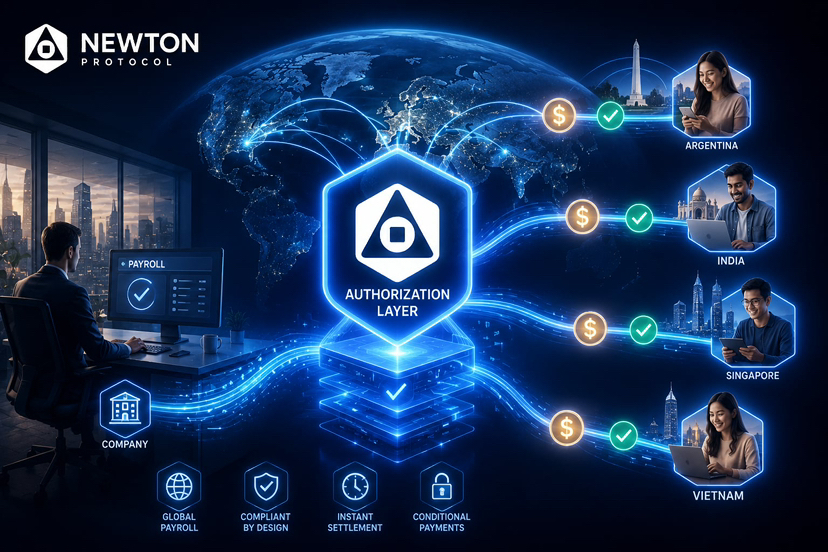
@NewtonProtocol is targeting a much bigger problem than the narrative “compliance for crypto.” In my view, Newton isn’t trying to build yet another blockchain to compete on speed or transaction fees. Newton Protocol is trying to build a layer between assets and applications—where policy becomes part of infrastructure. If a smart contract answers the question: how does money move, then Newton Protocol is trying to answer a harder question: how is money allowed to move. That’s a huge difference, because one side manages the transaction logic, while the other manages the logic of power.
Putting this into payroll makes the idea start to sound more interesting. Right now, when a global company pays wages, it usually has to go through many separate layers: HR confirms → accounting processes → the bank transfers → compliance checks → end-of-period reconciliation. The money runs one way, while the conditions run another. Newton Protocol is trying to reverse that process. Instead of letting compliance sit at the end of the line and block transactions, Newton moves policy to the front of the processing flow. That means a payroll payment can carry its execution conditions along with it: who can receive it, when it unlocks, geographic limits, reporting requirements, or conditions for completing the work.
Newton Protocol isn’t tokenizing payroll—Newton is trying to tokenize the right to receive payroll. It sounds similar, but it’s very different. Tokenizing assets is a familiar problem. Tokenizing the conditions for using an asset is the hard part. If they can do it, future companies may no longer manage employees’ accounts. They manage authorization logic instead. Pay is released only when conditions are met. Bonuses unlock automatically when KPIs are completed. Equity vests automatically. Taxes split off immediately upon receipt.
If it succeeds, Newton Protocol isn’t really going to compete directly with Ethereum or Solana. Those chains optimize execution and liquidity. Newton Protocol is trying to become the authorization layer of the digital economy. It doesn’t own the flow of money, but it stands in the layer that decides whether the money can continue on or not. If this happens, the value of the NEWT token won’t come mainly from the number of transactions anymore. $NEWT will start accumulating value from the number of policies being executed, the number of operators participating, and the degree of trust the network is coordinating.
But this is also where a weakness appears that I think Newton should address early. The smoother authorization is, the harder it becomes for users to see where power actually sits. One day the payroll might be withheld, but the user wouldn’t know which rule, who changed the rule, or what condition has just been applied. At that point, authorization is no longer UX—it becomes a black box. And the most dangerous thing about a black box is that it works too well, so nobody asks questions.
In my view, Newton Protocol should invest heavily in a layer of Explainable Authorization. People who get paid should be able to see what policy is affecting the received payment. Businesses should be able to see what logic is running. NEWT token holders should understand what principle their stake is protecting. Policies should be translated into human language instead of existing only as technical rules. Don’t turn authorization into a cave nobody can see inside.
Because in the story of Thạch Sanh, what makes everyone accept the outcome isn’t that Thạch Sanh is stronger.
It’s because everyone sees how he walked through the door.
If Newton Protocol wants to become infrastructure for global payroll, the biggest problem likely isn’t making money move faster.
It’s about making the law travel with the money… but still transparent enough that humans still dare to trust it.