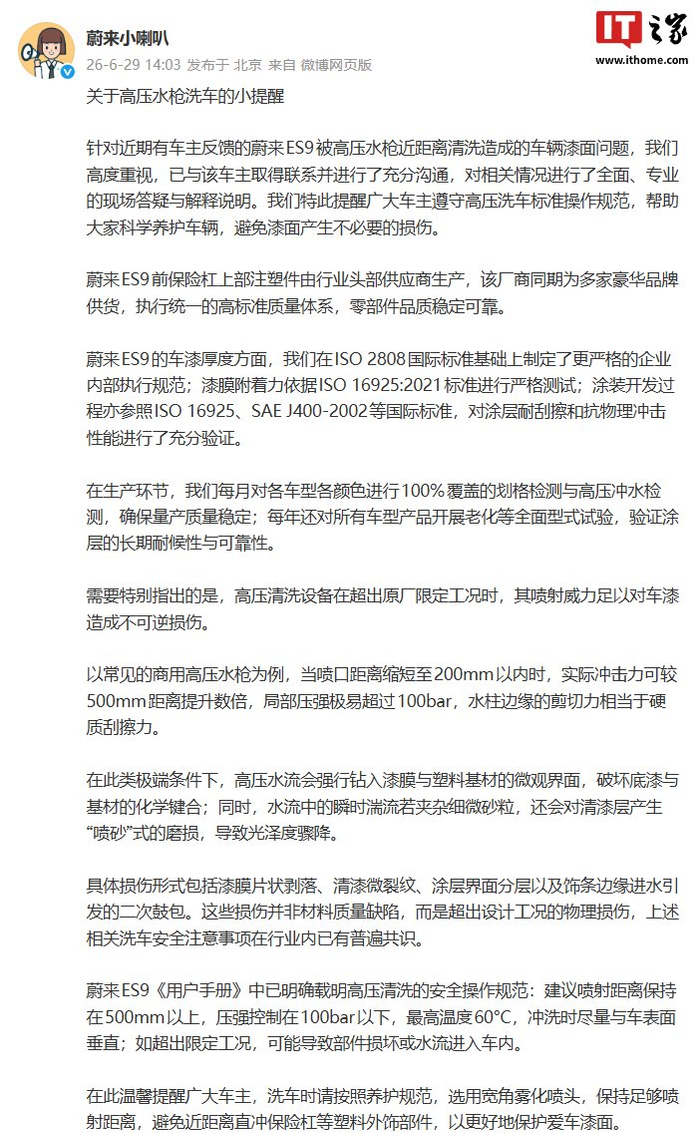
#NIO responds to issues with paint damage caused by high-pressure water guns#【NIO responds that the ES9 paint was damaged by near-distance cleaning with a high-pressure water gun, saying that the damage to the car’s paint from the equipment’s spray power under an extremely limited operating condition is irreversible】On June 29, NIO’s official account released a statement via its Weibo account @NIO Little Bell, today, (a small reminder about washing cars with a high-pressure water gun). It responded to recent feedback from owners about paint issues on the NIO ES9 caused by near-distance cleaning with a high-pressure water gun.
NIO’s official statement specifically pointed out that when high-pressure cleaning equipment is used beyond the operating conditions limited by the manufacturer, its spray force is strong enough to cause irreversible damage to the car’s paint. IT Home includes the original text below:
Regarding recent reports from some vehicle owners that the NIO ES9’s paint surface has been affected by nearby cleaning with a high-pressure water gun, we take this seriously. We have contacted the owner and held thorough communication, providing comprehensive, professional on-site Q&A and explanations about the relevant circumstances. We hereby remind all vehicle owners to follow the standard operating procedures for high-pressure car washing to help everyone care for vehicles scientifically and avoid unnecessary damage to the paint surface.
The upper bumper fascia molded part of the NIO ES9 is produced by a leading industry supplier. This supplier delivers to multiple luxury brands in the same period and follows a unified, high-standard quality system, ensuring stable and reliable component quality.
Regarding the paint film thickness of the NIO ES9, based on the ISO 2808 international standard, we have established stricter internal corporate execution requirements. The paint film adhesion is tested rigorously according to ISO 16925:2021. During the coating development process, international standards such as ISO 16925 and SAE J400-2002 are also referenced to fully verify the coating’s scratch resistance and physical impact resistance.
In the production process, we perform grid testing with 100% coverage and high-pressure flushing tests monthly for each vehicle model and color to ensure stable mass-production quality; each year, we also carry out comprehensive type tests such as aging for all vehicle model products to verify the coating’s long-term weather resistance and reliability.
It should be specifically noted that when high-pressure cleaning equipment operates beyond the factory-specified operating conditions, its jetting power is sufficient to cause irreversible damage to the vehicle’s paint.
Taking a common commercial high-pressure water gun as an example, when the nozzle-to-surface distance is shortened to within 200 mm, the actual impact force can increase by several times compared with a 500 mm distance. The local pressure can easily exceed 100 bar, and the shearing force at the edge of the water jet is comparable to the force of scraping a hard object.
Under such extreme conditions, the high-pressure water jet forces its way into the microscopic interfaces between the paint film and the plastic substrate, disrupting the chemical bonding between the primer and the substrate. At the same time, if the instantaneous turbulence in the water stream contains tiny sand particles, it can also cause “sandblasting”-type abrasion to the clear coat layer, leading to a sharp drop in gloss level.
Specific damage types include paint film blistering in sheet-like peeling, micro-cracks in the clear coat, delamination at the coating interface, and secondary blistering caused by water ingress at the edges of trim strips. These damages are not defects in material quality, but physical damage beyond the designed operating conditions. The related safety precautions for car washing mentioned above are widely recognized within the industry.
The NIO ES9 (owner’s manual) clearly states the safe operating procedures for high-pressure cleaning: it is recommended to keep the spraying distance at 500 mm or more, control the pressure below 100 bar, keep the maximum temperature at 60°C, and keep the rinse as perpendicular to the vehicle surface as possible. If the operation exceeds the specified operating conditions, it may cause damage to components or allow water to enter the vehicle.
As a friendly reminder to all vehicle owners, during car washing please follow care guidelines, choose wide-angle misting nozzles, maintain a sufficient spraying distance, and avoid directly blasting at close range plastic exterior parts such as the bumper to better protect your vehicle’s paint surface.