

@Lorenzo Protocol sits in that curious space where an idea feels both overdue and strangely experimental, as if the market has been nudging developers toward it for years without ever saying so aloud. The attempt to unify LSTs and LRTs into a single, coherent yield layer isn’t just a technical puzzle; it’s a response to a growing sense that the staking economy has become scattered, overly abstract, and at times almost too clever for its own good. I’ve watched this ecosystem stretch itself into a patchwork of wrappers, re-staked wrappers, synthetic wrappers of re-staked wrappers, and every possible permutation in between. After a while, you start to wonder whether the market actually needs more financial engineering—or simply needs a cleaner place to stand.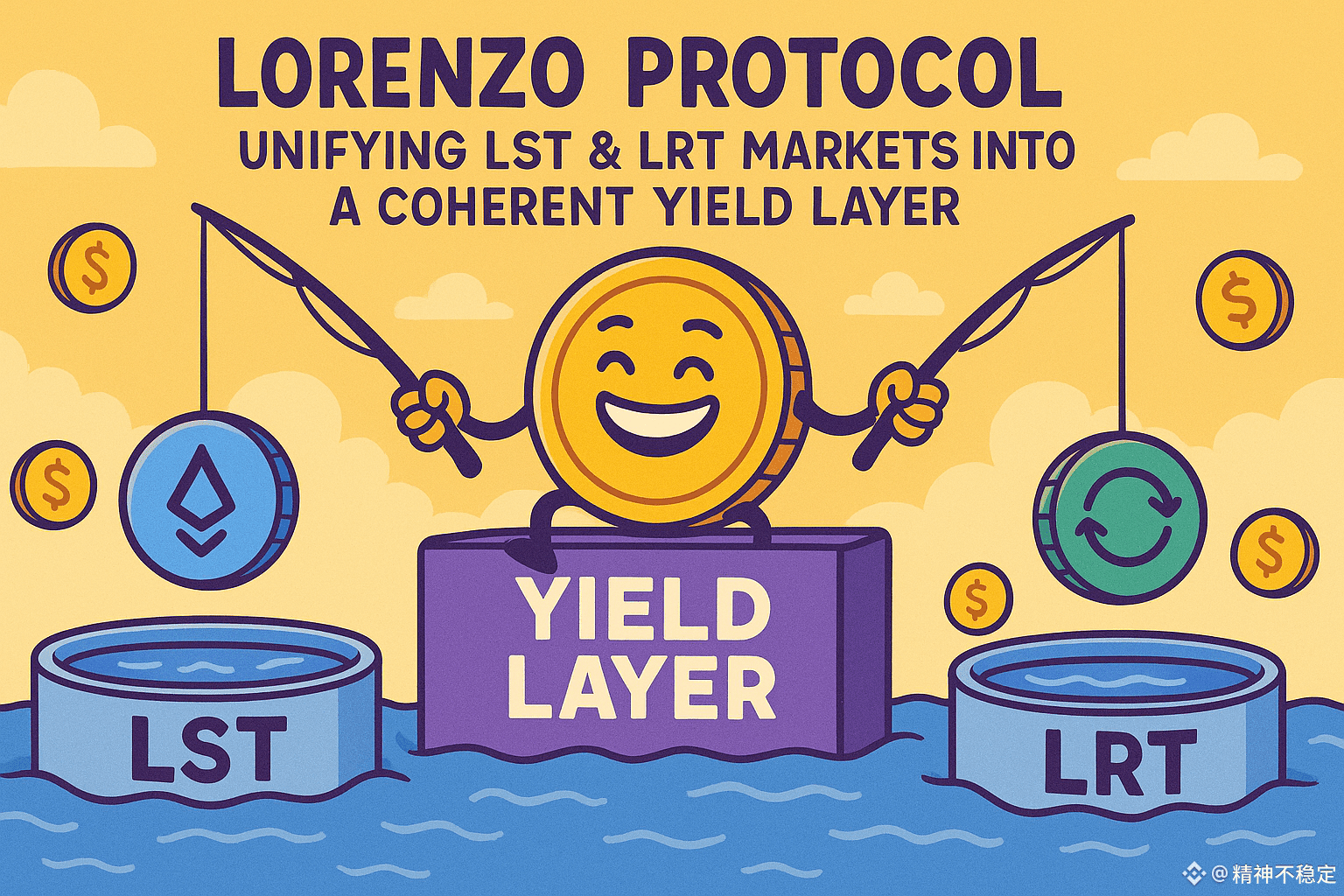
This is where Lorenzo feels timely. Not because it introduces some novel category of token, but because it tries to weave two fast-growing but increasingly disconnected markets—liquid staking tokens and liquid restaking tokens—into something that behaves as a unified system rather than parallel trains running on diverging tracks. Both markets have momentum. Both serve real demand. But they lack a shared foundation, and this lack has become more visible as staking yields fragment and users chase returns across multiple protocols with no real sense of how these layers relate to one another. It’s a strangely modern problem: there’s no shortage of opportunity, only a shortage of cohesion.
What Lorenzo proposes is less about creating new financial tricks and more about rebuilding the base logic of how staked capital moves around. Instead of treating LSTs and LRTs as separate ecosystems—one anchored to validator duties, the other to restaking obligations—Lorenzo tries to merge the flow of value so users don’t feel like they’re switching continents every time they change strategies. And honestly, this resonates with me. I’ve spent enough time tracing the journey of staked assets across the chain to feel the friction firsthand. Every extra layer, every repeated abstraction, adds a bit more cognitive load. Even for veterans, it becomes draining. For newcomers, it’s often a dealbreaker.
The interesting question is why this idea is trending now, given that the staking boom started long before restaking ever entered the room. Part of it is simply a matter of maturity. LSTs grew quickly because they solved an obvious problem: people wanted liquidity while still participating in validator rewards. LRTs emerged later to capture additional value from the same capital, but in doing so they introduced a more complex risk profile and a less intuitive user experience. As the restaking market swelled, the cracks in the overall structure became easier to see. We now have meaningful capital sitting in both layers, but not enough connective tissue to make the ecosystem feel whole.
Another reason is the recent shift in how users think about yields. The early years of staking were marked by eagerness—people were excited just to earn something on-chain. Now the conversation is more nuanced, more grounded. Users ask better questions. They compare risk-adjusted returns. They worry about smart-contract sprawl. They want protocols that help them make sense of complexity rather than amplify it. A unified yield layer, if executed well, doesn’t just improve returns; it reduces noise. That alone makes the concept feel surprisingly contemporary.
There’s also something subtly cultural happening. The crypto industry is inching toward a more integrated architecture, one where modular components don’t exist in a vacuum but in conversation with each other. We’ve seen this with rollup design, data availability layers, and shared sequencing.
What Lorenzo is doing—bringing different staking markets together—matches the way the rest of the ecosystem is shifting. Crypto is moving toward tools that link up instead of standing alone. And honestly, that matters to people emotionally. They want to feel connected, like their actions carry weight across the chain. When things stay broken into bits, it may create profits, but it also makes the space feel shaky.
Still, it’s hard not to feel cautious. I’ve seen many protocols promise harmony and deliver only another layer of abstraction. But Lorenzo’s approach—tying both token types into a single risk and reward flow—feels more structural than cosmetic. It doesn’t hand-wave away differences; it tries to encode them into a model where users don’t need to understand validator economics to navigate restaking opportunities.
It might or might not work once it gets bigger, but the drive behind it is real. And in this industry, big goals often hint at the direction the whole market is headed.
What stands out most to me is how grounded this effort feels. There’s no sweeping rhetoric about reinventing finance. Instead, it acknowledges something quite simple: people want clarity, control, and yields that don’t feel like puzzles. If anything, Lorenzo seems to be pushing back against the trend of turning staking into a gamified maze. It asks whether the industry can grow without spiraling deeper into complexity. That alone gives it a refreshing tone.
As we look ahead, the most meaningful impact may not be the protocol itself but the shift it signals. Developers are starting to treat yield not as fragmented silos but as an interconnected landscape. Users are demanding systems that respect their attention. And markets are rewarding designs that reduce friction instead of multiplying it. Lorenzo fits into this moment precisely because it acknowledges the messiness without ignoring the potential.
Even if it never becomes the one system that ties everything together, the idea reflects what many users want: staking that feels consistent instead of messy. And if the industry continues moving in that direction, the next phase of on-chain yield might finally feel straightforward, more like using a map than wandering through a maze.
@Lorenzo Protocol #lorenzoprotocol $BANK

