


For a long time, Web3 gaming followed a predictable pattern. Projects would launch with heavy rewards, attract a wave of users, and then slowly lose momentum as the incentives dried up. Players came for the money, not the experience, and once the rewards stopped feeling attractive, so did the game.
@Pixels changed that dynamic in a quiet but powerful way.
Instead of promising instant rewards, it introduced a system where players had to earn their place over time. This approach, known as play to airdrop, turned participation into a long term commitment rather than a quick opportunity. The idea was simple on the surface. Play the game, complete tasks, stay active, and you could qualify for future token rewards. But beneath that simplicity was a carefully designed incentive model.
Players were not just grinding for tokens. They were building history inside the game.
During its campaigns, Pixels created a system where users could climb leaderboards, complete daily tasks, and improve their in game reputation to increase their chances of receiving PIXEL tokens. What made this different was the focus on consistency. It was not about who could invest the most money or exploit mechanics the fastest. It rewarded those who showed up, played regularly, and contributed to the ecosystem.
This shifted player behavior completely.
Instead of short bursts of activity, the game started seeing steady engagement. People logged in daily, interacted with others, and explored different parts of the world. The result was a more natural growth curve, where the community expanded alongside the game itself rather than ahead of it.
Another key aspect was accessibility.
Pixels did not require players to make large upfront investments. Anyone could join, start playing, and work their way up. This lowered the barrier to entry and opened the doors to a much wider audience. As more players joined, competition increased, making the airdrop feel earned rather than guaranteed.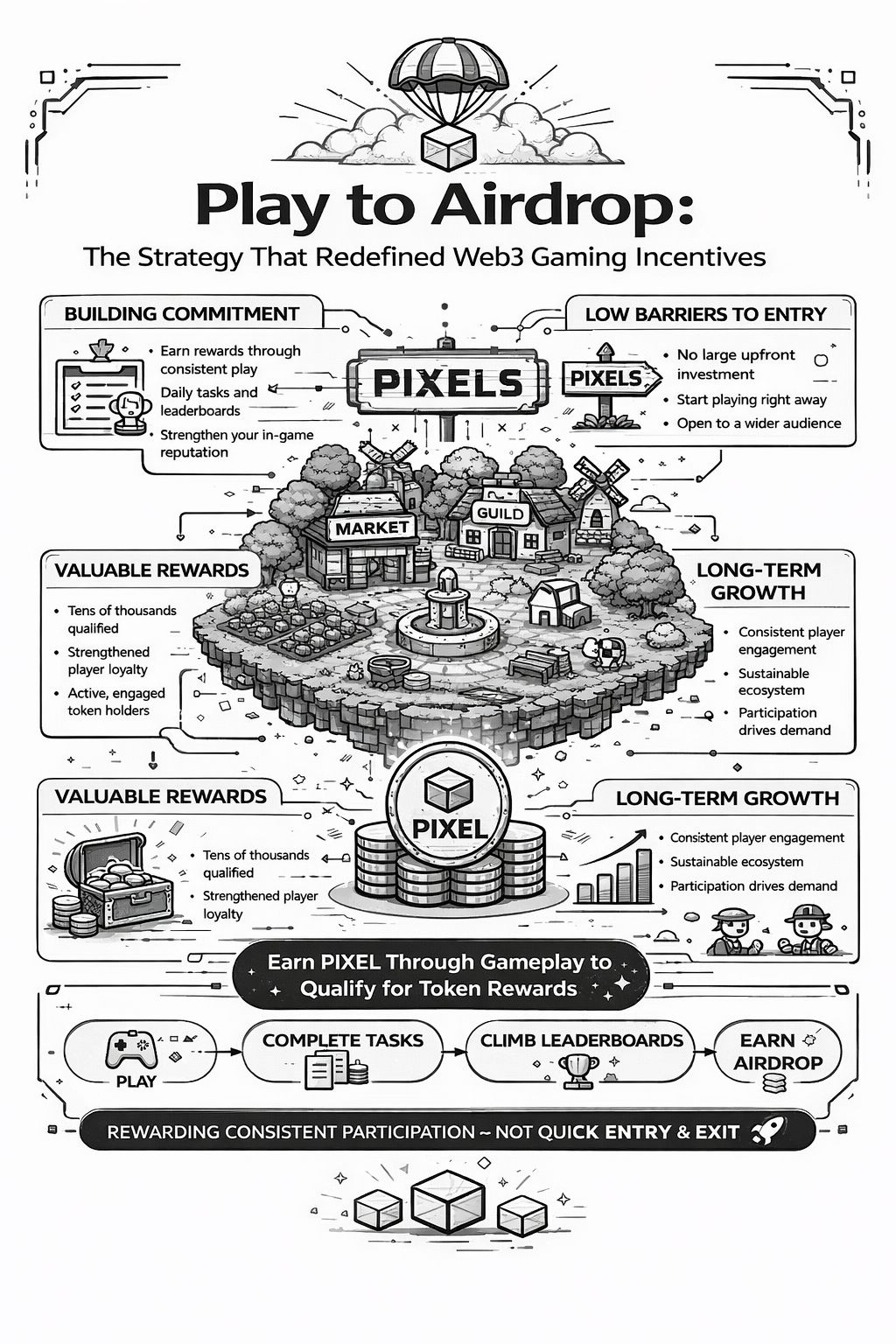
And that sense of earning matters.
When rewards are given too easily, they are often treated as disposable. But when players invest time and effort, the value becomes personal. This psychological shift is what made the play to airdrop model so effective. It created a deeper connection between the player and the ecosystem.
The scale of these campaigns also played a role. Tens of thousands of players eventually qualified for token rewards, turning the airdrop into a major event within the Web3 space. It was not just about distribution. It was about recognition. Early players felt seen, and that built loyalty that extended far beyond the airdrop itself.
At the same time, the model helped solve one of the biggest problems in token distribution.
Instead of allocating large portions of supply to insiders or passive investors, Pixels distributed tokens to active participants. This meant the people holding $PIXEL were the same ones using it, trading it, and contributing to the in game economy. That alignment between users and ownership created a much stronger foundation for long term sustainability.
There is also a strategic layer to all of this.
Play to airdrop acts as both a growth engine and a filtering mechanism. It attracts attention, brings in new users, and then naturally filters out those who are not genuinely interested. What remains is a core community that understands the game and is more likely to stay engaged.
In many ways, it bridges the gap between marketing and gameplay.
Instead of spending heavily on ads, Pixels turned its own game into the acquisition channel. Every task completed, every leaderboard climb, and every interaction became part of a larger onboarding process. By the time the token launched, players were already familiar with the ecosystem.
That is a huge advantage.
The success of this approach did not just benefit Pixels. It also influenced the broader Web3 gaming space. More projects began experimenting with similar models, realizing that rewarding genuine engagement works better than chasing short term hype.
Play to airdrop is not just a trend. It represents a shift in how incentives are designed.
It moves away from extraction and toward participation. It rewards time, effort, and consistency instead of capital alone. And most importantly, it aligns the growth of the game with the growth of its community.
Pixels did not invent the idea of airdrops. But it redefined how they could be used.
Not as a giveaway, but as a foundation for building something that lasts.