
@SignOfficial | #SignDigitalSovereignInfra | $SIGN
Most crypto projects try very hard to be noticed.
They push loud narratives, flashy branding, fast promises, and the usual wave of excitement that fills timelines for a few days and then disappears. After spending enough time in this space, you start to notice a pattern. A lot of tokens are designed more for attention than for endurance. They know how to trend, but they do not always know how to matter.
That is one reason why $SIGN caught my attention in a different way.
What makes Sign interesting to me is not noise. It is direction. While many projects seem focused on temporary visibility, Sign feels like it is building around something deeper: trust, verification, coordination, and digital structure that can actually be useful in the real world. That difference may sound simple, but in crypto, it is rare.
What first stands out is that this project does not feel built for a short moment. It feels like it is trying to solve problems that continue to exist whether the market is bullish or quiet. Digital identity, verifiable records, fair distribution systems, sovereign infrastructure — these are not small themes. These are the kinds of challenges that become more important as digital systems grow larger and more serious.
That is where Sign starts to feel different.
Instead of treating blockchain like a tool only for speculation, it seems to treat it like infrastructure. Something that should help systems become clearer, more reliable, and easier to trust. That idea matters a lot to me, because trust is still one of the biggest weak points in the digital world. People are constantly being asked to believe platforms, believe data, believe processes, and believe institutions without being given enough proof. A strong system should not depend only on claims. It should make verification possible.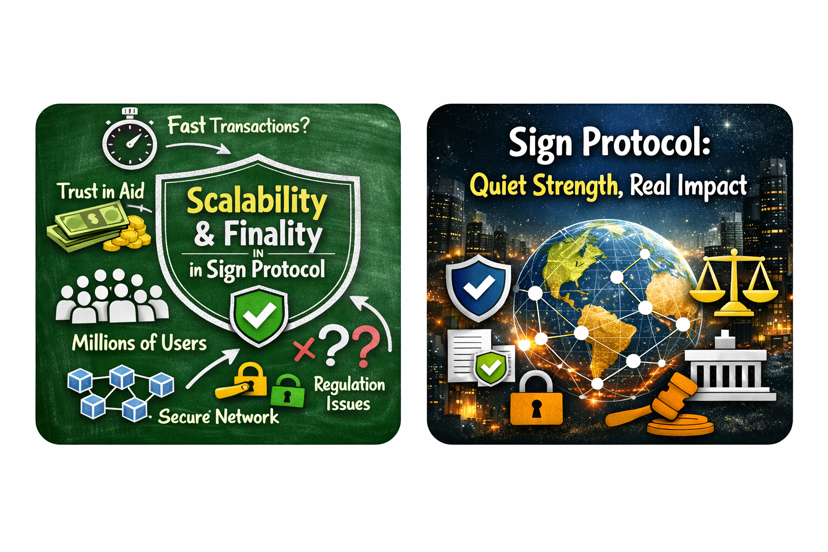
That is why the Sign approach feels meaningful.
Its broader direction suggests a future where countries, institutions, and digital communities can use blockchain in a practical way, not just as a trend but as working infrastructure. When a project starts thinking about digital credentials, compliant distribution, public records, payment rails, and national-scale coordination, it begins to move beyond the usual altcoin conversation. It enters a more serious space where execution matters more than marketing.
And honestly, that is what I respect most.
A lot of people in crypto still underestimate quiet builders because they are not always the loudest in the room. But the projects that focus on foundations often end up being the ones with longer relevance. Not because they generate the most hype, but because they create something others can actually use. That is the feeling I get from $SIGN. It does not look like it is trying to entertain the market every day. It looks like it is trying to build something that can remain useful over time.Of course, none of this means the road is easy.
Projects working close to real institutions, regulation, and national systems usually move through slower and more complex paths. Adoption takes time. Execution has to be stronger. Expectations become higher. But that also makes the opportunity more serious. If Sign continues to grow in this direction, it will not just be another token with a narrative. It could become part of the underlying structure that helps digital systems function better.
That is a much bigger idea than hype.For me, $SIGN feels interesting because it connects blockchain to something more mature. Less noise, more proof. Less performance, more purpose. Less short-term excitement, more long-term usefulness. In a market full of projects competing to be seen, Sign feels like one of the few trying to become necessary.
And in the long run, that may matter much more.