

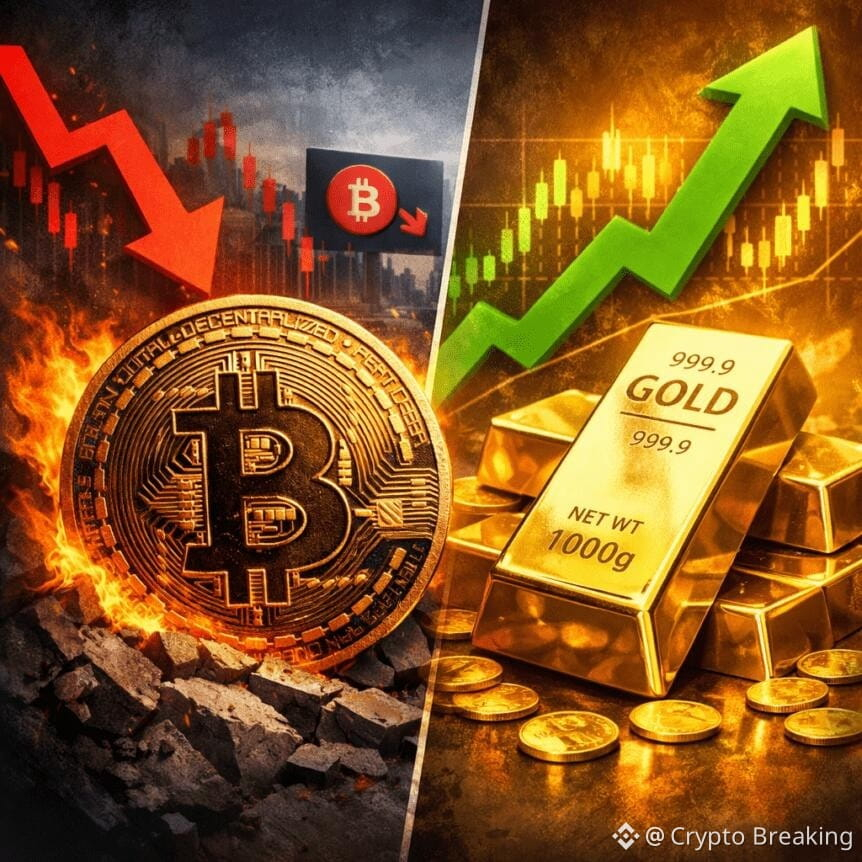
Bitcoin (CRYPTO: BTC) and gold are diverging in 2026, as persistent liquidity dynamics and shifts in risk appetite reshape how each asset behaves. Gold has surged roughly 153% since the start of 2024, while Bitcoin has retraced about 30% over the same period. Analysts attribute the split to a steady expansion of global money supply, a cooling appetite for high-beta tech equities, and a drift of capital from exchanges into self-custody. Taken together, these forces help explain why gold strengthens in a liquidity-driven environment while Bitcoin struggles to keep pace in a bear-market backdrop for risk assets.
Key takeaways
Gold has outperformed Bitcoin since early 2024, rising about 153% versus a roughly 30% decline for BTC, signaling divergent responses to the same macro backdrop.
Longer-term BTC trends have tracked money-supply growth (M2), but the strongest rallies historically occurred when liquidity growth aligned with surges in software and SaaS equities, highlighting the role of speculative appetite in crypto cycles.
Tokenized exposure to hard assets is gaining traction: Binance launched 24/7 gold futures trading on January 5, with cumulative volumes approaching $35 billion and peak daily volume over $4 billion, underscoring demand for crypto-native hedges.
Exchange liquidity has shifted lower as traders move assets into self-custody, with Binance’s combined BTC, ETH, XRP and major stablecoins portfolio value dipping to around $102 billion — the lowest since April 2025, reflecting a cautious operating environment.
Historical patterns show that BTC’s price moves amplify or dampen with shifts in speculative sentiment, suggesting that today’s liquidity abundance coexists with a bear phase for risk assets, and a concurrent rise in gold demand as a hedge.
Tickers mentioned: $BTC, $ETH, $XRP
Sentiment: Bearish
Price impact: Negative. Bitcoin’s price trajectory has lagged gold’s gains amid a cautious, risk-off regime and thinning exchange liquidity.
Trading idea (Not Financial Advice): Hold. In a liquidity-driven regime where hard assets and tokenized hedges attract capital, patient positioning and prudent risk controls are advisable.
Market context: The 2026 environment features ample liquidity but mixed risk appetite, with money-supply growth supporting long-term upside while speculative fervor in tech equities drives volatile cycles. Tokenized gold activity on crypto venues reflects a broader search for hedges within digital assets, even as exchange balances shrink and self-custody gains traction.
Why it matters
The widening gap between gold and Bitcoin highlights a foundational question for crypto markets: where does investor value come from when macro liquidity remains supportive but risk sentiment downgrades exposure to high-beta assets? Gold’s performance, closely tied to money-supply expansion, reinforces gold’s status as a traditional hedge, even as investors explore novel ways to gain exposure to hard assets via crypto platforms.
For market participants, the move toward tokenized hedges signals a potential shift in cross-asset strategy. The crypto ecosystem is evolving from a pure beta bet on technology equities to a blended approach that seeks protection in assets with tangible, real-world demand. This may affect how liquidity pools behave in stress episodes and could influence choices around custody, settlement, and the role of exchanges in the overall ecosystem.
From a risk-management perspective, the decline in on-exchange reserves, coupled with continued demand for gold-linked products, suggests traders are recalibrating where and how they store value during periods of volatility. The dynamic also raises questions about regulatory intent and oversight as tokenized hedges gain traction, potentially shaping future liquidity provisions and market structure in crypto markets.
What to watch next
Monitor January 2026 and subsequent data on gold futures trading on crypto venues, including cumulative volume and daily spikes, to assess whether tokenized gold remains a durable hedge amid ongoing volatility.
Track Binance’s reserve metrics for BTC, ETH, XRP and other major assets to gauge shifts in exchange liquidity versus self-custody adoption, and what that implies for market depth.
Follow updates to the broader money-supply indicators (M2) and related macro signals, as changes here are linked to long-horizon crypto trends and the relative performance of hard assets vs. digital assets.
Watch commentary from macro strategists and market historians about the BTC–gold divergence, including any fresh empirical tests of liquidity-driven models and the role of speculative cycles in crypto markets.
Observe any forthcoming data on tokenized asset products and exchange-venue innovations that could alter hedging strategies and liquidity channels within the crypto ecosystem.
Sources & verification
Jurrien Timmer’s analysis on the relationship between gold, Bitcoin, and money-supply growth (as cited via his X post).
CryptoQuant data on Binance gold futures volumes and the growth of tokenized gold trading activity.
CryptoQuant data detailing Binance’s reserves for BTC, ETH, XRP and other major assets, including the trend to lower portfolio value.
Historical references to the relationship between software/SaaS stock performance and BTC rallies in 2017–2018 and 2020–2021, contrasted with 2022 tech declines.
Liquidity, speculation, and the bitcoin-versus-gold dynamic in 2026
Bitcoin (CRYPTO: BTC) and gold are presenting divergent profiles as 2026 unfolds. Gold has surged about 153% since the start of 2024, while BTC has slipped roughly 30% over the same period. Analysts attribute the split to a widening global money supply, a cooling appetite for high-growth tech equities, and a drift of capital from exchanges into self-custody. Taken together, these forces help explain why gold strengthens in a liquidity-driven environment while Bitcoin struggles to keep pace in a bear-market backdrop for risk assets.
In a post on X, Fidelity director of global macro Jurrien Timmer highlighted gold as a classic hard-money asset that has tracked money-supply expansion closely, with pullbacks that attract short-term buyers. He noted that Bitcoin’s behavior follows broader liquidity trends over time, yet the strongest rallies tend to align with periods when liquidity growth is paired with rising software and SaaS equities — proxies for speculative appetite. The historical record shows that during 2017–2018 and again in 2020–2021, software stocks climbed roughly 58% and 93% year over year, and Bitcoin benefited from those liquidity-driven surges. Conversely, 2022 saw a sharp decline in software valuations and a deep dip for BTC even with money-supply levels remaining elevated.
These patterns imply that money-supply growth undergirds Bitcoin’s long-term trend, while the direction and speed of price moves are amplified by the degree of speculative fervor in technology equities. Timmer argues that today, liquidity remains ample while investor sentiment toward risk assets has shifted into a bear phase, helping gold and base-money exposure rally while BTC lags.
To illustrate the dynamic with on-chain behavior, data from CryptoQuant shows that Binance’s total portfolio value across BTC, ETH, XRP, and major ERC20 and TRC20 stablecoins has declined to roughly $102 billion — the lowest since April 2025, down from about $140 billion in August 2025. The drop, about $38 billion, is attributed to a combination of lower asset prices and user withdrawals into self-custody during periods of bearish volatility. The effect on liquidity is nuanced: fewer assets sit on exchanges at a moment when traders typically rely on vaults and cold storage to insulate positions. The practical takeaway is that near-term liquidity on centralized venues appears to be thinning, potentially widening bid-ask spreads and complicating quick entry or exit for large players.
Meanwhile, a notable shift in demand within crypto-native venues has materialized around tokenized gold. On January 5, Binance launched 24/7 gold futures trading, a move that CryptoQuant data shows has already amassed a cumulative volume near $35 billion, with more than $4 billion traded on the most active day. Weekly volumes hover around $4.7 billion, underscoring a growing interest in instrumenting traditional hedges inside crypto markets. The development follows a two-day gold correction that rallied the demand for tokenized exposure to hard assets. As the ecosystem experiments with cross-asset hedges, investors are watching whether tokenized gold can serve as a liquidity bridge in periods of market stress.
The net takeaway from these shifts is a portrait of an asset-class tug-of-war: Bitcoin retains exposure to the expansion and contraction of the money spigot, but its price action is increasingly contingent on the risk-on or risk-off temperament of the broader market. With speculative sentiment still meandering in the bear camp, gold’s safe-haven appeal, and the allure of hard-asset exposure within crypto venues, are likely to remain central themes for 2026.
This article was originally published as Bitcoin Price Slump vs Gold Gains Highlights a Shifting Crypto Market on Crypto Breaking News – your trusted source for crypto news, Bitcoin news, and blockchain updates.


