


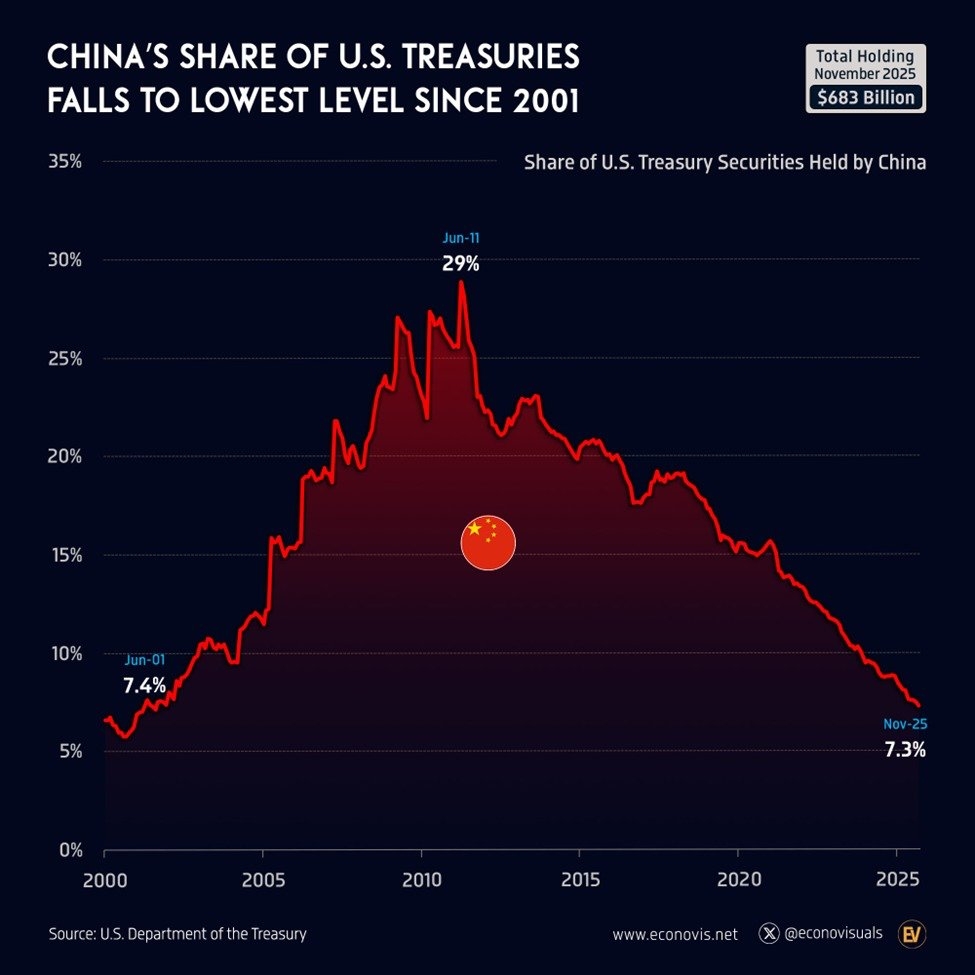
A historic shift in global capital flows is underway. China, once the voracious buyer of US debt that helped fund the 21st-century American economy, is aggressively unwinding its position. New data reveals that Beijing is systematically rotating out of US Treasuries and into physical gold, a strategic pivot that has pushed its exposure to American debt to multi-decade lows.
❍ Treasury Holdings Collapse to 2001 Levels
The scale of China's retreat from the US bond market is staggering.
7.3% Share: China’s Treasury holdings as a percentage of all foreign holdings have plummeted to 7.3%. This is the lowest market share recorded since 2001, effectively erasing nearly a quarter-century of accumulation dominance.
A -21.5 Point Drop: To understand the magnitude of this exit, China held 28.8% of all foreign-owned US debt at its peak in June 2011. Since then, that share has collapsed by -21.5 percentage points.
Lowest Since 2008: In absolute terms, China’s holdings have fallen by -$627 billion from their highs, settling at just $683 billion. This is the lowest total level since 2008.
❍ Erasing a Decade of Accumulation
The data indicates a structural unwinding rather than a tactical trade. China has now effectively erased half of the Treasuries it accumulated between 2000 and 2010. The "recycling" mechanism—where China sold goods to the US and used the dollars to buy US debt—appears to be broken.
❍ The Golden Hedge: 15 Months of Buying
As dollars exit, gold enters. The People's Bank of China (PBOC) is replacing paper promises with hard assets.
15-Month Streak: In January, the PBOC acquired another 1 tonne of gold, marking its 15th consecutive monthly purchase.
Record Reserves: This relentless accumulation has pushed China's total official gold holdings to a record 2,308 tonnes.
Some Random Thoughts 💭
This is "de-dollarization" in action, not just in rhetoric. By swapping US Treasury bonds (which can be sanctioned or frozen) for physical gold (which has no counterparty risk), Beijing is immunizing its reserves against geopolitical leverage. The fact that holdings are down to 2001 levels suggests we are entering a new era of financial multipolarity. If the second-largest economy in the world no longer wants to hold the world's reserve asset, the structural demand for US debt may face a long-term headwinds, forcing yields higher to attract new buyers.
