

Author: Zhou Yu, Editor: Deng Yongyi, Sean
When the MIA Camera became a hit in China, an American version of the MIA Camera was also becoming popular on the other side of the ocean.
Last month, BeFake AI was launched on Google Play and the Apple Store. Within just a few weeks of its launch, it has already topped the Apple Store's free rankings in the United States, Britain, France and other places.
What they play is fake,
Image source: BeFake AI
Like MiaoYa Camera, BeFake can generate AI images by selecting presets or entering your own prompts, but as the name suggests, BeFake does not seek to simulate the reality of the real world as much as possible, but to use AI to "create fakes" and change and enhance the real images taken by the original camera.
BeFake claims to be the "first AI-enhanced social network" that can make every photo posted unique.
Currently, users can use its basic features for free, or unlock advanced features through a subscription, which costs $2.99/week, $9.99/month, or $99.99/year.
At the end of August, BeFake also revealed that it had completed a $3 million seed round of financing led by Khosla Ventures in April 2022. Other investors in this round of financing include Next Coast Ventures, Maveron Ventures, Peter Thiel, Joe Lonsdale and WSInvestments.
The American version of "Butterfield Duck" features a fake
As an application focusing on virtual social interaction, BeFake’s slogan is quite straightforward: since “fake” can be very interesting, why should we pursue “reality”?
BeFake's name directly "competes" with BeReal, a social media that was very popular last year. Dumont, one of the founders of BeFake, showed no mercy to this social media that focuses on authenticity: even BeReal is fake because its users have begun to plan their "real" moments.
However, in terms of core gameplay, BeFake is exactly the same as BeReal. At a certain time every day, BeFake will send a message to users, reminding them to start taking pictures and activating the user's front and back cameras.
After receiving the message, BeReal users will have two minutes to take a selfie with a camera without beauty filters and record what they are doing at the moment. The random time point and short time limit mean that it is extremely difficult for users to fake and must be authentic.
BeFake goes to the other extreme - users cannot upload unedited original photos. When they receive the message, a 20-minute countdown will officially begin. Users have to take photos in these 20 minutes and use AI to edit and publish them.
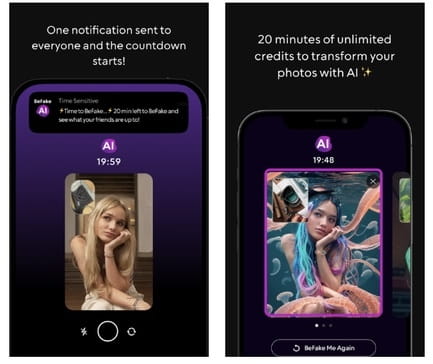 Image source: BeFake AI
Image source: BeFake AI
BeFake comes with many ready-made photo styles and custom location replacements, and users can use these options directly to generate surreal pictures.
For example, you can instantly change your background to a "relaxed holiday style" when you are sitting at home. Do you want to add some sci-fi scenes? Just click.
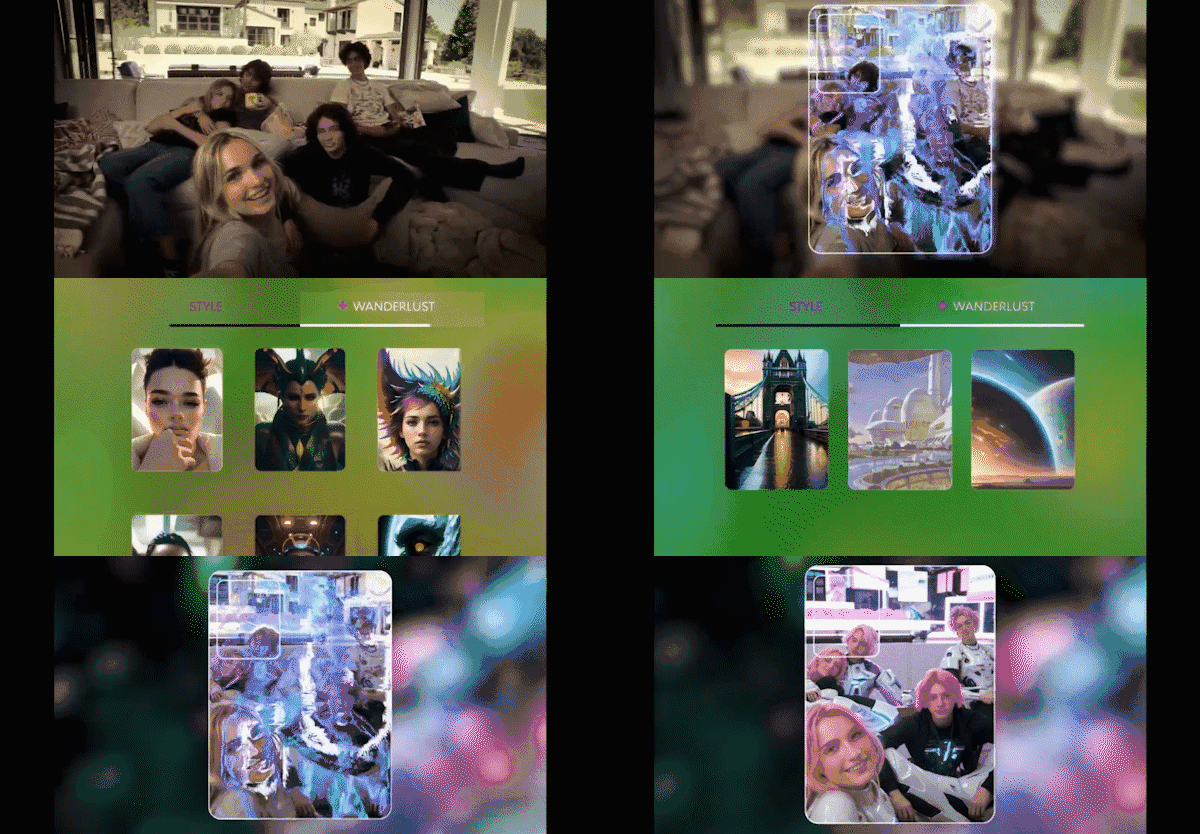
Image source: BeFake AI
Of course, if the user is not satisfied with the existing templates, he or she can also enter a customized prompt.
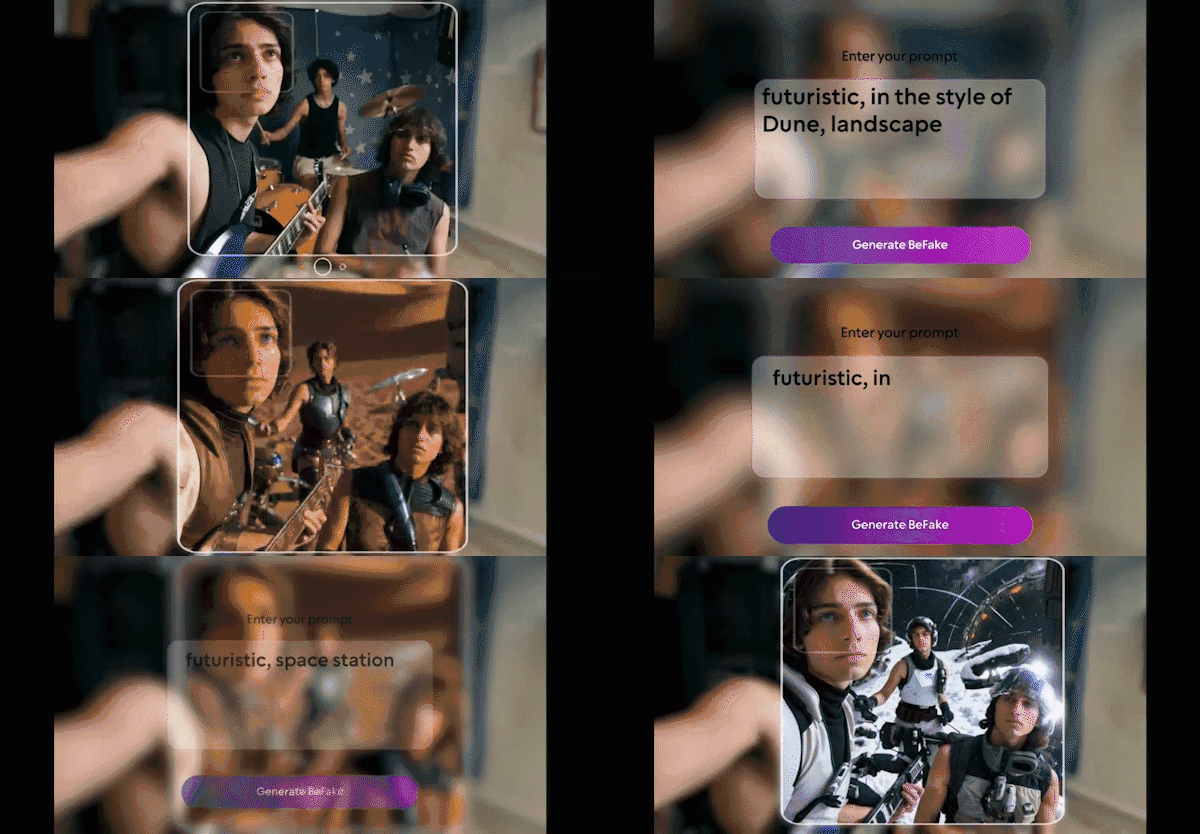 Image source: BeFake AI
Image source: BeFake AI
After the picture is created, users can also swipe the screen left and right to compare the original picture with the AI-generated picture. After the photo is edited and published, users can comment and interact with other users in different functions such as "Friends", "Popular" and "Discover".
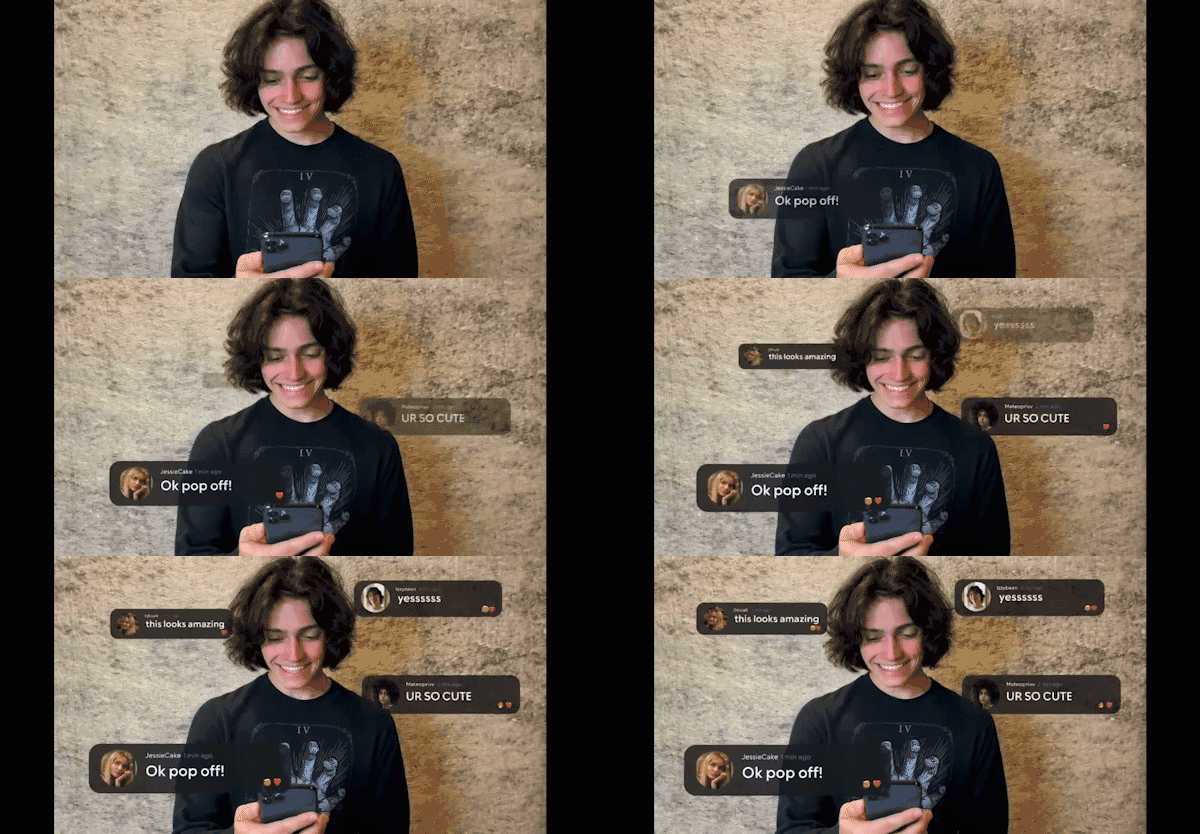 Image source: BeFake AI
Image source: BeFake AI
Other AI applications on the market, such as MiaoYa Camera, generally require users to upload dozens of photos in advance for AI to learn in order to generate more realistic photos, but BeFake does not require this step.
In addition, although the AI's response time can be controlled within 30 seconds for each operation, usually no more than 10 seconds, in order to create better results, users spend an average of about 10 minutes editing pictures each time.
As for future development, product founder Dumont believes that in order to retain users for a long time, it is necessary to quickly adapt to the changing tastes of users. He said that some of the content of BeFake is like making a game, which can be adjusted quickly, so that we can respond in time according to user preferences.
At present, most of the basic functions of BeFake are free. Of course, there is also a subscription model. Users can enjoy more functions after paying, including anonymous photo posting, delayed posting, viewing friends' past dynamics, unlimited AI production prompts, etc.
From gaming giants to virtual social networking
BeFake, which became popular this year, was actually founded in 2021 by the company "Alias Technologies". As an AI software development company, the company's two founders, Kristen Garcia Dumont and Tracy Lane, were previously the CEO and COO of the gaming giant Machine Zone.
During his tenure as CEO of Machine Zone, Dumont led the development and launch of two mobile games, including "World War II Rising" and "Final Fantasy 15: A New Empire", with a total revenue of $1 billion. Lane was mainly responsible for community, management, compliance and platform cooperation.
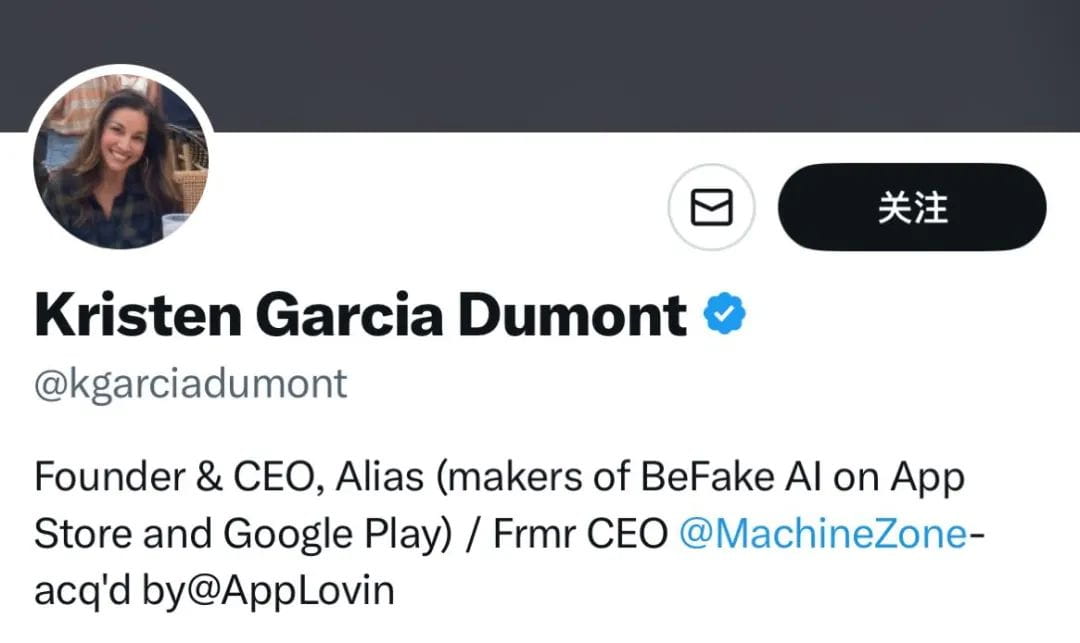 Image source: X (Twitter)
Image source: X (Twitter)
It was their experience working at gaming companies that made the two wonder: “If gamers can connect with each other through algorithms in an anonymous manner, why can’t social media do the same?”
Dumont said that gamers all have a separate digital identity to draw on, and seeing this magical connection develop as the algorithm works is definitely a spark moment.
It was precisely because of this that the two developed the product BeFake AI.
Users use BeFake AI to create fake images that may not necessarily express complete authenticity, but real creativity. Sometimes, these false fantasies may reflect a truer self.
"In current social media, either post-production beautification or pre-production planning is required," Dumont explained. "People often feel anxious and vulnerable when posting 'real' content. Staying true is very stressful and makes social interaction more difficult. So, BeFake allows people to create AI fake pictures to enhance themselves."
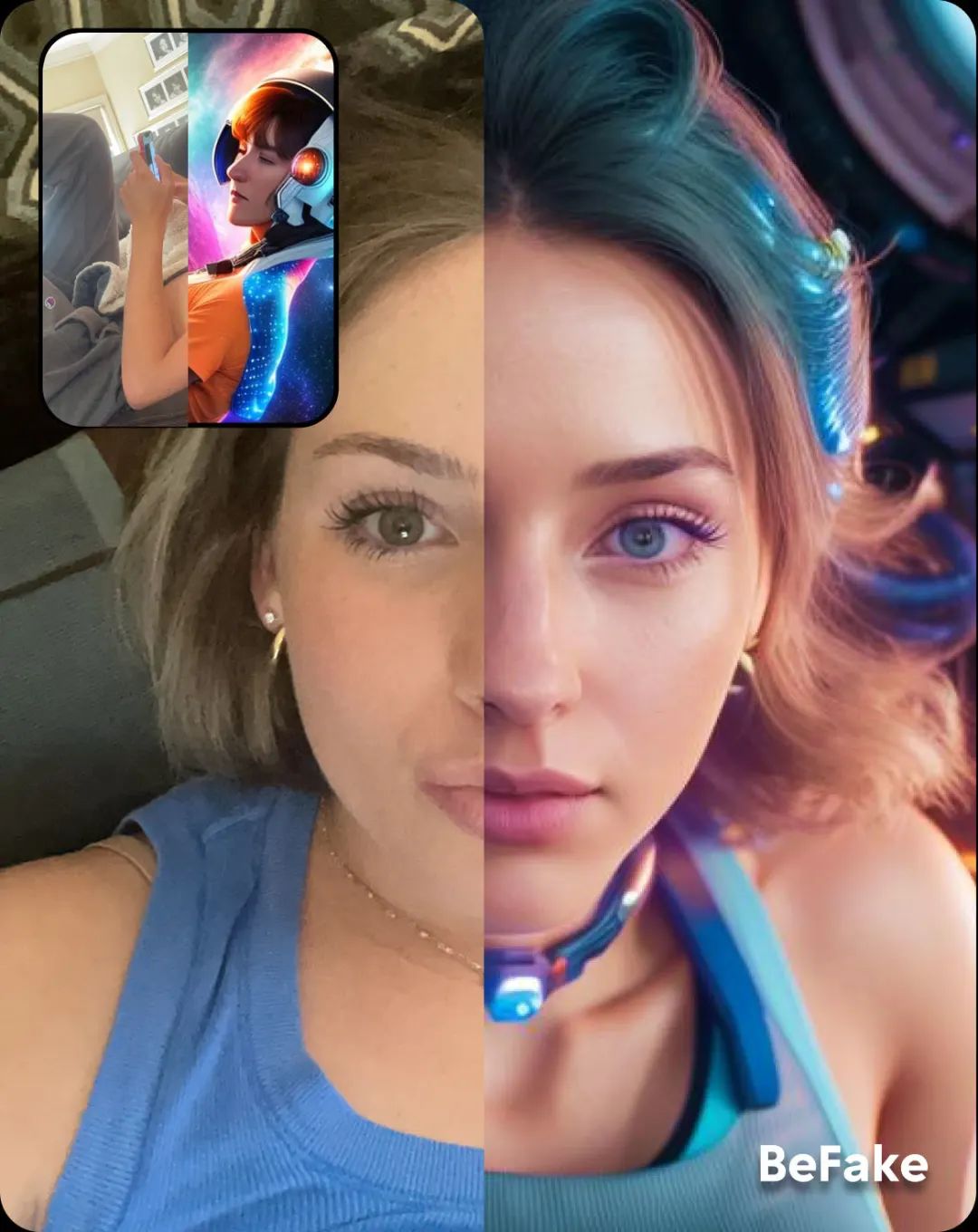 Image source: BeFake AI
Image source: BeFake AI
In addition, Dumont also emphasized the importance of platform community building to the future development of BeFake, a social app. She said: "The moat of most AI applications is not the underlying technology, but the community."
"Every company has proprietary technology, but only when the open source community gets bigger and bigger and the open source tools get better and better can you make better use of these tools and become better and better," Dumont added.
At present, BeFake is still mainly focusing on static AI images. In the future, it will further reduce the difficulty of using the technology and benefit more content creators. However, BeFake also stated that it is possible to enter the field of AI video in the future.