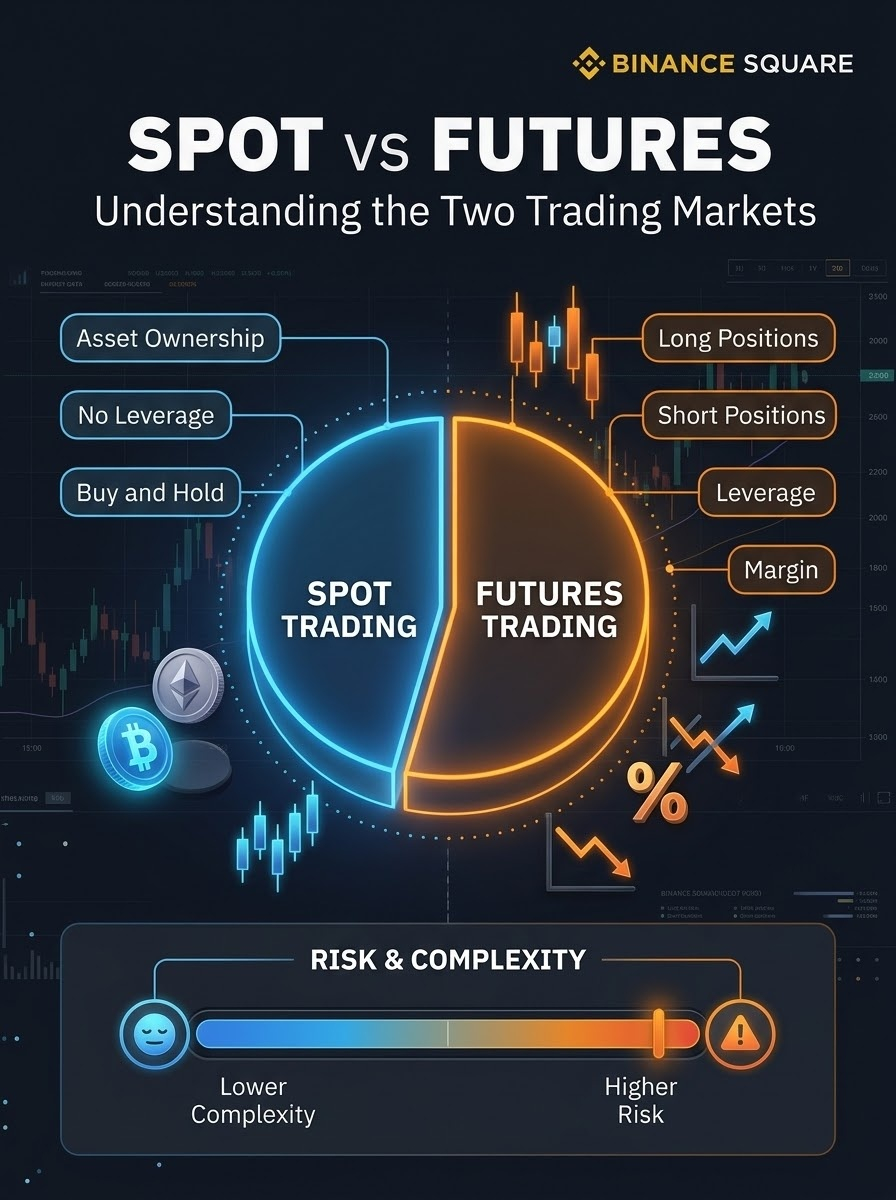

When people enter crypto trading, one of the first decisions they face is whether to trade Spot or Futures. Many focus on which option can generate higher profits, but I believe that's not the most important question.
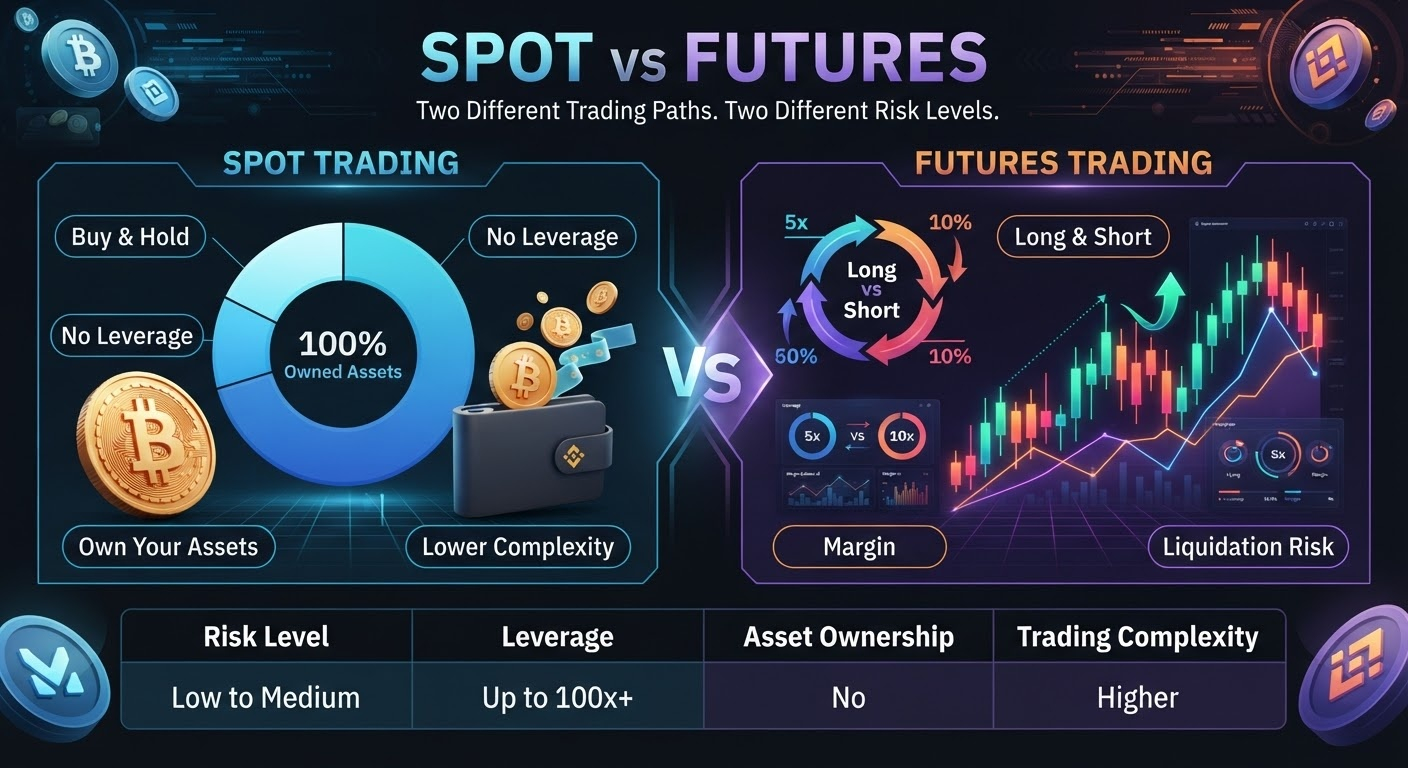
The better question is: Which trading method matches your experience, strategy, and risk tolerance?Both Spot and Futures offer opportunities, but they work in very different ways.
1. Spot Trading: Building Without Rushing
Spot trading is a straightforward way to participate in the crypto market. You buy an actual cryptocurrency and hold it in your account.
For example, if you purchase BTC through Spot trading, you own that BTC. You can hold it during market fluctuations, sell it when your target is reached, or build your position gradually.
One thing I appreciate about Spot trading is that you don't have to worry about liquidation from ordinary price movements when buying without borrowed funds.
However, that doesn't mean Spot is risk-free. If the market falls significantly, the value of your holdings can also decrease.For people who prefer a slower approach, Spot trading can provide an opportunity to understand market movements without adding leverage to their positions.
2. Futures Trading: More Flexibility, More Responsibility
Futures trading works differently. Instead of directly owning the cryptocurrency, you're trading contracts based on its price.You can take a Long position when expecting the price to rise or a Short position when expecting it to fall.Leverage is another important feature. It allows traders to control a larger position with a smaller amount of margin.
But here's where things get serious.A small market movement against a highly leveraged position can cause significant losses. If the margin becomes insufficient, your position may be liquidated.Some perpetual futures contracts also involve funding payments, which traders should understand before opening positions.
3. The Biggest Difference Appears During a Market Crash
Imagine Bitcoin suddenly drops 10%.A Spot holder who purchased BTC without borrowing can decide whether to hold, sell, or adjust their strategy.
A Futures trader holding a leveraged Long position may face liquidation much earlier, depending on leverage, margin, and market conditions.
This is why comparing only potential profits doesn't tell the whole story.Understanding what happens when the market moves against you is equally important.
4. Risk Management: The Part Many Traders Ignore
In my opinion, risk management deserves more attention than entry signals or profit targets.A trader can have a good market prediction and still lose money because of poor position sizing.
Before opening a trade, consider three things:
- How much capital am I willing to risk?
- Where should I exit if the trade goes against me?
- Is the potential reward worth the risk?
Using a stop-loss, avoiding excessive leverage, and keeping position sizes under control can help traders manage exposure.No strategy guarantees profits, but having a risk management plan can prevent one bad decision from becoming a much bigger problem.
5. Common Mistakes New Traders Should Avoid
There are a few mistakes I frequently notice in crypto trading discussions.Chasing green candles: Entering a trade simply because a coin is pumping can lead to buying near a local top.Trading emotionally: Trying to recover losses immediately often leads to unnecessary trades and bigger mistakes.
Using too much leverage: Higher leverage doesn't automatically mean better trading. It also increases the impact of small price movements.
Ignoring market research: Following random signals without understanding the reason behind a trade can make it difficult to develop independent judgment.
Learning to avoid these mistakes is just as important as learning technical analysis.
6. Which One Should You Choose?
I don't think every trader needs to participate in both markets.
- Spot: Suitable for people who prefer owning crypto and building positions over time.
- Futures: More suitable for experienced traders who understand leverage, margin, liquidation, and position sizing.
Beginners can start by understanding Spot trading and basic market analysis before considering more complex trading products.There is no need to rush into Futures just because other traders are sharing screenshots of impressive profits.
7. My Take: Survival Comes Before Profit
Crypto markets will always create new opportunities. But opportunities mean very little if poor risk management repeatedly wipes out your capital.I would rather see a trader understand one market properly than jump between different trading methods without a plan.
The goal shouldn't be to make every trade profitable. The goal should be to make decisions that allow you to stay in the market long enough to learn, improve, and grow.
Final Thought:
Spot and Futures aren't competitors where one must be better than the other. They are different tools for different trading approaches.
The smartest decision isn't choosing the market with the biggest profit potential. It's choosing the one whose risks you genuinely understand.Remember, in crypto trading, protecting your capital is also a part of making progress. Sometimes the best trade is the one you decide not to take.