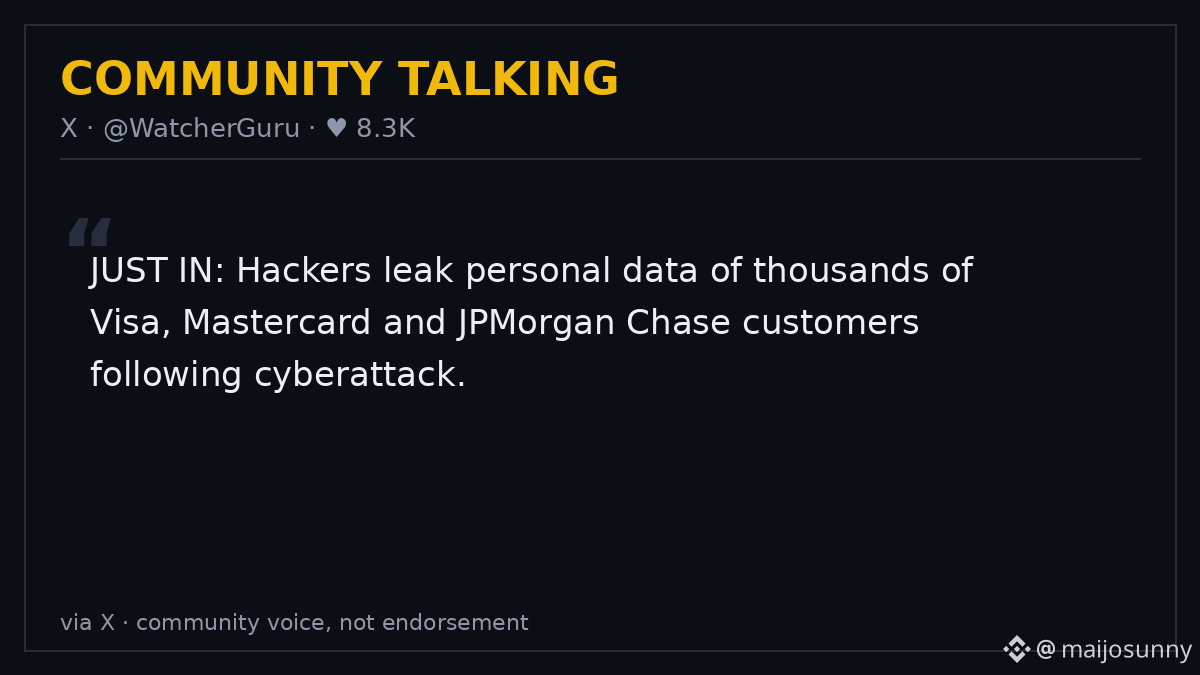
Your bank leaked your data this week. Your wallet never asked for it. Coincidence?
Visa, Mastercard and JPMorgan Chase all landed on ransomware group n0n's leak site on Nov 16, with a 48-hour countdown. On Thursday, the data went public.
What actually leaked (WSJ / NY Post):
• JPMorgan: emails, phone numbers and account IDs of 16,000 of its wealthiest customers, from its Reserve program
• Visa: Asia-Pacific cardholder program records, via a third-party provider
• Mastercard: a limited set of benefit-program records
⚠️ What it is NOT: no card numbers were confirmed exposed anywhere. Visa says its own systems were not involved. JPMorgan says the Nov 16 outage was a software bug, not a cyberattack.
🤔 Why should crypto traders care?
Your email and phone are the raw material for the next phishing wave, and crypto holders are the top targets. Attackers go after the weakest link, and it is rarely the cryptography: vendor gets hit, your inbox becomes the attack surface, one convincing "bank" email, wallet drained.
My take: this is not about card numbers. It is about how many copies of you exist in databases you never chose. Self-custody removes one copy, your coins, but your identity still lives in vendor systems.
✅ Action Required:
• Don't click links in "bank" emails, open the official app instead
• Expect phishing texts using your real name and account details
• Verify any wallet message twice before signing anything
Bottom line: TradFi's data model leaks. The question is whether the market treats that as a crypto use case, or just another headline.
$BTC sits at $62,298 (-0.68% 24h) while Fear & Greed reads 10, Extreme Fear (alternative.me). Traders are not pricing a TradFi trust crisis yet.
Is this the week "trust us with your data" finally breaks, or a headline we forget by Monday? 👇
Not financial advice. DYOR.
#crypto #CyberSecurity #DataBreach