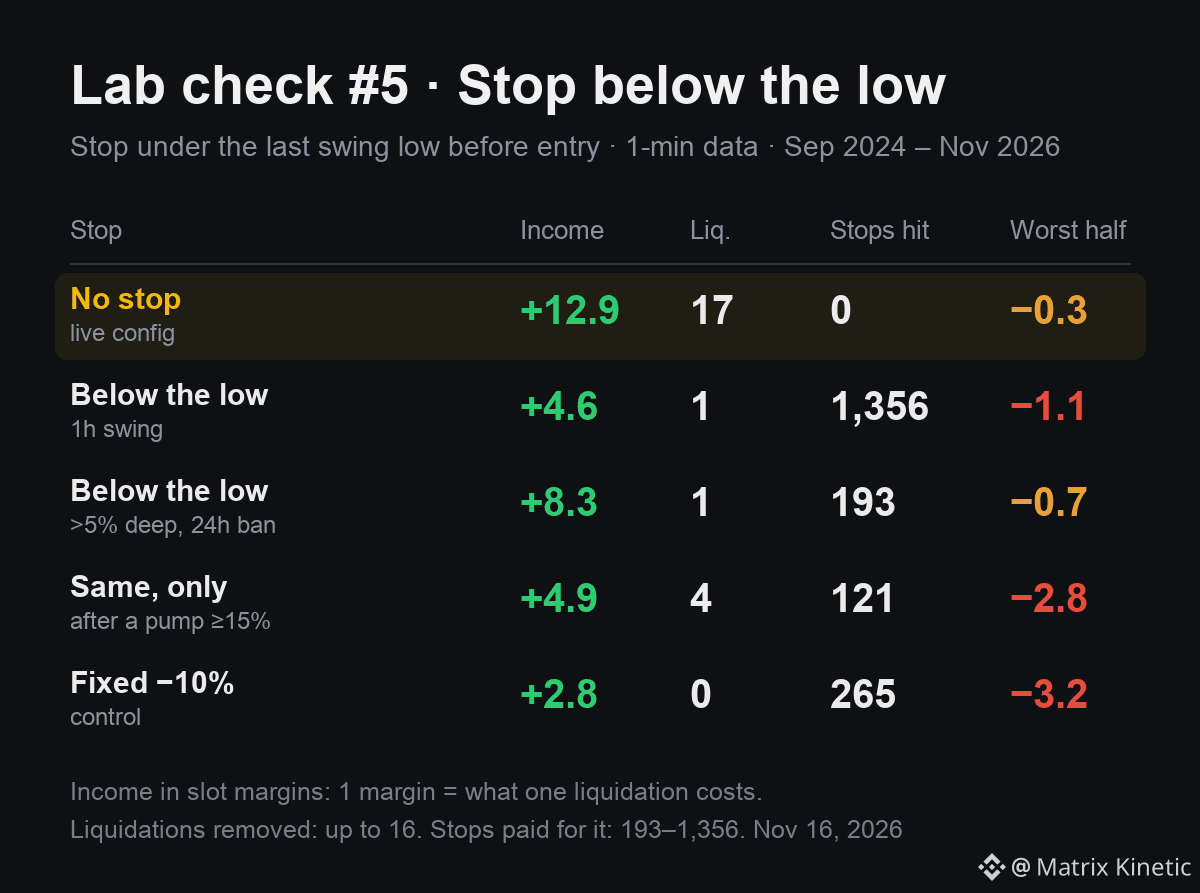
Lab check #5. A stop below the low.
My $TIA entry on Oct 17 came right after a pump. A stop under the last swing low before entry would have closed it at −0.28 margin instead of a full liquidation. The model repeated that trade on its own and confirmed it.
Then I ran it over 2 years and 32 coins:
No stop: +12.9 margins, 17 liquidations
Stop below the low: +4.6, 1 liquidation, 1,356 stops
Only if more than 5% deep, plus a 24h ban on the coin: +8.3, 193 stops
Fixed −10%: +2.8, 265 stops
The liquidations disappear. But each liquidation removed costs about 12 stops at roughly 0.2 margin each. In total I'd pay 2–3 times what the liquidations cost, just in small pieces.
Why: at the moment the stop fires, TIA looked like a dozen other cycles at the same depth that came back to the take. Those comebacks are the grid's income. The exception is only visible afterwards.
The stops that survived the test sit at the far edge: the liquidation itself, or a 30-day cut.
A stop 9.5% under the last order, like on my Veles bot, loses less each time. But it fires more often: 20–27 times instead of 17–18. Net: the same or worse.
So I switched on the one stop that passed: a stop-limit 0.5% above the liquidation price, armed only after the whole grid is filled. It fires in the same cases as the liquidation, with no extra exits. It just skips Binance's clearing fee and gets back what's left of the margin: about 5% of a margin saved each time.
Where do you put the stop on a grid bot?
#DCA #stoploss
Below the last low
0%
Fixed %
100%
At liquidation
0%
No stop
0%
1 Votos • Votação encerrada