

Can you swap tenge for USDT person to person in Kazakhstan and stay inside the rules? Yes. Since July 2026 Binance Kazakhstan runs its own P2P service for KZT, where ads come only from approved professional partners, every buyer and seller has passed identity checks, and the tenge side moves by bank transfer to an IBAN.
👉 Open a Binance account with code GETREWARD
This guide explains what makes that setup different from the open P2P many people in Almaty and Astana used for years, what to prepare before your first order, how a buy and a sale actually run, and which warning signs should make you cancel. Screens and limits vary by account and change often, so your own app has the final word.
What changed for tenge P2P in 2026
Four things happened in a short space of time, and together they explain why the KZT market looks the way it does now.
The law got enforced: Article 11(5) of the Law on Digital Assets bans organising the circulation of digital assets in Kazakhstan without a licence or authorisation under AIFC law or national law. The Astana Financial Services Authority (AFSA) repeated this in an April 2026 public warning that named P2P services on unlicensed platforms among the risks.
AFSA set a P2P model: Its published rules allow P2P only on digital asset trading facilities licensed in the Astana International Financial Centre. The facility must hold custody permissions, lock the seller's coins until the deal settles, run KYC and anti-money-laundering checks, and move fiat only through banks AFSA has approved.
Binance Kazakhstan launched under that model: The local platform is operated by BN KZ Technologies Limited, listed in the AFSA public register with licence number AFSA-A-LA-2024-0028. Its P2P service went live in mid-July 2026 with ads from licensed partners only and IBAN transfers for tenge at the first stage.
Courts and app stores followed: In September 2026 the AIFC Court granted AFSA injunctions against several unlicensed crypto platforms, and the order was sent to Google and Apple so their apps can be geo-restricted in Kazakhstan.
For you as a user, the practical point is this. If a deal goes wrong on a platform without a local licence, there is no Kazakh authority that can step in. AFSA says as much in its warning: people dealing with unlicensed firms get none of the protections that apply to supervised ones.
Regulated P2P compared with the open model you may remember
The buttons look familiar, but several things behind them work differently.
Who posts the ads: On an open P2P market almost any verified user can become an advertiser. On Binance Kazakhstan only professional partners approved by the platform, called P2Pro or Makers, can post ads. You are always the taker.
How tenge moves: Open markets list whatever the advertiser accepts, including card-to-card transfers and e-wallets. The regulated service settles by IBAN transfer through official bank channels.
Escrow: Both models lock the seller's coins once an order opens. Under the AFSA rules this lock is a licence condition, not just a product feature.
Identity: Both require verification. On the Kazakh side, tenge methods tie your account to your IIN, the 12-digit individual identification number, so the name and IIN on the bank account have to match the verified profile.
Where you complain: A licensed operator answers to AFSA and has a formal complaints process. With an unlicensed platform you are left with its own support desk and nothing behind it.
Choice and price: Fewer advertisers means fewer ads to pick from, especially in the first months. The gap between buy and sell prices can be wider than on a crowded open market, so compare before you commit.
Three things to set up before your first order
An identity check that includes your IIN: Binance's help page for tenge deposits through Freedom Bank says that if the document you verified with does not show your IIN, you have to reset verification and redo it with one that does. Doing this before you need tenge saves a wait of a day or more in the middle of a trade. If a check gets rejected, these notes on fixing a rejected Binance KYC check cover the usual causes, from glare on the photo to a name mismatch.
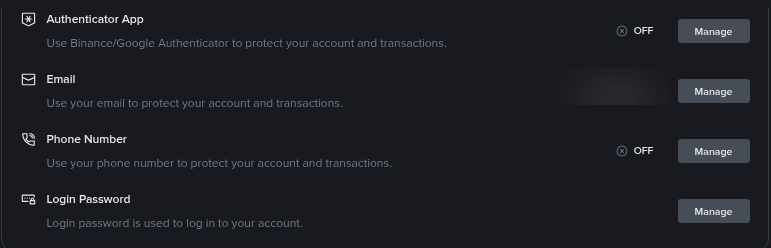
An authenticator app: P2P means coins and money moving between strangers, and a hijacked account is the fastest way to lose both. Turn on the authenticator in Security before you trade, so a leaked password alone is not enough to open orders or release coins.
A tenge bank account in your own name: A Kazakh IBAN has 20 characters and starts with KZ. Keep it handy in your banking app, and make sure the account holder name matches your Binance profile letter for letter. Transfers from a spouse's or a friend's account are the classic reason an order ends up in appeal.
How a first tenge buy runs, step by step
Open P2P, choose Buy, pick USDT and set the currency to KZT.
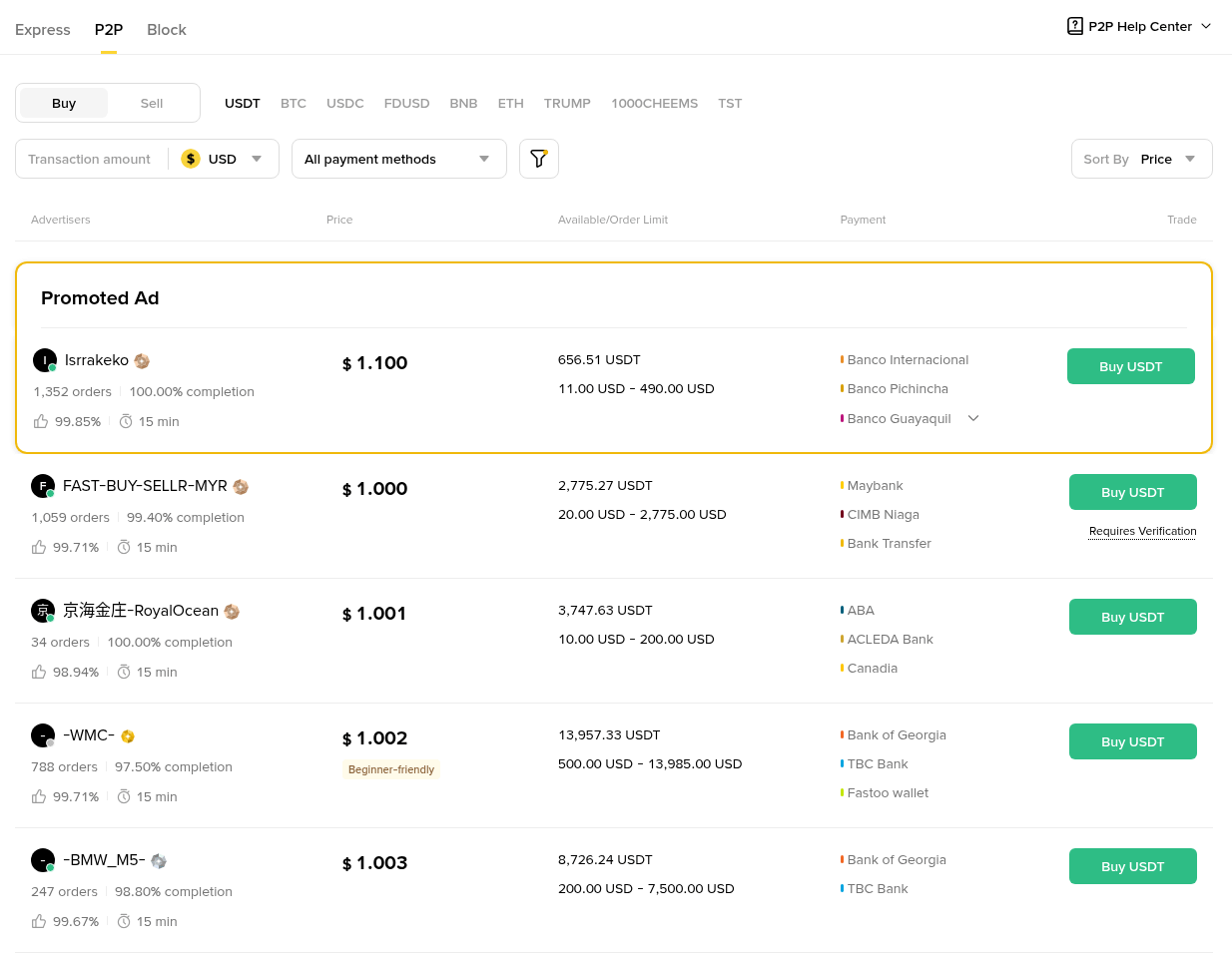
Read each ad before the price. Look at the order count, the completion rate, the time limit and the minimum and maximum order size.
Type the amount in tenge. The order screen shows how much USDT you get at that ad's price, which is the number that matters.
Open the order. The partner's USDT is now locked by the platform and the timer starts.
Send the exact tenge amount by IBAN from your own account to the details shown inside the order. Add a reference only if the order asks for one.
Tap the button that marks the transfer as done only after your bank shows it as sent.
Wait for the partner to confirm receipt. The USDT then appears in your Funding wallet.
Two habits make this smoother. Do the first order small, well under any limit you plan to use later, so a slow bank or a typo costs you nothing but time. And keep the order ID with the bank receipt, because any appeal starts with those two items.
The market page looks like the capture below. It was taken on the global site with USD selected, but the tenge page lists the same details for every ad.
Selling USDT for tenge without surprises
A sale is the same flow in reverse, and the one step that matters most is the last one.
Move the coins first: P2P sells from the Funding wallet. If your USDT sits in Spot, transfer it across before opening the order, otherwise the amount field stays empty.
Open the order: Your USDT is locked as soon as you do. It is not gone, it is held until you release it or the order is cancelled.
Check your own bank app: Wait until the full tenge amount is credited, from an account in the partner's verified name. A screenshot or a forwarded SMS is not proof of anything.
Release: Only then tap Release and confirm with your authenticator code. After release the platform cannot pull the coins back for you.
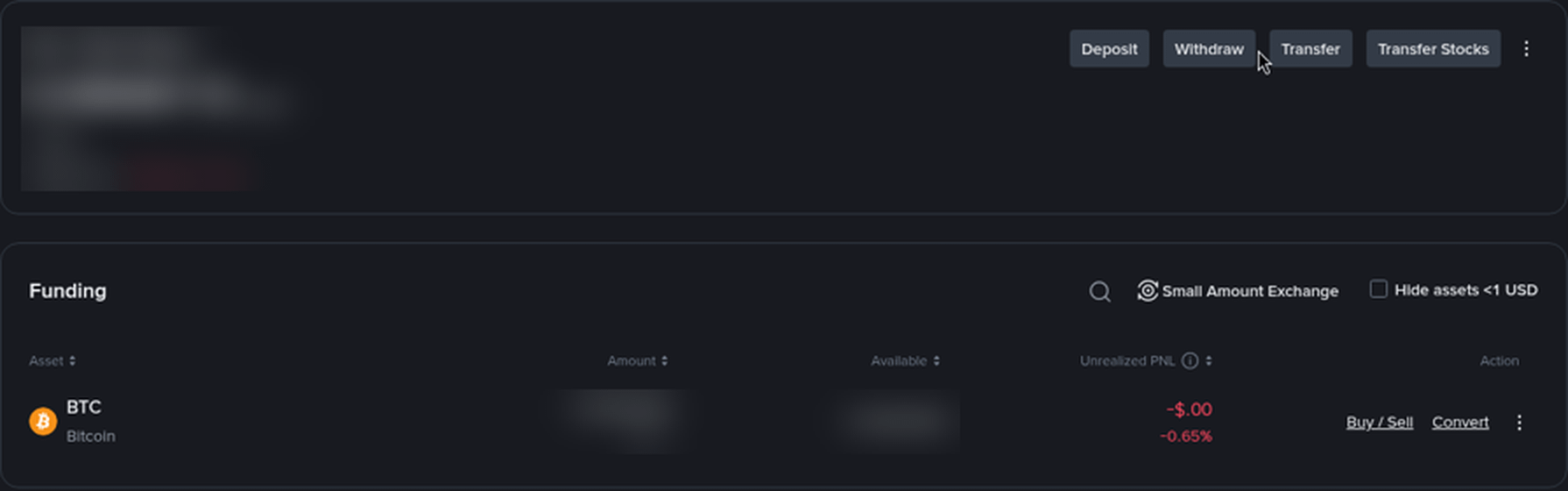
Coins you buy on P2P land in the Funding wallet, and coins you sell leave from there. The screen below shows where to find it and the Transfer button that moves USDT to Spot when you want to trade.
Illustrative tenge math before you tap Buy
The numbers here are made up to show the method. They are not a quote and not what you will see on any given day.
Say you want to put 100,000 KZT into USDT. Ad A shows 500 tenge per USDT and ad B shows 505.
Ad A: 100,000 ÷ 500 = 200 USDT.
Ad B: 100,000 ÷ 505 = 198.02 USDT.
The gap: About 1.98 USDT, close to 1,000 tenge, for picking the higher price. On a 1,000,000 KZT order the same gap is nearly 10,000 tenge.
Now look at the round trip. If the buy ads sit around 505 and the sell ads around 495, buying and selling straight back would cost about 10 tenge on every USDT, roughly 2%. That spread is the real cost of P2P for most takers, so check both sides of the market before treating P2P as a cheap in-and-out.
Two more lines belong in the sum. Your bank may charge for an interbank IBAN transfer, and that fee depends on your bank and plan, not on Binance. And check whether the order screen shows a separate fee line; on many P2P markets the taker's cost is built into the price rather than charged on top.
Warning signs that should stop the order
Most P2P losses follow a short list of patterns. Cancel, or refuse to release, if you see any of these.
A move off the platform: The other side wants to continue on Telegram or WhatsApp, or offers a better price if you deal outside the order.
Changed bank details: You are asked to send tenge to a card number or a different IBAN from the one shown inside the order.
A name that does not match: Money arrives from a third party rather than the partner's verified account.
Pressure: Messages telling you to release quickly before the money shows, or threats of an appeal if you wait.
Fake helpers: Someone claiming to be support or an AFSA officer who can unfreeze your order for a fee. Real support works inside the app.
A platform you cannot find in the register: AFSA keeps a public list of licensed firms. A well-known name, a slick app or heavy advertising does not mean a platform is licensed.
For the everyday habits behind these rules, from reading advertiser stats to keeping records, see this guide to buying and selling crypto safely on P2P.
What to do if a tenge order stalls
You sent tenge but the timer is running out: Mark the transfer as done if you really sent it, then write in the order chat with the time of the transfer. If the partner does not respond, use the appeal button once it becomes active and upload the bank receipt.
The bank holds the transfer: Banks sometimes ask about the purpose of a transfer to a crypto-related account. Answer truthfully and keep the order ID ready. Cancelling and resending to a different account only makes the trail harder to follow.
The order was cancelled after you sent money: Do not send again. Open an appeal or contact support from the order page with the receipt, and wait for the partner's refund through the platform.
The tenge method is greyed out: This usually means verification is missing the IIN or still under review. Check the verification page before contacting anyone.
Coins did not show up: Look in the Funding wallet, not Spot. P2P purchases always arrive there first.
Records worth keeping
Save the order ID, the date, the amount in tenge and USDT, and the bank statement line for every P2P trade. It takes a minute per order and answers almost any question a bank or a tax adviser can ask later. Tax treatment of crypto in Kazakhstan has its own rules, so talk to a local adviser about your situation; nothing here is tax or financial advice.
A short routine for every tenge trade
Verified profile with your IIN, authenticator on, bank account in your own name. Small first order. Read the ad, then the price. Transfer only to the details inside the order. Release only when your bank app shows the money. Keep the order ID with the receipt.
New to Binance? You can check the active Binance bonus event to see which welcome tasks currently apply to eligible new users.
Sign-up code: GETREWARD
FAQ
Is P2P on Binance Kazakhstan the same as P2P on the global site?
The buy and sell flow looks alike, but on the local platform ads come only from approved professional partners and tenge moves by IBAN through official bank channels.
Do I need an IIN to trade tenge?
For tenge methods, yes in practice. If your verified document does not show your IIN, Binance asks you to reset verification with one that does.
Can I use a card transfer instead of an IBAN?
At launch the service settled tenge by IBAN only. Other methods may be added later, so check the options shown inside the ad.
What if the partner never confirms my transfer?
Open an appeal from the order once the button is active and attach your bank receipt. The partner's USDT stays locked while the case is reviewed.
Are P2P prices fixed?
No. Each partner sets its own price and limits, and they move with the market through the day.
Disclosure: this article includes a Binance sign-up link with the code GETREWARD. Crypto prices can fall. This is not financial or tax advice.