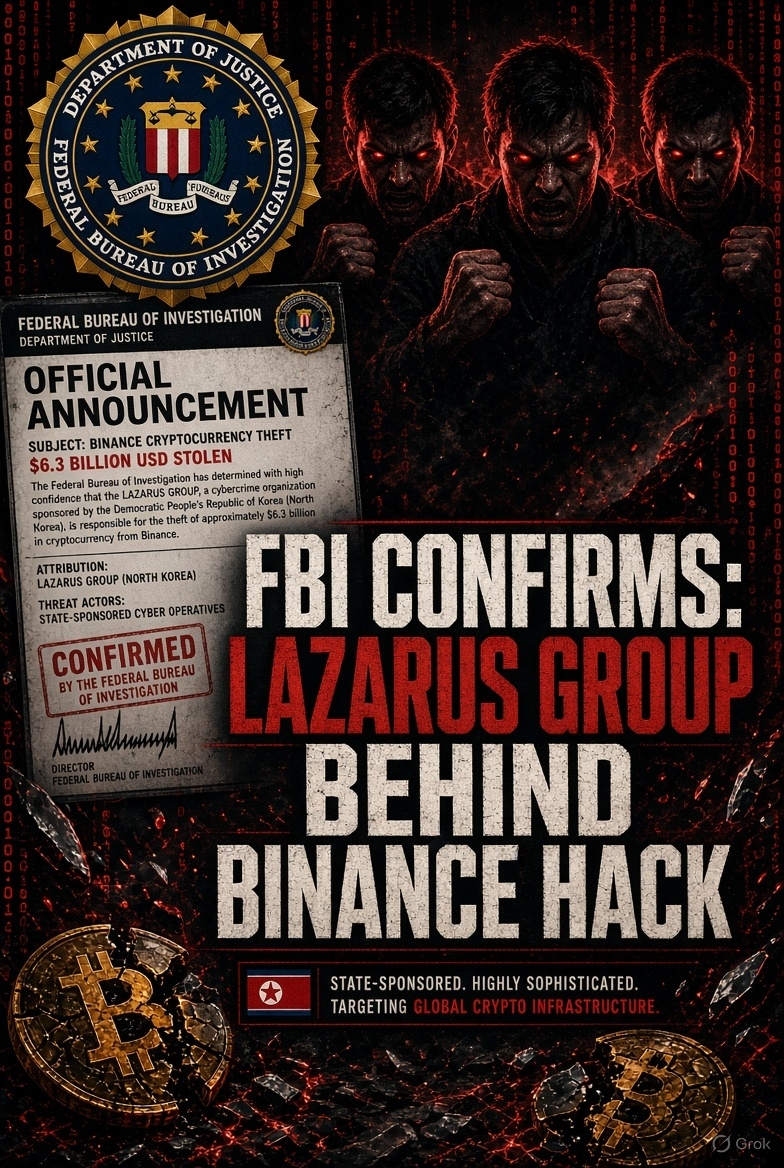

#FBIConfirmsNorthKoreaIsResponsibleForBinanceCryptoHack
Record $6.3 Billion Binance Heist: North Korea’s Lazarus Group Strikes Again
The Attack and Attribution
On October 29, 2026, attackers drained $6.3–6.4 billion from Binance hot wallets across multiple blockchains in about 20 minutes. The FBI confirmed North Korea’s TraderTraitor unit—part of the Lazarus Group under the Reconnaissance General Bureau—as responsible. This marks the largest crypto theft on record, surpassing the $1.5 billion Bybit hack of 2025.
Lazarus Group Profile and Methods
Lazarus is a North Korean state-sponsored cyber unit active since at least 2009. It funds the regime’s weapons programs through theft and espionage. Core tactics include spearphishing with fake job offers and coding tests, supply-chain compromises, and trojanized applications. AppleJeus, a signature malware family, embeds malicious code in fake crypto trading apps for Windows and macOS, then deploys second-stage tools like FALLCHILL for key theft and remote control.
Scale of North Korean Crypto Crime
North Korean-linked actors have stolen an estimated $12.8 billion in cryptocurrency since 2017 across roughly 100 incidents. In 2026 alone they took $7.4 billion—about 85% of global crypto-hack value that year. Major prior cases include Ronin Bridge ($625 million) and Bitget ($387 million).
Binance’s Response
The exchange suspended withdrawals, froze approximately $3 billion of the stolen assets with partners, and used company funds to cover user losses. By early November it had replaced about 90% of the stolen tokens, with the remaining less-liquid assets still being acquired. Withdrawals were scheduled to resume around November 1.
Market Impact and Sentiment
Bitcoin fell 3–6% to near $76,400, Ethereum dropped about 5%, and BNB declined more than 7%. Futures liquidations exceeded $1.5 billion in 24 hours, mostly long positions. The Fear & Greed Index entered “fear” territory (around 36). Total crypto market capitalization dipped roughly 2%. Recovery was supported by Binance’s rapid coverage assurances and the fact that the Bitcoin network itself was not compromised.
Security Lessons and Warning Signs
The breach exposed weaknesses in hot-wallet management, multi-chain signing systems, and resistance to social engineering. Indicators of compromise include unexpected trading-app installations, traffic to known C2 domains, unauthorized wallet activity, and phishing emails that alter recovery settings or create forwarding rules. For email accounts specifically, watch for unknown logins, unexpected sent messages, changed recovery details, missing mail, or sudden filter rules.
Outlook
The incident shows state-sponsored actors continue to treat centralized crypto platforms as high-value funding sources. While Binance’s scale limited systemic damage, the rising volume of North Korean thefts underscores the need for stronger cold-storage isolation, multi-party authorization, continuous monitoring of account-code changes, and better defenses against sophisticated social engineering.