$SKHYB : SKHYB Volume Divergence
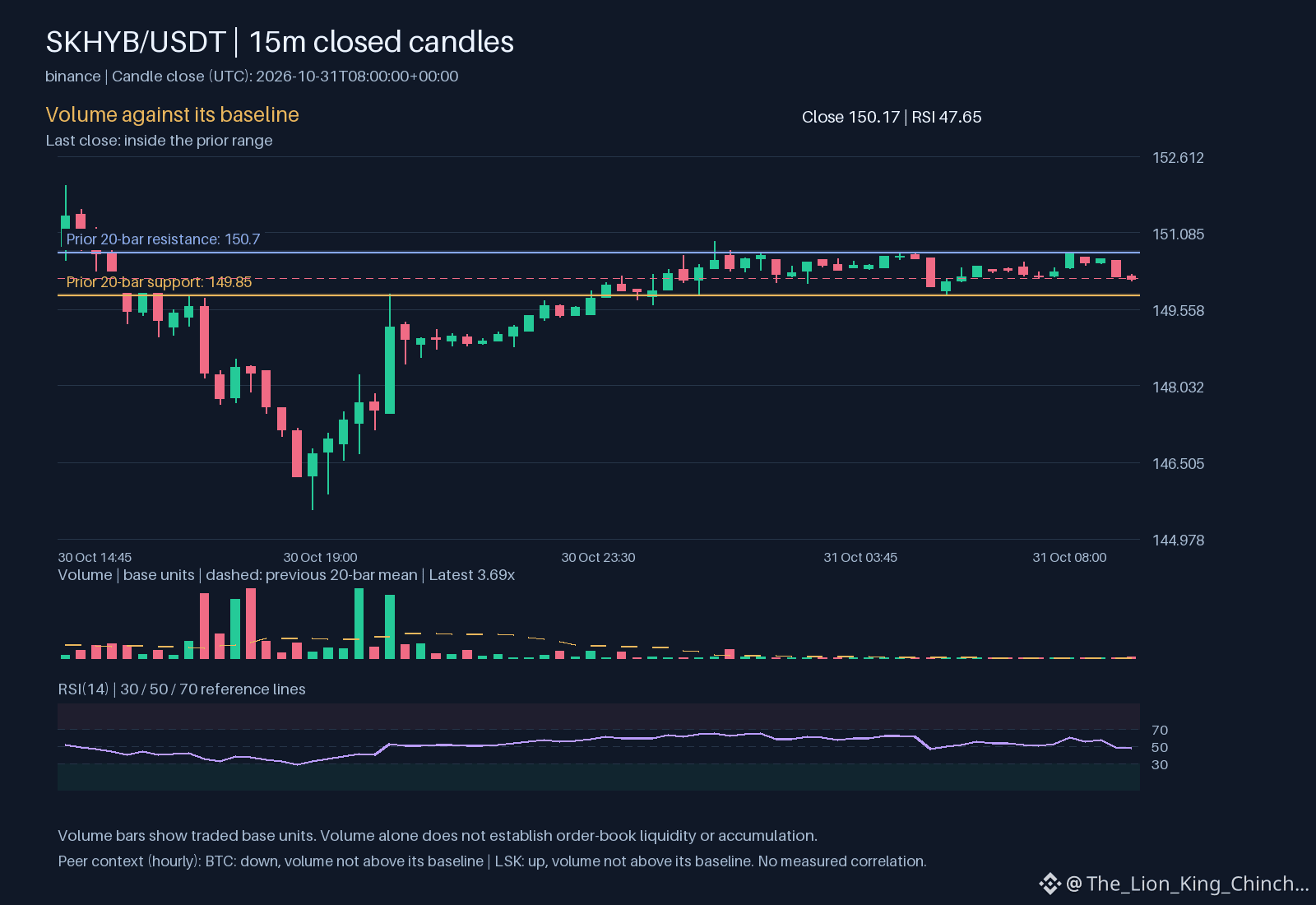
The core question for $SKHYB is how elevated volume pairs with downward pressure. The observed hourly direction is down, yet volume sits above the normal baseline. This specific combination suggests active participation rather than passive drift. When price falls while trading activity rises, it often reflects disagreement among market participants rather than a unified consensus.
Peer observations add context but limit conclusions. $BTC shows an hourly direction down with volume not above baseline. $LSK moves up hourly, also with volume at normal levels. These peers provide a different backdrop. They show that not all assets in the same venue move simultaneously with similar intensity. A shared directional move does not imply capital rotation or a common cause. It is merely a parallel observation at a specific moment.
This comparison cannot establish correlation or sector membership. The distinct volume profiles on $SKHYB versus its peers highlight the limits of simple direction matching. We must distinguish this current fact from broader market trends. The elevated volume on $SKHYB is a specific local feature. It does not prove a sustained trend. To assess the durability of this move, we need to see if the volume supports the price level or if the downward pressure exhausts itself. Watching how the move holds relative to the baseline is more informative than the initial direction alone.
Probabilistic market research, not a recommendation or guaranteed return.
The comparison to keep in mind: $BTC has hourly direction down and volume not above its baseline; $LSK has hourly direction up and volume not above its baseline. This alone does not establish correlation.
Which matters more in this comparison: direction or how the move holds?
#SKHYB