

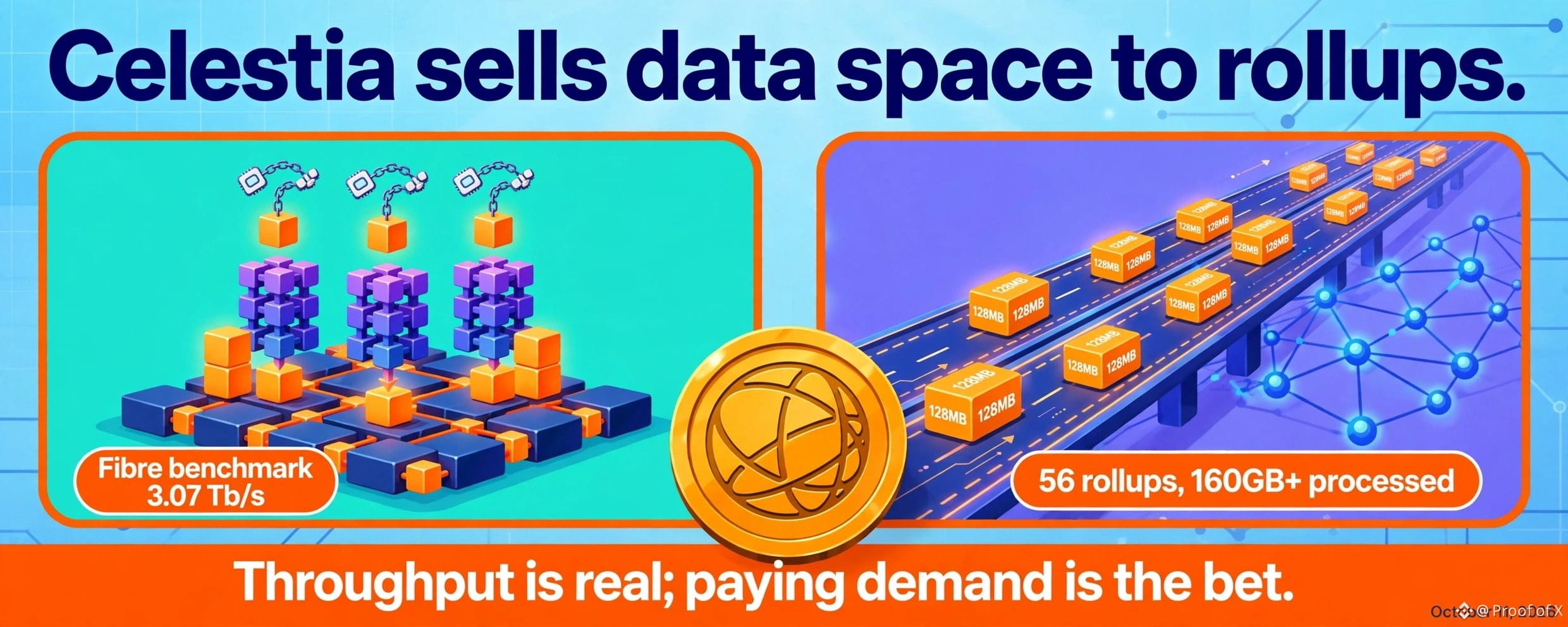

Every rollup needs the same raw material, and $TIA sells it by the block.
BUSINESS
Celestia is the first modular blockchain: it orders transaction data and proves that data is available, while execution happens on rollups built above it.
Rollups submit their transaction data to Celestia as blobs and pay for that blobspace in $TIA, which makes the token the metering unit for the network's only product.
Network activity remains real: more than 160GB of data flowed through the network across 56 rollups in early January 2026, according to network activity reports.
$TIA is staked to secure the chain under CometBFT proof of stake, so holders earn yield while the chain they secure carries other chains' data.
TECHNOLOGY
The core invention is data availability sampling: light clients check random data shards instead of downloading whole blocks, so throughput can scale without every node storing everything.
The Matcha upgrade lifted the maximum block size from 8MB to 128MB, a 16x jump in data availability throughput, and cut annual token inflation from 5% to 2.5%.
The Ginger upgrade cut block times from 12 seconds to 6 seconds, doubling throughput for the rollups posting above.
The Fibre program is the next leap: an October 1, 2026 benchmark across 120 validators averaged 3.07 terabits per second over 143 seconds, with test block capacity up from 200 to 2,000 blob submissions and test block time down to 1 second.
The V8 protocol upgrade adds single-signature cross-chain transfers and zero-knowledge verified messaging, and Matcha removed the cross-chain bridge token filter so non-$TIA assets can route through the layer.
One honest caveat: Celestia moved its SP1 Blobstream deployments into legacy status in September 2026, so rollups using that verification bridge must migrate to another path.
SECTOR
Data availability is now its own market segment, growing alongside the rollup ecosystem it serves.
Cheaper DA lowers the cost of launching and operating a rollup, which is why rollup-as-a-service platforms keep building on DA layers like Celestia.
When L1 gas markets spike, rollups with external DA options keep fees predictable — a structural reason demand for dedicated DA persists through cycles.
COMPETITION
$ETH offers native DA through EIP-4844 blobs at about 8.2MB per block today with full danksharding planned — the highest-trust option, priced by L1 demand.
EigenDA, secured by restaked $ETH validators, pitches configurable high throughput for performance-focused L2s, with trust rooted in its operator committee.
$AVAIL runs its own proof-of-stake DA chain with data availability sampling, positioning as the general-purpose alternative.
Celestia's edge is sovereign, publicly verifiable DA with namespaced blobs and fraud-proof light clients — but it must convert throughput benchmarks into paying blobspace demand.
TOKENOMICS
Per CoinGecko, $TIA carries a market cap of about $532.4M with fully diluted valuation near $641M.
About 979M tokens circulate out of a 1.179B total, roughly 83%, with no stated max supply.
No token unlock schedule was verifiable from a cited source this run.
Not financial advice. DYOR.
$TIA