

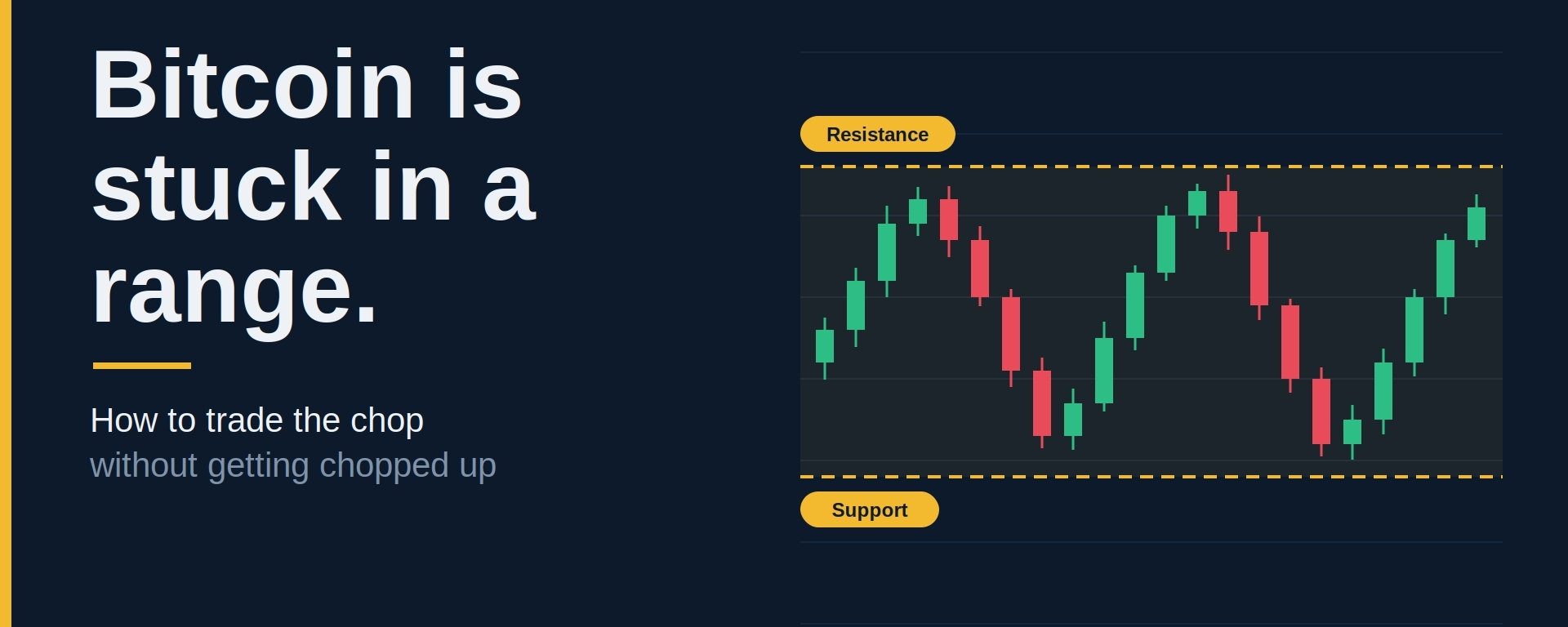

If Bitcoin’s chart looks like it’s going nowhere, you’re not imagining it. Bitcoin opened October trading near $84,800, moving within a range of roughly $83,500 to $86,600. Whether price breaks out of that band is expected to shape the rest of the month
Sideways markets feel boring, but they’re where a lot of accounts quietly bleed through overtrading, fake breakouts and stop-hunts. Here’s how to handle them.
1. Know What a Range Actually Is
A range is simply a zone where buyers defend a floor (support) and sellers defend a ceiling (resistance). Price bounces between them until one side runs out of strength.
Mark both levels on your chart before you do anything else. If you can’t clearly point to the top and bottom, you don’t have a range to trade yet.
2. Don’t Trade the Middle
The middle of a range is the lowest-edge zone on the chart. You’re far from support and far from resistance, so your stop is either too tight (it gets clipped) or too wide (the risk isn’t worth it).
Patient traders wait for price to come to the edges, where the risk-to-reward is best and the invalidation level is obvious.
3. Treat Breakouts With Suspicion Until Confirmed
Ranges are famous for fake-outs: price spikes through a level, triggers everyone’s orders, then snaps back inside. To reduce your odds of being the liquidity:
Wait for a candle close beyond the level, not just a wick
Look for a retest of the broken level that holds
Check whether volume expands on the move; a breakout on weak volume is a warning sign
Being a little late to a real breakout costs you far less than being early to a fake one.
4. Cut Your Size and Your Leverage
Choppy markets punish leverage. A 3-4% swing inside a range is normal, and at high leverage that’s enough to liquidate you without Bitcoin ever “breaking” anything.
When the market has no clear direction, the smart move is often smaller positions, lower leverage, or simply staying flat. Not trading is a position.
5. Use This Time to Prepare, Not to Gamble
Ranges end. When one does, the move can be fast. Use the quiet period to:
Write down your plan for both a breakout and a breakdown
Decide your entries, stops and position sizes in advance
Review your trading journal for mistakes you keep repeating
Preparation done now is what keeps you calm when volatility returns.
The Bottom Line
Nobody knows which way the range will break, and anyone who says they do is guessing. Price forecasts you see online, including the optimistic and the apocalyptic ones, are opinions, not facts. Your edge isn’t predicting the direction. It’s managing risk so you survive either outcome.
Are you trading the range, waiting for the breakout, or sitting out? Tell me in the comments. 👇
Disclaimer: This article is for educational purposes only and is not financial advice. Crypto assets are highly volatile and you can lose your capital. Always do your own research and only invest what you can afford to lose.
#Bitcoin #BTC #CryptoTrading #TradingStrategy #BinanceSquare