


Main Takeaways
The on-chain economy is no longer limited to crypto-native assets. The “tokenized equities” category crossed $3B in market capitalization in late September 2026, according to a report from Binance Research. While that is small relative to traditional markets, it’s a meaningful milestone for on-chain finance.
bStocks reached around $800M market capitalization in under four months, and has been among the most transferred instruments in the tokenized equities category on-chain.
The share of value deployed in DeFi has also more than tripled in 2026, rising from 1.8% to 6.3% on a 60-day rolling basis.
The phrase “on-chain economy” is no longer exclusive to cryptocurrencies. In 2026, we’re seeing a new category emerge in the form of tokenized equities. While the underlying exposure is a different market, the format is familiar to crypto users: assets that can be held in a wallet, transferred on-chain, and used across on-chain applications.
According to a recent report from Binance Research, the tokenized equities category crossed $3B in market capitalization in the fourth week of September 2026. The broader on-chain real-world asset (RWA) market reached $38B this year, up about 50% year to date, which puts tokenized equities at roughly 8% of total on-chain RWA value.
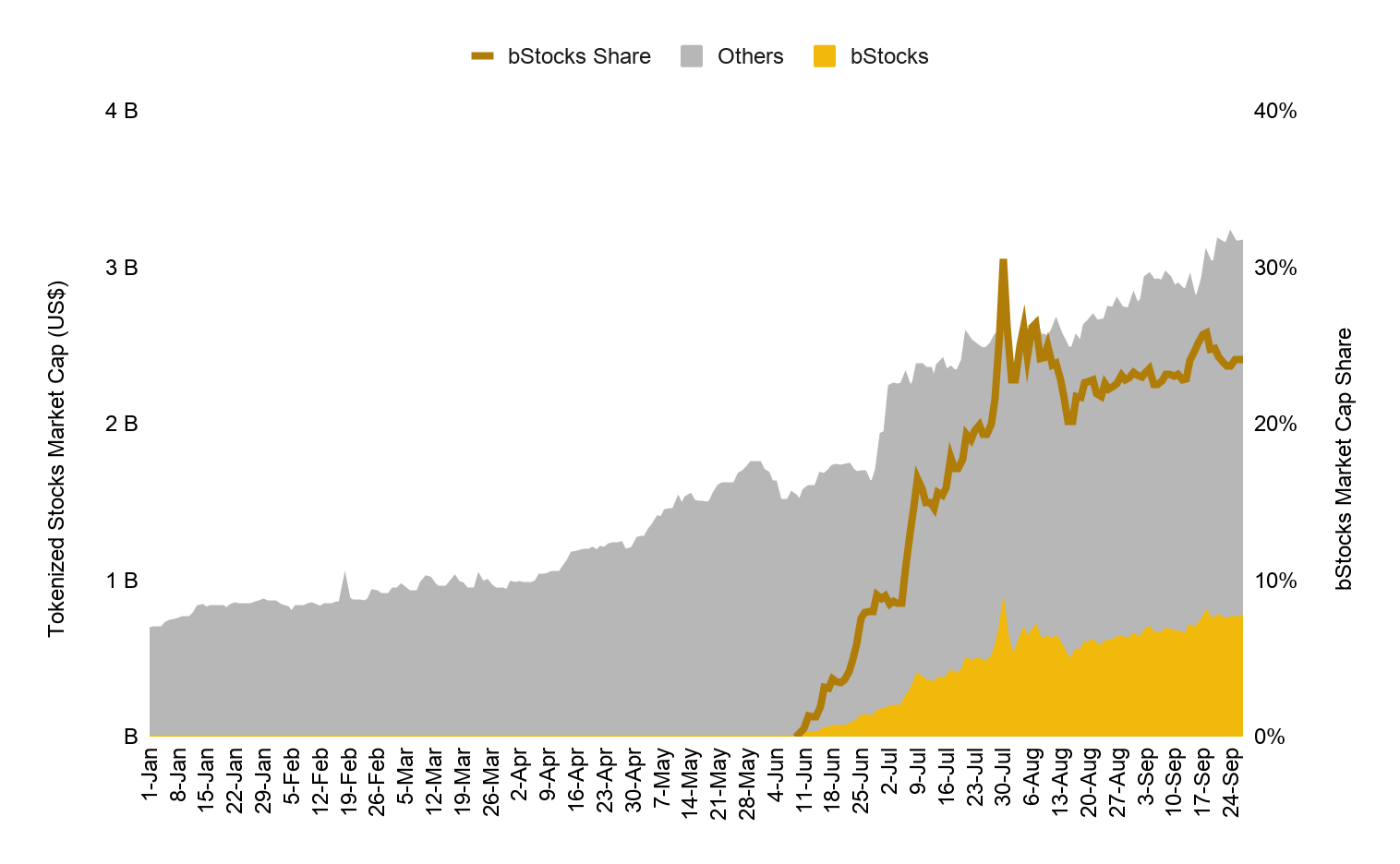
Figure 1: Tokenized equities market capitalization crossed US$3B, with bStocks capturing roughly a quarter since its June launch. Source: Binance Research, as of September 29 2026.
A note on terminology: Third-party dashboards often group equity-linked tokens, such as bStocks, under “tokenized stocks.” Please see our disclaimer below for further information.
Why Tokenized Equities are Growing
Tokenized equities have been the fastest-growing RWA category in 2026. Part of that momentum arrived in June, around the same time we launched bStocks.
bStocks reached around $800M in under four months, or roughly a quarter of the global tokenized equities category by market capitalization.
Category data also shows rising on-chain transfers, which is a useful signal that people are moving these assets around, and not just buying and holding them idly.
Why Binance Launched bStocks
bStocks was built for users who want equity-linked exposure that fits how they already use crypto. Traditional equities sit behind market hours and brokerage workflows. Tokenized instruments can be traded around the clock, including weekends, giving users the opportunity to respond to major events that play out after market close.
Beyond 24/7 trading, the other big distinction is portability. bStocks holders can move their exposure between the Binance exchange and their own wallet for self-custody. In a traditional brokerage account, moving holdings typically means transferring between brokers. On Binance, that portability is also paired with a 1:1 conversion mechanism, allowing users to convert between bStocks and stocks with no fees.
Where Activity is Concentrating
Tokenized equities are distributed across multiple chains, but in 2026, BNB Chain has become a key venue. As of this September, BNB Chain held around $1B in tokenized equities, about 34% of the market, according to Binance Research (as of Sep 28, 2026). BNB Chain also had about 1.8M tokenized equity holders, representing 45% of holders across the category.
Important clarification: BNB Chain is a community-driven blockchain ecosystem and is not a Binance product. Binance operates within the BNB Chain ecosystem.
From Holding to Real Utility
So what do people do with their tokenized equities once they’re on-chain? According to Binance Research, holders are increasingly deploying these assets across DeFi, including using them as collateral and pairing them in liquidity pools.
The 60-day rolling DeFi TVL ratio, which measures tokenized equity value deployed in DeFi relative to total active market capitalization, more than tripled from 1.8% to 6.3%. Put simply, this suggests a growing share of tokenized equities is being put to work instead of sitting idle.
This is where the “on-chain” part becomes tangible. Once an asset can be transferred, collateralized, and deployed across protocols, it starts to behave like a composable building block rather than a static position.
Final Thoughts
Tokenized equities passed $3B in 2026, but the more important signal is how they’re being used. Holder counts are rising, transfer activity has grown, and DeFi usage is climbing — all signs of real adoption, not just capital inflow. The result looks less like a separate crypto universe and more like a broader financial network, where different asset types can be held, moved, and used side by side. Within this shift, bStocks gives users tokenized security exposure on crypto rails, including the capability to trade 24/7 and move between the exchange and self-custody, on their own terms.
Further Reading
Introducing bStocks – Trade and Hold Tokenized 1:1 U.S. Stocks on Binance
Why Tokenized Securities? A Look at bStocks vs. Traditional Stocks
bStocks Is Scaling Faster Than Any Other Tokenized Stock Product
Disclaimer: bStocks tokenized securities are classified as Certificates representing certain Financial Instruments (paragraph 92, Schedule 1 to FSMR). bStocks are not stocks or shares and bStocks do not allow holders to directly own a share or stock in the underlying listed company. bStocks do not represent any affiliation with the underlying asset's issuer. bStocks are offered through an Approved Prospectus in the ADGM and are not offered in any other jurisdiction. No public offer is made outside of the ADGM. Tokenized securities are available only to eligible users in permitted jurisdictions on a secondary market basis only. It is your sole responsibility to ensure that accessing and trading tokenized securities is lawful in your jurisdiction before proceeding. Accessing this product from a jurisdiction in which it is prohibited or restricted does not create any liability or obligation on the part of Binance. We may restrict, suspend, reject, cancel, or unwind access or transactions if we determine, in our sole discretion, that your access or transaction may breach applicable law, product restrictions, eligibility criteria, sanctions requirements, or the relevant offering documents. Tokenized securities may be held and transferred on-chain outside the CSD environment.