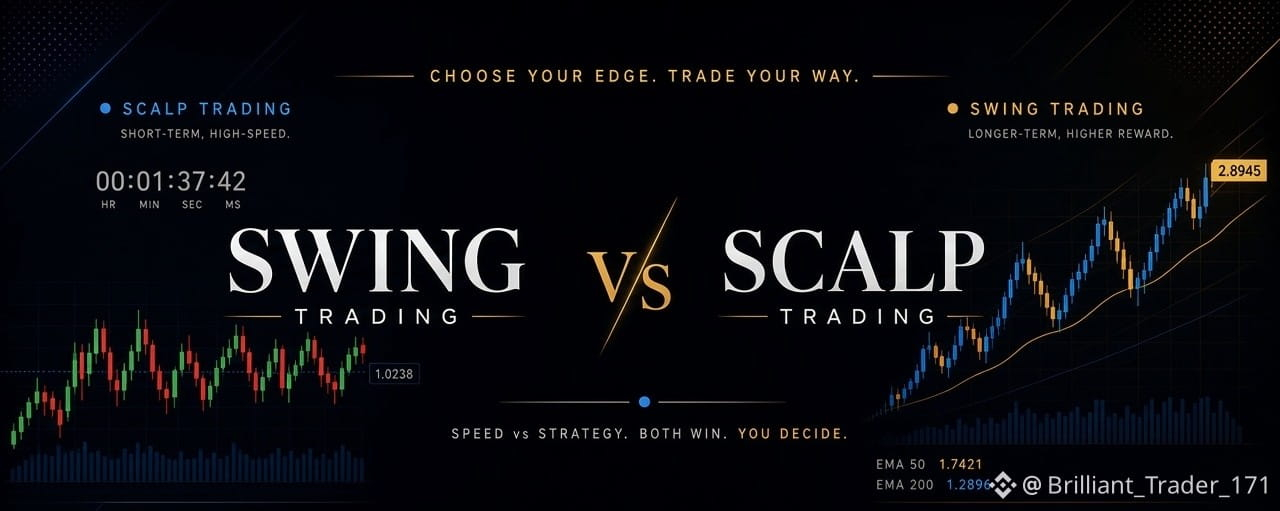

Most traders spend years chasing the “perfect” style. Some sit glued to charts all day. Others take positions and walk away. The difference between these two approaches is not just timeframes — it is the difference between constant stress and sustainable growth.
Let’s break it down clearly.
What is Scalp Trading?
Scalp trading means analyzing and executing trades on lower timeframes. Most positions are opened and closed within 1 to 4 hours. The goal is to capture small, frequent moves.
Typical characteristics:
Very tight stop-loss
Small targets (usually 5% to 15% maximum)
Multiple trades per day
Almost entirely technical
If you open a scalp trade in the morning, it is usually closed the same day. There is little room for larger moves.
What is Swing Trading?
Swing trading involves holding a position for several days to a week (sometimes longer). The focus is on capturing the “swing” of a bigger move.
Key traits:
Smaller stop-loss relative to the potential reward
Larger targets (20%–60%, occasionally 100% or more)
Combination of technical entry with fundamental thesis
Far fewer trades
Because the setup is built on stronger reasoning, swing traders can comfortably hold through daily noise.
And Then There Is Long-Term Trading
Long-term trading is essentially high-conviction investing. You buy solid projects in parts (DCA style), ignore short-term volatility, and hold for months. Targets start from 5x–10x and can reach 100x on the right gems. There is no traditional stop-loss mentality — only quality selection and patience.
Who Makes More Money? Who Is Safer?
Scalp traders usually take 1–3 trades per day. Even the disciplined ones end up with small daily gains. The moment one stop-loss hits, many start overtrading. That is where accounts get damaged. Consistent small wins are possible, but significant capital growth is rare.
Swing traders operate differently. Most of their setups are rooted in fundamentals. This raises the probability of hitting targets. Even if two or three trades stop out, one full target can recover previous losses and still leave the account in strong profit. Over a series of 10 trades, if 6–7 hit their targets, the overall equity curve looks very healthy.
Long-term holders sit at the top of the performance pyramid. By allocating capital gradually into quality projects and holding through full cycles, many turn their capital into 12x or more within a year. Some go well beyond 20x. The edge comes from selection and patience, not daily activity.
The Practical Verdict: Swing vs Scalp
If we focus only on active trading styles, swing trading is the clear winner for most people.
Why?
A swing trader does proper analysis, places the trade, sets alerts for take-profit and stop-loss, and then lives their life. There is no need to watch every 5-minute candle. Mental capital stays intact.
A scalper, on the other hand, spends the entire day in front of the screen waiting for the next setup, managing open positions, and fighting the constant emotional pull of the market. It is exhausting, and over time it destroys both focus and consistency.
I personally focus on swing trading combined with selective long-term accumulation in strong projects. This approach gives me both solid returns and freedom.
If you are still stuck in the cycle of staring at charts all day for small percentage moves, consider shifting toward higher-quality setups with better risk-reward and room to breathe.
Quality over quantity. Patience over hyperactivity. That is how real accounts grow.
Follow + Join Chatroom 🤍
Like + share + Join Chatroom Groups