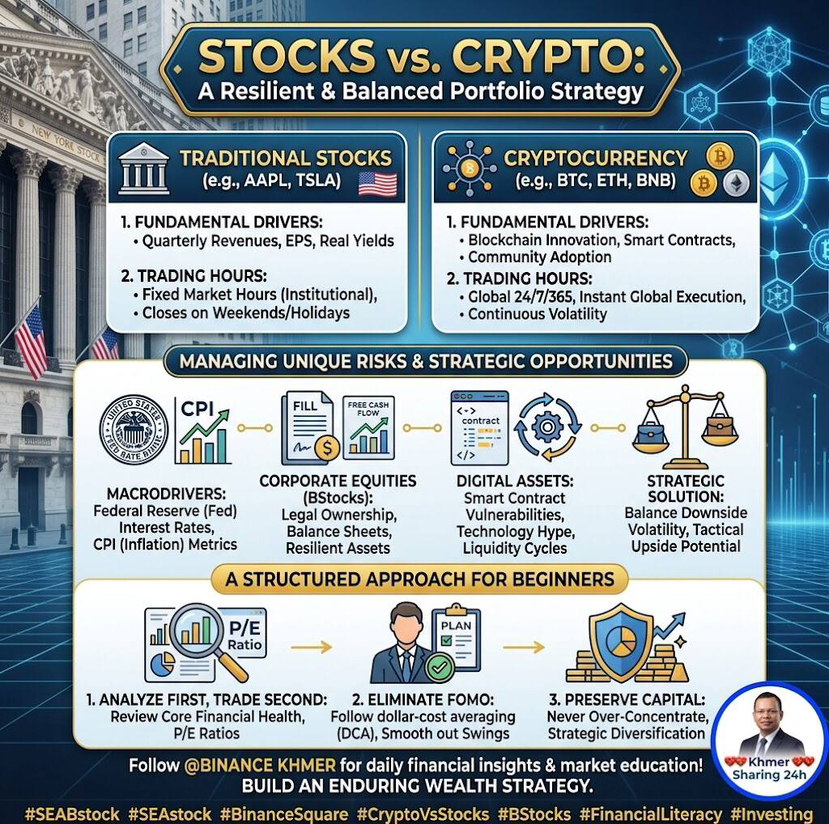

As global financial markets become increasingly interconnected, many investors find themselves navigating both traditional equities and decentralized cryptocurrencies. While both asset classes offer distinct growth avenues, they function under entirely different market architectures, risk profiles, and fundamental drivers.
Understanding these critical differences is essential for anyone looking to build a resilient and balanced portfolio.
1. Fundamental Drivers: Real Yield vs. Network Innovation
Traditional Stocks: Equity shares represent legal ownership in established corporations. Stock prices correlate directly with tangible financial data, including quarterly revenues, profit margins, balance sheets, and dividend payouts.
Cryptocurrency: Digital assets derive value from decentralized network security, smart contract utility, technological innovation, and broad community adoption.
2. Trading Hours and Liquidity Dynamics
Stock Market Structure: Equities trade within fixed institutional hours (typically 9:30 AM to 4:00 PM EST for major US exchanges) and close on weekends and public holidays. This structural schedule limits after-hours price slippage and allows market participants to process news calmly.
Crypto Market Structure: Digital asset exchanges operate 24/7/365 across global networks. While continuous trading allows instant global execution, it also exposes participants to non-stop market volatility and unexpected liquidity swings.
3. Managing Unique Risk Profiles
Systemic Regulatory & Macro Risks: Stocks are heavily influenced by corporate earnings releases, federal antitrust laws, and macroeconomic benchmarks set by the Federal Reserve (such as benchmark interest rates and CPI metrics).
Technological & Volatility Risks: Digital assets face challenges such as smart contract vulnerabilities, rapid market liquidity cycles, and evolving global regulatory policies.
The Strategic Solution: Prudent investors balance both worlds. Holding resilient corporate equities through vehicles like BStocks helps stabilize downside volatility, while tactical crypto exposure offers dynamic upside potential.
4. A Structured Approach for Beginners
1 Analyze First, Trade Second: Review core financial health indicators (P/E ratios, operational cash flows) before selecting individual equities.
2 Eliminate Emotional FOMO: Chasing sudden market momentum leads to poor entry prices. Implement automated dollar-cost averaging (DCA) to smooth out price swings.
3 Preserve Capital Through Diversification: Never over-concentrate your total capital into a single sector or single digital token.
Final Thoughts
Modern investing is not about choosing between equities and blockchain technology—it is about leveraging the strengths of both to construct an enduring wealth strategy. Expand your knowledge base, follow proper risk management protocols, and trade with confidence!
Follow @Binance Khmer for daily financial insights and market education!
@Binance Square Official @Binance Khmer #SEABstock #SEAstock