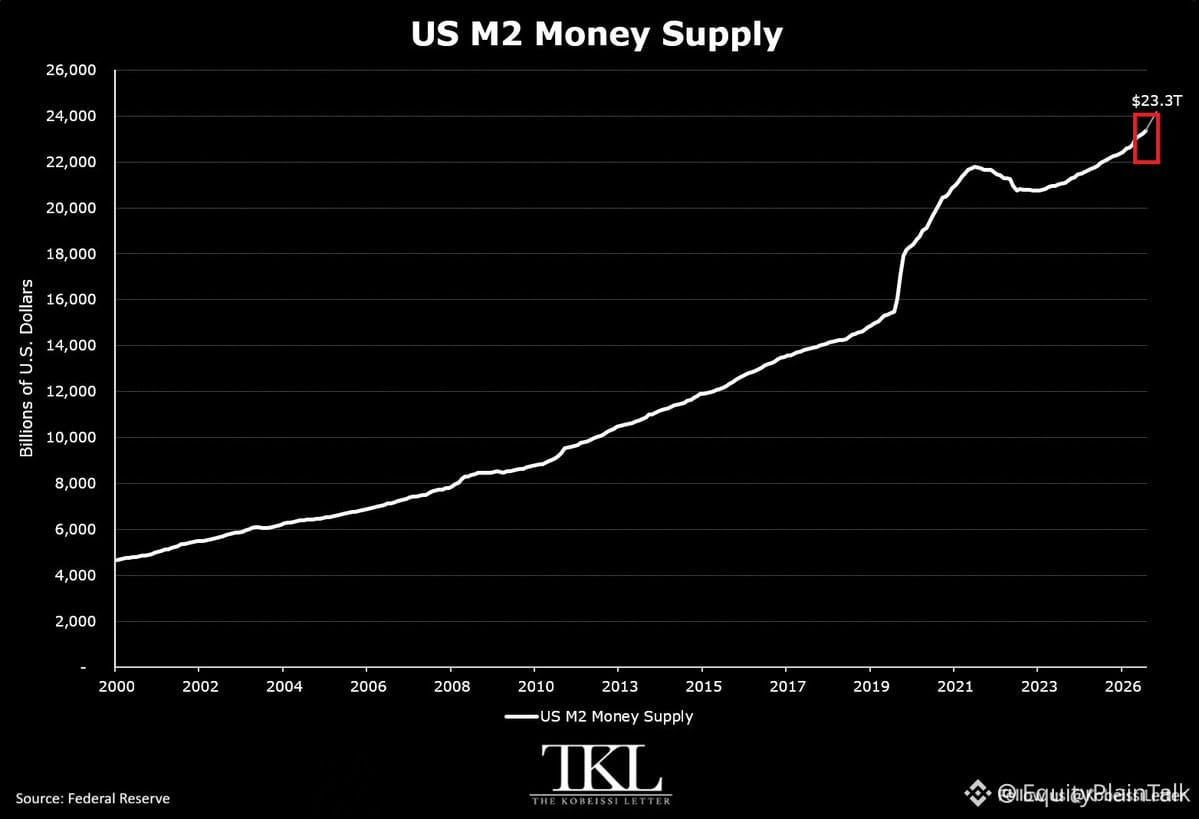
U.S. money supply just jumped $124.9 billion in August—now sitting at a record $23.34 trillion.
That's 28 straight months of increases, adding up to $2.61 trillion total.
Year-over-year growth hit 5.7%, the fastest pace since June 2022. Compare that to just 2.0% growth we saw in August 2024—this is a serious acceleration.
Since the pandemic started in 2020, M2 has ballooned by $7.85 trillion. That's an average of $1.21 trillion per year, or about 6.5% annualized.
Money creation is clearly speeding up again. More dollars chasing the same assets usually means one thing: upward pressure on prices, whether that's stocks, real estate, or everyday goods.
If you're wondering why markets feel frothy or why your dollar doesn't stretch as far, this is part of the answer. Liquidity is flooding back in, and it's showing up in asset valuations and inflation expectations.
Keep an eye on how this plays out in equity multiples and sector rotation over the next few quarters.
That's 28 straight months of increases, adding up to $2.61 trillion total.
Year-over-year growth hit 5.7%, the fastest pace since June 2022. Compare that to just 2.0% growth we saw in August 2024—this is a serious acceleration.
Since the pandemic started in 2020, M2 has ballooned by $7.85 trillion. That's an average of $1.21 trillion per year, or about 6.5% annualized.
Money creation is clearly speeding up again. More dollars chasing the same assets usually means one thing: upward pressure on prices, whether that's stocks, real estate, or everyday goods.
If you're wondering why markets feel frothy or why your dollar doesn't stretch as far, this is part of the answer. Liquidity is flooding back in, and it's showing up in asset valuations and inflation expectations.
Keep an eye on how this plays out in equity multiples and sector rotation over the next few quarters.