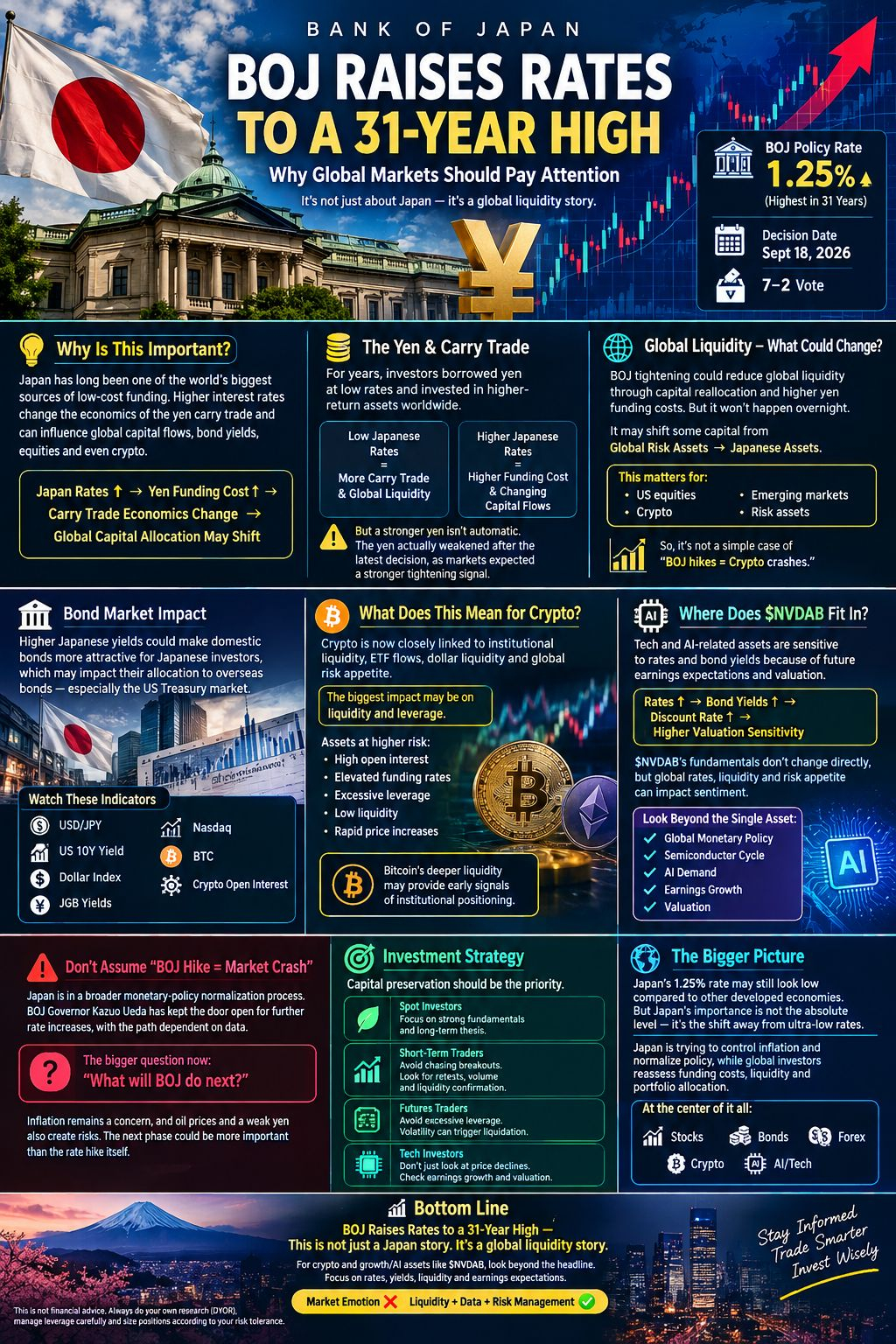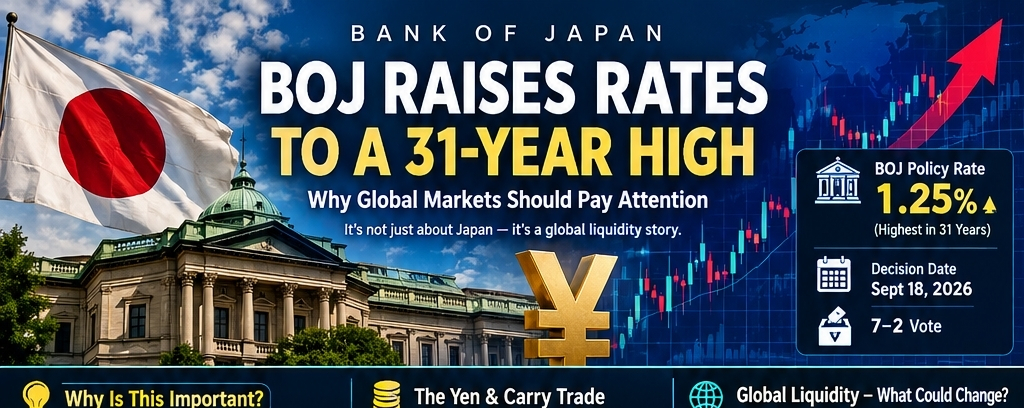

The Bank of Japan (BOJ) has raised its policy rate again, taking it to 1.25%, the highest level in roughly 31 years. The decision marks another important step away from Japan’s long-standing ultra-loose monetary policy and puts global markets on alert.
At first glance, this may look like a Japan-only monetary policy story.
It isn’t.
For years, Japan has been one of the world’s major sources of low-cost funding. As Japanese interest rates move higher, the economics of global capital allocation, currency markets, bonds, equities and even crypto can gradually change.
And that is where the real investment story begins.
💴 Why Is the BOJ Rate Hike So Important?
Japan spent decades operating with extremely low interest rates. That environment encouraged investors to borrow yen at relatively low costs and deploy that capital into higher-returning assets around the world.
This strategy is commonly associated with the yen carry trade.
Now, as Japanese interest rates rise, the cost of yen-based funding changes.
In simple terms:
Japan Rates ↑ → Yen Funding Cost ↑ → Carry Trade Economics Change → Global Capital Allocation May Shift
The important point, however, is that “rate hike = stronger yen” is not always an immediate or automatic relationship.
Following the latest decision, the yen initially weakened because some investors had expected stronger tightening guidance. Two BOJ policymakers also opposed the rate increase.
That means investors need to watch the BOJ’s communication—not just the headline rate.
📉 What Could This Mean for Global Liquidity?
The bigger question is:
Could BOJ tightening reduce global liquidity?
Potentially—but the impact would likely develop through capital allocation rather than happen overnight.
As Japanese domestic yields become more attractive, some Japanese capital could potentially remain at home rather than seeking returns overseas.
At the same time, higher yen funding costs could change the risk-reward calculation for international investors using yen-based financing.
That could influence capital flows toward:
Global Risk Assets → Japanese Assets
if the relative return advantage changes sufficiently.
For markets such as US equities, emerging markets and crypto, this matters because they are highly sensitive to global liquidity and investor risk appetite.
But it would be too simplistic to assume:
BOJ hikes → Crypto crashes.
Markets are influenced by multiple variables at the same time:
Federal Reserve policy
US Treasury yields
Dollar strength
Yen movement
Global liquidity
Oil prices
Institutional risk appetite
Crypto leverage and open interest
That is why BOJ should increasingly be viewed as a global liquidity variable, not simply a Japan-specific event.
🏦 The Bond Market Is Another Key Area to Watch
BOJ tightening also matters for the Japanese Government Bond (JGB) market.
If Japanese yields continue rising, Japanese investors may find domestic fixed-income assets relatively more attractive.
That could influence how much capital Japanese investors allocate to overseas bonds.
The US Treasury market is particularly important because Japanese investors have historically been significant participants in global fixed-income markets.
For that reason, I would watch several indicators together over the coming weeks:
🇯🇵 USD/JPY
🇺🇸 US 10Y Yield
💵 Dollar Index
🇯🇵 JGB Yields
📈 Nasdaq
₿ $BTC
📊 Crypto Open Interest
Looking at these indicators together can provide a much clearer picture of whether the BOJ decision is actually changing global liquidity conditions.
₿ What Does This Mean for Crypto?
Crypto is no longer an isolated market.
Bitcoin, Ethereum and major crypto assets have become increasingly connected to institutional liquidity, ETF flows, dollar liquidity and broader global risk appetite.
That makes the most important potential impact of BOJ tightening the effect on liquidity and leverage.
If global investors become more defensive, high-beta crypto assets could experience greater volatility.
The assets most exposed may be those with:
High open interest
Elevated funding rates
Excessive leverage
Low liquidity
Rapidly rising prices
These conditions can increase the risk of sudden liquidation cascades.
Bitcoin, because of its deeper liquidity, may also provide an important signal of how institutional capital is reacting.
So I would not treat a green candle as automatically bullish—or a red candle as automatically bearish—after a BOJ decision.
The key is confirmation.
🤖 Where Does an Asset Like $NVDAB Fit In?
This is where the macro connection becomes particularly interesting.
Technology and AI-related assets are heavily influenced by future earnings expectations and valuation.
When interest rates and bond yields rise, the discount rate applied to future cash flows can also increase.
In simplified terms:
Rates ↑
→ Bond Yield Pressure ↑
→ Discount Rate ↑
→ High-Valuation Growth Stocks Become More Rate-Sensitive
This does not mean the BOJ rate hike directly changes the fundamentals of $NVDAB.
Instead, the potential impact comes through global interest rates, bond yields, liquidity and investor risk appetite.
That means an asset such as $NVDAB should not be analyzed solely through its company-specific narrative.
Investors should also consider:
Global Monetary Policy + Semiconductor Cycle + AI Demand + Earnings Growth + Valuation
That broader framework can provide a more complete picture.
⚠️ The Biggest Mistake Would Be Assuming “BOJ Hike = Market Crash”
I would not view the situation that simply.
The BOJ has moved its policy rate to 1.25%, but Japan remains in a broader monetary-policy normalization process.
BOJ Governor Kazuo Ueda has kept the possibility of further rate increases open, while the future path remains dependent on incoming economic and inflation data.
That makes the next phase especially important.
The key question is no longer simply:
“Did BOJ raise rates?”
The bigger question is:
“What will BOJ do next?”
That answer could have a much greater influence on markets.
🔍 My Market Watchlist
From an investment perspective, I would focus on several key indicators following this BOJ decision.
1️⃣ USD/JPY
Is the yen actually strengthening following the rate hike?
If the yen remains weak despite higher Japanese rates, investors may start questioning how effectively monetary tightening is influencing currency expectations.
2️⃣ US 10-Year Treasury Yield
A sharp rise in Treasury yields could put additional pressure on growth stocks and crypto valuations.
3️⃣ Bitcoin Liquidity
BTC price alone is not enough.
Volume, open interest, funding rates and liquidation data can provide a much better picture of market positioning.
4️⃣ Nasdaq and AI Stocks
These markets can help show whether changing global rates are creating pressure on high-growth technology valuations.
5️⃣ Yen Carry Trade
The relationship between Japanese funding costs and global risk assets could become increasingly important as Japan continues moving away from its ultra-loose policy framework.
💡 Investment Perspective: What Should Investors Focus On?
During major macro events, capital preservation should remain a priority.
A single rate hike does not necessarily mean investors need to completely reposition their portfolios.
Instead:
For Spot Investors
Focus on assets with stronger fundamentals and a clear long-term thesis rather than chasing short-term volatility.
For Short-Term Traders
Avoid blindly entering breakouts immediately after major macro announcements.
Retests, volume and liquidity confirmation can provide a more disciplined approach.
For Futures Traders
Macro events such as BOJ decisions can create sudden volatility.
Excessive leverage can turn a correct market direction into a losing trade if the position is liquidated before the market moves as expected.
For Tech Investors
A falling price does not automatically mean an asset has become cheap.
Valuation should be considered alongside earnings growth, future demand and broader interest-rate conditions.
🌏 The Bigger Picture Is More Important
Japan’s 1.25% policy rate may still look relatively low compared with rates in some other developed economies.
But the importance of Japan is not simply the absolute level of its interest rate.
Japan has historically been one of the world’s major sources of low-cost funding.
That system is gradually changing.
As a result, every major BOJ policy decision could become increasingly important for global investors.
Japan is trying to manage inflation and normalize monetary policy.
At the same time, global investors are reassessing funding costs, liquidity and portfolio allocations.
And in the middle of all of this are:
Stocks + Bonds + Forex + Crypto + AI/Tech
🧠 Bottom Line
BOJ Raises Rates to a 31-Year High — this is not just a Japan story. It is a global liquidity story.
The move to a 1.25% policy rate represents an important milestone in Japan’s monetary-policy normalization.
But for global markets, the rate hike itself may not be the most important factor.
The bigger signals could come from:
BOJ guidance + Yen Direction + Bond Yields + Global Capital Flows
For crypto investors, the message is simple:
Macro cannot be ignored anymore.
And for growth or AI-related assets such as NVDAB, investors should look beyond the individual asset and consider the broader environment of:
Rates + Yields + Liquidity + Earnings Expectations
Rather than trying to predict the market from one headline, a confirmation-based approach may be more useful.
Because volatility itself is neither bullish nor bearish.
Market Emotion ❌
Liquidity + Data + Risk Management ✅

#BOJRaisesRatesTo31YearHigh #BuffettStepsDownAsBerkshireChairman #NVDAB #NVDAB #BABAB #bSto #BTC