

Gold had every reason to rally last week. The war with Iran widened, oil climbed toward $108 a barrel, and inflation picked up pace. Instead, the metal dropped to its lowest level in more than a month. The explanation has less to do with gold itself than with interest rates: pricier oil stoked inflation fears, those fears pushed up the odds of another Fed hike, and gold owners got caught in a rate scare that had nothing to do with the metal's usual safe haven appeal.
A Five-Week Slide
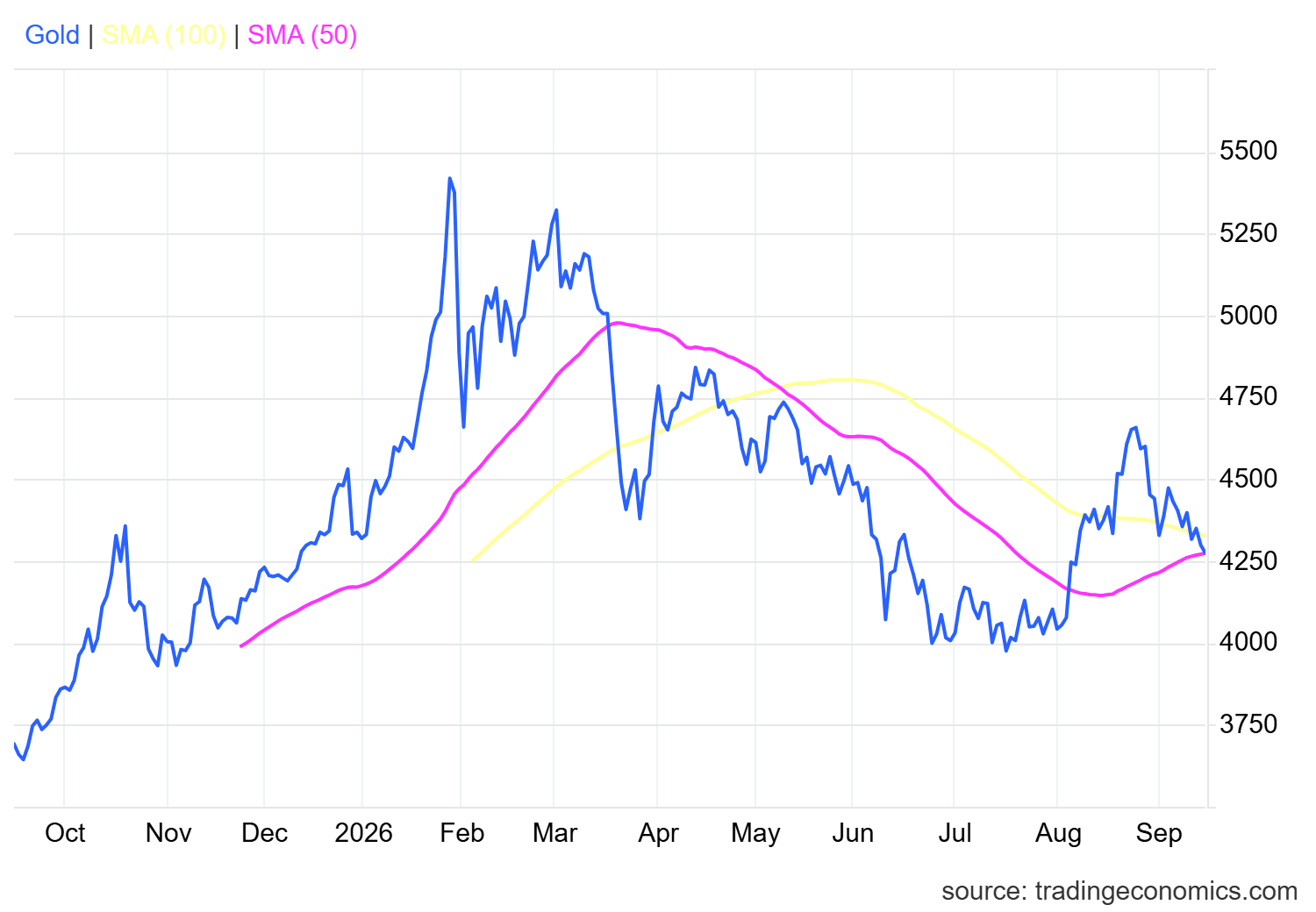
Gold changed hands around $4,300 an ounce on Tuesday, hovering near five-week lows and giving back a chunk of its summer run. The pattern is textbook correction after a sharp rally. The metal gained 7.45% in the week of Aug. 2 and another 5.19% the week after, peaking at 4,697.66 on Aug. 23. From there, the trend reversed. Four straight weekly declines of 3.22%, 0.56%, 1.84% and 1.29% pulled gold down to 4,292.83 by Sep. 13, roughly 8.6% below its August high.
Oil, Pipelines, and Rate Bets
Crude kept climbing for reasons that had nothing to do with gold directly. Saudi Arabia's East-West pipeline stayed shut, and Ukraine disputed President Trump's claim that it had already reached an agreement with Russia to halt attacks on energy infrastructure. A shock of that size to energy markets makes rate cuts harder to justify almost by definition, and the sudden escalation of the conflict has pushed crude back above $100 a barrel.
US inflation has now run above the Fed's 2% target for more than 65 months, and that streak is doing a lot of the work behind markets' near certainty about a hike. The repricing didn't start with Friday's data. Fed Governor Christopher Waller, a permanent voter on the committee and one of its more dovish members, told Reuters NEXT on September 3 that he could support holding rates steady if August's figures confirmed disinflation was still intact. But he left himself an out:
"It may be appropriate to raise the policy rate" this week, Waller said, if the incoming data showed that improvement had proven fleeting.
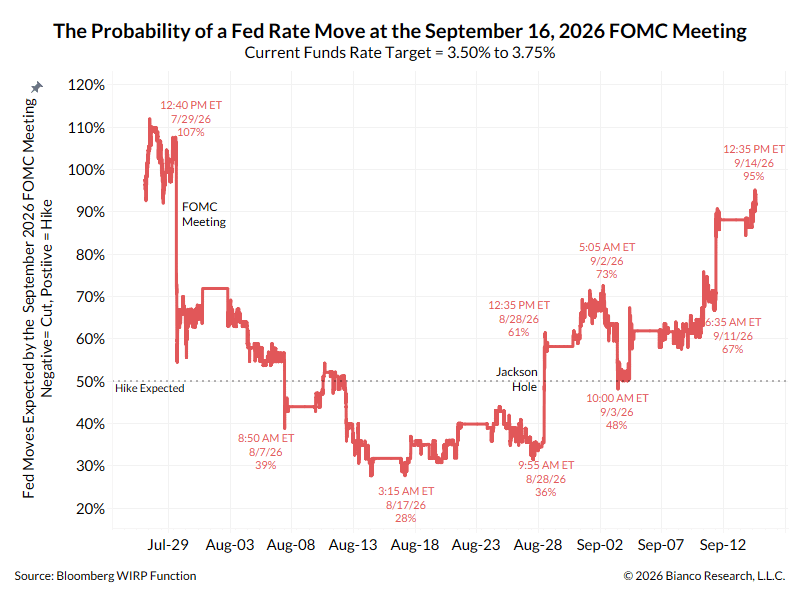
Rising energy costs feed inflation, and inflation feeds pressure on the Fed to tighten. Markets are now pricing roughly a 92% probability of a 25-basis-point hike on Wednesday, with one more hike priced in by year-end. For gold, the math is simple: higher rates make an asset that pays no yield less attractive to hold.
Warsh had set that tone weeks earlier. In an August 28 speech at the Kansas City Fed's Jackson Hole symposium, his first as chair, he said this summer's inflation readings, while better than feared, hadn't convinced him that underlying price pressures had meaningfully improved. The Fed, he said, still had work to do.
At this point, a hold looks almost unthinkable. Standing pat would likely reignite the kind of Treasury selloff that followed the July 29 meeting, when long-dated yields spiked, and Treasury Secretary Scott Bessent had to step in with a surprise buyback plan just to calm the market down.
Buybacks like that tend to reinforce what traders call the debasement trade, shifting pressure away from the bond market and onto the dollar instead. When the government repurchases long-term Treasuries and replaces them with shorter-term debt, it suppresses longer-dated yields, a softer version of the old Operation Twist playbook. If investors read that as financial repression against a backdrop of already elevated federal debt, confidence in the dollar's long-term purchasing power can erode, pushing flows toward hard assets like gold, silver and bitcoin.
The Bull Case for Gold
Robin Brooks, an economist at the Brookings Institution, makes a version of the same case. He argues gold's outlook stays bullish even after Warsh's hawkish turn. If what's forming is effectively a Treasury-Fed accord to cap long-term yields, that also caps the upside on real interest rates, and real rates are the primary cost of holding something that pays no yield, like gold. As US debt keeps rising, he says, those de facto yield caps add fuel to the debasement trade instead of putting it out.
"Out-of-control debt is driving everything these days, and it'll drive gold higher," Brooks wrote.
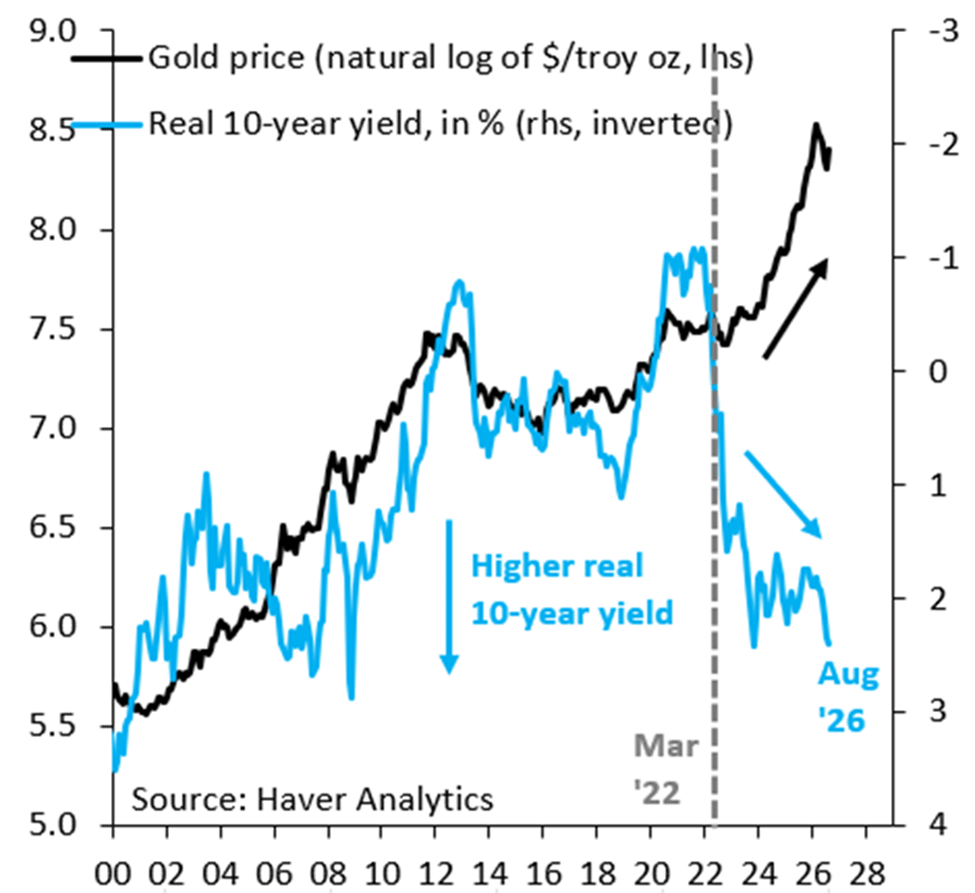
Goldman Sachs is forecasting further gains for gold, even as growing use of derivatives tied to the metal may be adding to its volatility, according to Lina Thomas, senior commodities analyst at Goldman Sachs Research, and Daan Struyven, the firm's co-head of Global Commodities Research. The bank's year-end target sits at $4,900 per troy ounce, up from around $4,300 as of September 10.
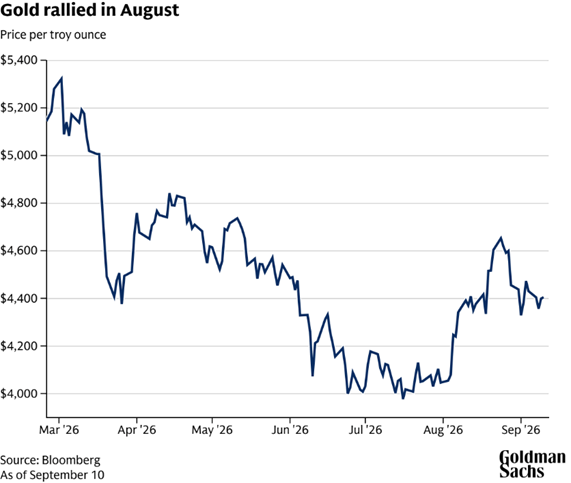
A few forces are doing the heavy lifting behind that call:
Central banks have stepped up gold purchases since 2022, when G7 countries froze Russian central bank assets in Europe in response to the invasion of Ukraine. Goldman Sachs Research expects central bank buying to average 50 tonnes a month in 2026, up from 17 tonnes a month before 2022.
Demand for gold call options is climbing too, as investors hedge against large-scale policy shifts. Rising prices can prompt option holders to buy more gold while forcing dealers to buy gold of their own to hedge short exposure, which accelerates the rally. The same mechanism runs in reverse: falling prices can push dealers to unwind those hedges, driving prices lower still. That dynamic raises the odds gold overshoots Goldman's forecast, but it also points to "greater two-sided volatility" in the rally, Thomas and Struyven write.
Potential Fed hikes pose some downside risk, but Goldman sees the balance of risks to its 2026 forecast tilted to the upside on net. "Gold's share in private portfolios remains low, and recent geopolitical developments—including Iran and broader tensions—may accelerate diversification beyond central banks to private investors, including by weighing on perceptions of Western fiscal sustainability," Thomas and Struyven write.
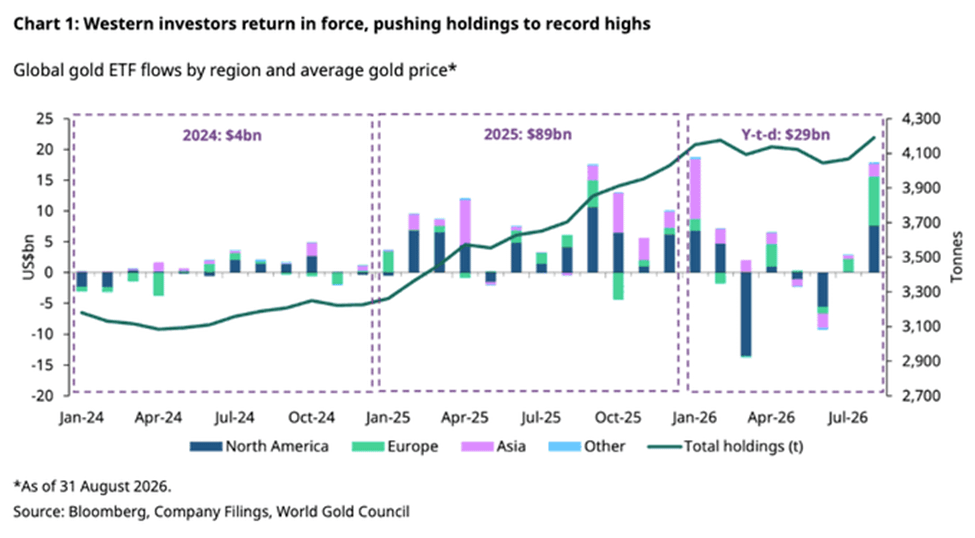
Global gold-backed ETFs pulled in US$18 billion in August, the second largest monthly inflow in value terms on record. Collective holdings climbed by 121 tonnes to 4,189 tonnes, also a record high.
The Debasement Trade, Still Running
That's the crux of the debasement trade. Governments have every incentive to keep yields from rising too far, since higher borrowing costs make already stretched debt loads even harder to carry. Buybacks, direct purchases, yield-control measures- all of it treats the symptom. None of it touches the underlying fiscal problem.
That's also why shorting government bonds directly has become a messier trade to run. The cleaner expression may sit in currencies and precious metals instead: weaker currencies as governments try to manage growth and debt at the same time, and gold alongside its peers as stores of value in a world where policymakers keep leaning on the scale to hold down the natural rise in yields. The multiyear bond selloff still has room to run. If anything, government intervention keeps strengthening the case for the debasement trade rather than weakening it.