What if data only had to be verified once?
Today, the same piece of information can be checked over and over again.
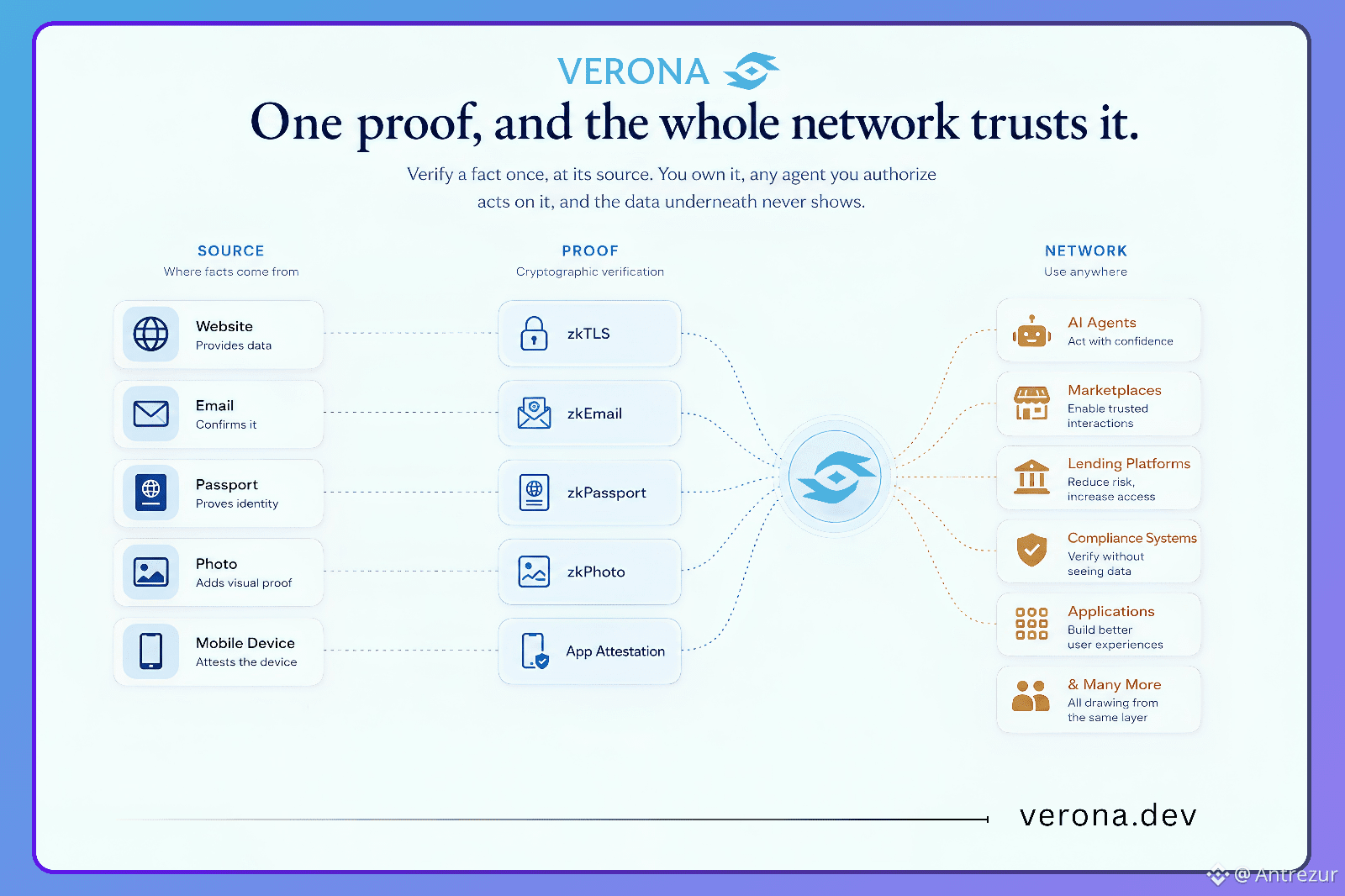
A website provides the data.
An email confirms it.
A passport proves identity.
A mobile device provides another layer of attestation.
But verification often stops at the application that performed it.
$Verona takes a different approach.
Instead of treating every verification as a one-time result, it turns the result into a cryptographic proof that can be reused across the network.
Data can be verified at its source through technologies such as zkTLS, zkEmail, zkPassport, zkPhoto, and App Attestation.
The important part is what happens next.
The underlying data does not need to be exposed. What travels through the network is the proof that a particular fact has been verified.
That proof can then be used by AI agents, marketplaces, lending platforms, compliance systems, applications, and other consumers of trusted information.
Verify once. Prove it. Reuse it.
This creates something bigger than a verification system.
It creates a shared layer of trust where different applications do not need to start from zero every time they need to know whether something is true.
And as AI agents become more capable of acting on behalf of users, having access to information that is not only available, but verifiable and private, becomes increasingly important.
One proof, and the whole network can trust it.
#CryptoAi
Today, the same piece of information can be checked over and over again.
A website provides the data.
An email confirms it.
A passport proves identity.
A mobile device provides another layer of attestation.
But verification often stops at the application that performed it.
$Verona takes a different approach.
Instead of treating every verification as a one-time result, it turns the result into a cryptographic proof that can be reused across the network.
Data can be verified at its source through technologies such as zkTLS, zkEmail, zkPassport, zkPhoto, and App Attestation.
The important part is what happens next.
The underlying data does not need to be exposed. What travels through the network is the proof that a particular fact has been verified.
That proof can then be used by AI agents, marketplaces, lending platforms, compliance systems, applications, and other consumers of trusted information.
Verify once. Prove it. Reuse it.
This creates something bigger than a verification system.
It creates a shared layer of trust where different applications do not need to start from zero every time they need to know whether something is true.
And as AI agents become more capable of acting on behalf of users, having access to information that is not only available, but verifiable and private, becomes increasingly important.
One proof, and the whole network can trust it.
#CryptoAi