
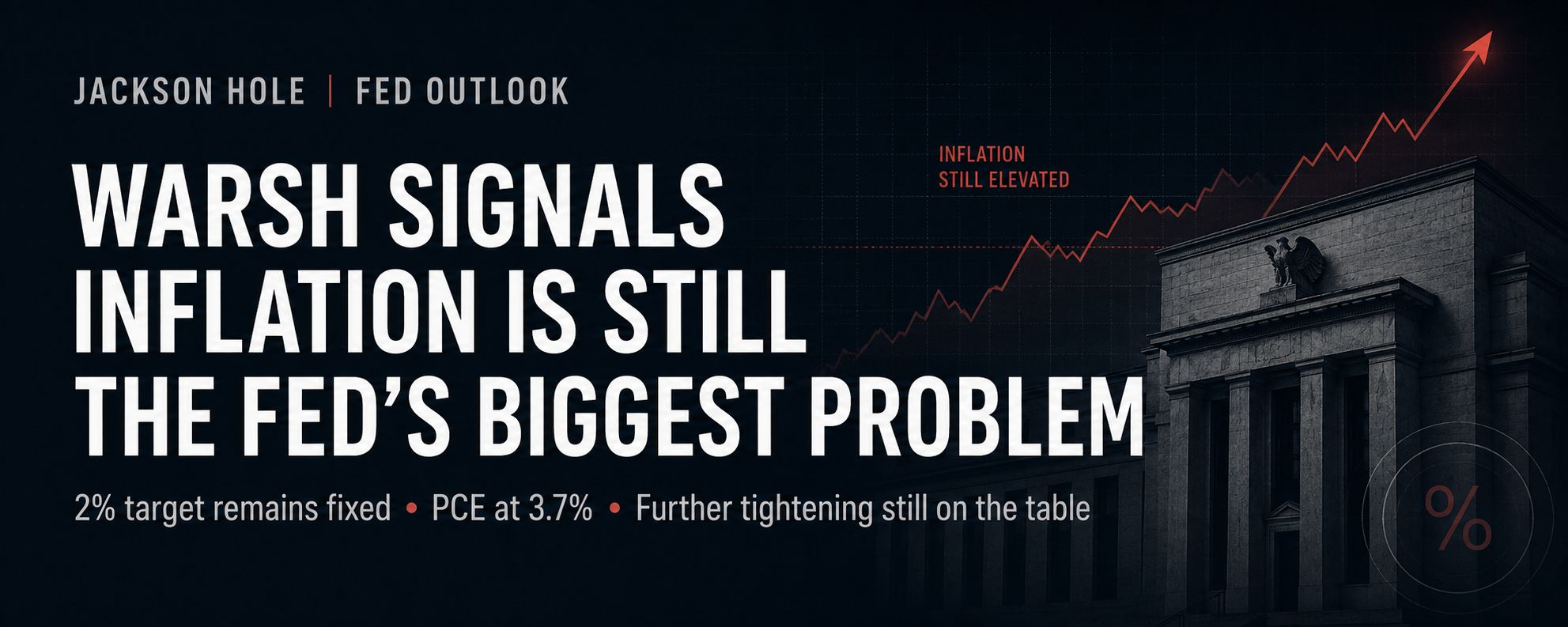


Federal Reserve Chair Kevin Warsh delivered a clear warning at Jackson Hole: the battle against inflation is not finished, and the Fed is not ready to declare victory.
While recent inflation data has shown some improvement, Warsh argued that the underlying picture remains uncomfortable. His message to markets was straightforward inflation is still too high, the U.S. economy remains strong, and further monetary tightening cannot be ruled out.
At the center of his speech was the Federal Reserve’s 2% inflation target, which Warsh described as “firm and fixed.”
According to the figures highlighted in his remarks, PCE inflation remains around 3.7% over the past year. More importantly, roughly 54% of goods and services within the PCE basket are still experiencing price increases above 3%.
That suggests inflationary pressure remains broad rather than being limited to a handful of categories.
Warsh acknowledged that recent inflation readings have been more encouraging, but said they have not yet convinced him that the underlying trend has changed meaningfully.
For the Fed, a few better data points are not enough. Policymakers want to see clear and sustained evidence that inflation is moving quickly back toward the 2% target.
A Strong Economy Gives the Fed Room to Stay Hawkish
One of the most important parts of Warsh’s message was his assessment of the broader economy.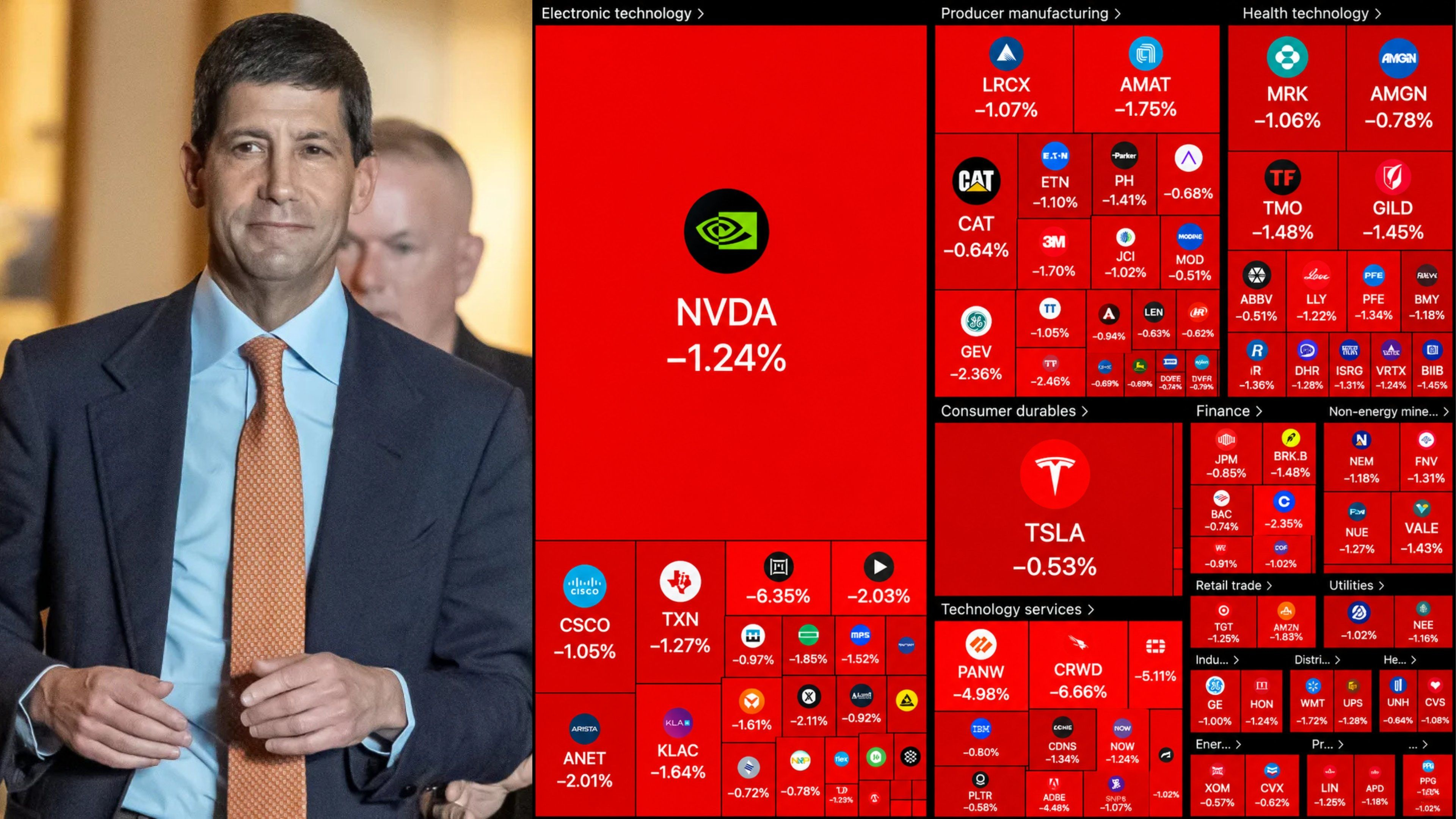
Despite elevated interest rates, the U.S. economy continues to show resilience. The labor market remains close to full employment, consumer activity is holding up, and corporate profitability remains strong.
Warsh noted that S&P 500 profits have increased by more than 20% over the past year.
He also argued that financial conditions are difficult to describe as restrictive, despite the level of policy rates.
That matters because if higher interest rates are not significantly slowing economic activity or financial markets, the Fed may have less reason to rush toward rate cuts.
Instead, policymakers could decide that restrictive policy needs to remain in place for longer or potentially become even tighter if inflation fails to improve.
AI Investment Is Becoming a Major Economic Force
Warsh also focused heavily on artificial intelligence and its growing influence on the U.S. economy.
More than half of this year’s growth in business investment is reportedly connected to the AI buildout, highlighting how rapidly companies are spending on data centers, chips, infrastructure, and related technologies.
Warsh described AI as a potential “hinge point” for economic growth.
However, he remained cautious about assuming that massive AI investment will immediately translate into equally large productivity gains.
The technology could eventually increase productivity, lower costs, and expand economic capacity, but the timing and scale of those benefits remain uncertain.
For monetary policymakers, that creates another complicated variable.
AI could support stronger long-term economic growth, but heavy investment spending could also contribute to stronger demand in the near term.
Warsh Warns Markets Against Becoming Too Comfortable
Another notable warning concerned inflation expectations.
Warsh suggested that expectations can appear stable for long periods until suddenly they are not.
If businesses and consumers begin expecting permanently higher inflation, those expectations can influence wages, pricing decisions, and spending behavior, making inflation harder for the Fed to control.
That is one reason Warsh appears unwilling to relax policy too early.
He also delivered unusually direct criticism of the Federal Reserve itself, saying the institution bears responsibility for 65 months of elevated inflation.
The comment reinforces his view that restoring price stability is not simply another policy objective it is central to rebuilding the Fed’s credibility.
Markets Should Stop Looking to the Fed for the “Next Trade”
Warsh also signaled that he wants changes in how the Federal Reserve communicates with financial markets.
He argued for less forward guidance and suggested that traders should stop relying on the Fed to provide clues for their “next trade.”
For years, markets have closely analyzed nearly every Fed speech and policy statement for indications of where interest rates are heading.
Warsh appears to prefer a framework where policy decisions remain more dependent on incoming economic data rather than being heavily pre-committed through guidance.
He also emphasized that traditional interest-rate policy should remain the Fed’s primary tool.
Extraordinary measures should, in his view, be reserved for genuine financial crises rather than becoming a routine part of monetary policy.
What Does This Mean for September?
Despite the hawkish tone, Warsh did not explicitly commit to a September rate hike.
That distinction is important.
His speech was not a direct announcement that higher rates are coming. Instead, it was a warning that markets should not assume the Fed is finished tightening simply because recent inflation data has improved.
The Fed still wants convincing evidence that inflation is moving sustainably and rapidly toward 2%.
Warsh summarized the situation clearly: if that progress does not appear, “we have work to do.”
For markets, the message is difficult to interpret as dovish.
The economy remains resilient, employment remains strong, financial conditions remain relatively supportive, and inflation continues to run above target.
That combination gives the Federal Reserve room to maintain restrictive monetary policy.
The immediate question is therefore not simply whether the Fed will hike rates in September.
The bigger question is whether incoming inflation and employment data will give policymakers enough confidence to step back or force them to tighten policy further.
For investors across stocks, bonds, gold, and crypto, that means volatility around upcoming inflation reports and Federal Reserve meetings could remain elevated.
The Jackson Hole message was clear: the 2% target remains non-negotiable, inflation remains the priority, and the Federal Reserve is not ready to declare the fight over.