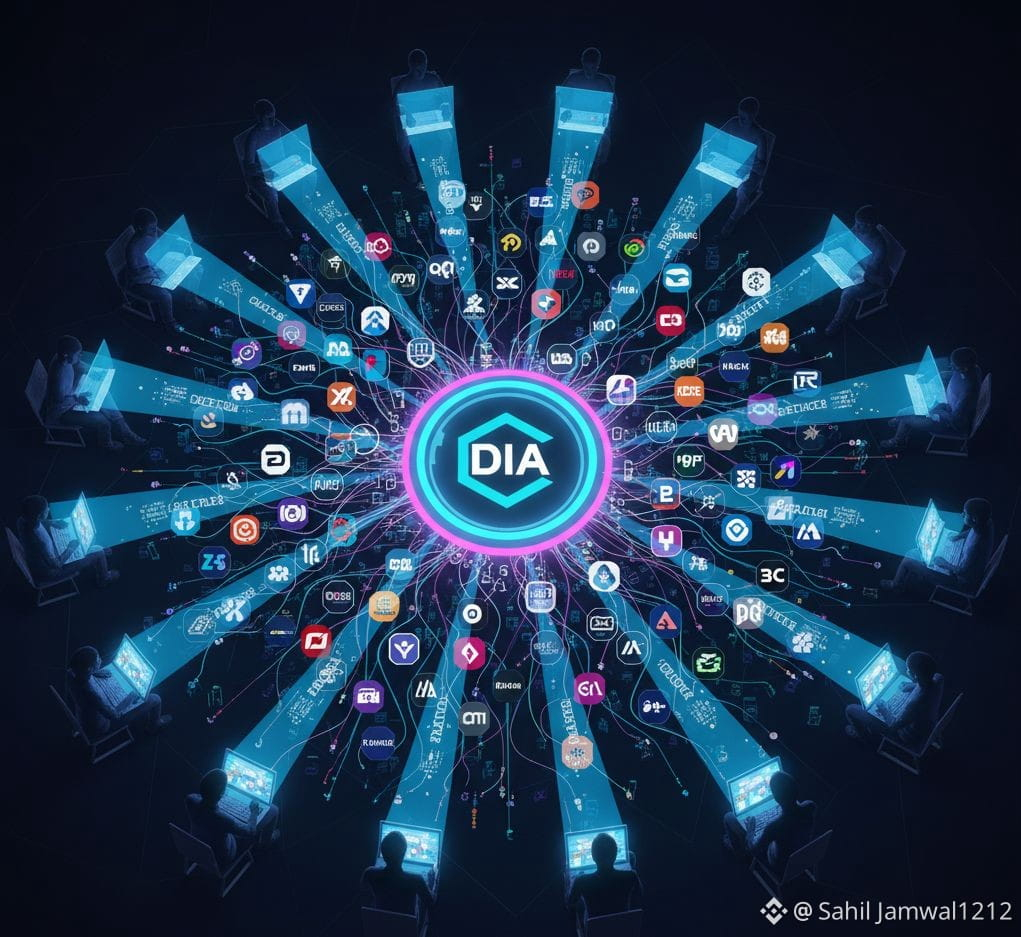
DIA's Oracle Grants Program removes oracle cost barriers for dApps by using staking rewards to fund oracle gas updates. Each participating chain has a dedicated vault that earns rewards from DIA staking activity, which then covers the cost of on-chain oracle updates for builders deploying on that chain.
In practical terms: a protocol building on a supported chain can access DIA price feeds for up to one year without paying directly for oracle infrastructure. The cost is borne by DIA stakers through their yield.
The circular loop
The model creates a dependency chain worth mapping out:
DIA stakers lock tokens on Lasernet → earn staking yield A portion of yield flows into per-chain grant vaults Vaults fund gas for oracle price updates on those chains Builders on those chains access oracle feeds at no direct cost Cheaper integration lowers the barrier to adoption More builders adopt DIA, expanding its on-chain footprint in 2025 alone, 36 new dApps integrated DIA and 19 new blockchains deployed its oracle stack $DIA
Broader adoption creates more demand context for staking
Current scale
The honest question
Free-then-paid models are common in SaaS. The risk is identical here: adoption during the grant period may not translate to paid retention after it ends. Whether the protocols that onboard via grants continue using DIA infrastructure — and on what terms — is a legitimate open question that will determine whether the circular model actually compounds or simply delays churn.
That said, the mechanism itself is structurally interesting: staking yield becoming a builder subsidy is a less common design choice than direct protocol fees, and worth understanding regardless of how it plays out.
Not financial advice. All data sourced from publicly available information. DYOR before making any investment decisions.
In practical terms: a protocol building on a supported chain can access DIA price feeds for up to one year without paying directly for oracle infrastructure. The cost is borne by DIA stakers through their yield.
The circular loop
The model creates a dependency chain worth mapping out:
DIA stakers lock tokens on Lasernet → earn staking yield A portion of yield flows into per-chain grant vaults Vaults fund gas for oracle price updates on those chains Builders on those chains access oracle feeds at no direct cost Cheaper integration lowers the barrier to adoption More builders adopt DIA, expanding its on-chain footprint in 2025 alone, 36 new dApps integrated DIA and 19 new blockchains deployed its oracle stack $DIA
Broader adoption creates more demand context for staking
Current scale
The honest question
Free-then-paid models are common in SaaS. The risk is identical here: adoption during the grant period may not translate to paid retention after it ends. Whether the protocols that onboard via grants continue using DIA infrastructure — and on what terms — is a legitimate open question that will determine whether the circular model actually compounds or simply delays churn.
That said, the mechanism itself is structurally interesting: staking yield becoming a builder subsidy is a less common design choice than direct protocol fees, and worth understanding regardless of how it plays out.
Not financial advice. All data sourced from publicly available information. DYOR before making any investment decisions.