
A financial blockchain doesn't need every piece of information to be treated the same way.
That's the part of Dusk's privacy model I keep coming back to.
Think about a regulated asset. There may be information that the market should be able to see. At the same time, some details may need to stay confidential. And in another situation, an authorized institution might need access to specific information for a defined reason.
Dusk's approach is built around those different requirements rather than forcing one visibility setting onto everything. Its documentation describes privacy with selective disclosure alongside public and transparent flows.
For me, that makes the word “programmable” important.
The idea isn't simply that transactions are private. It's that the financial workflow can determine what should be visible, what should remain confidential, and when particular information should be available to an authorized party.
Then there is settlement.
Dusk describes deterministic settlement as a core requirement for market infrastructure, with DuskDS providing deterministic finality for financial workflows.
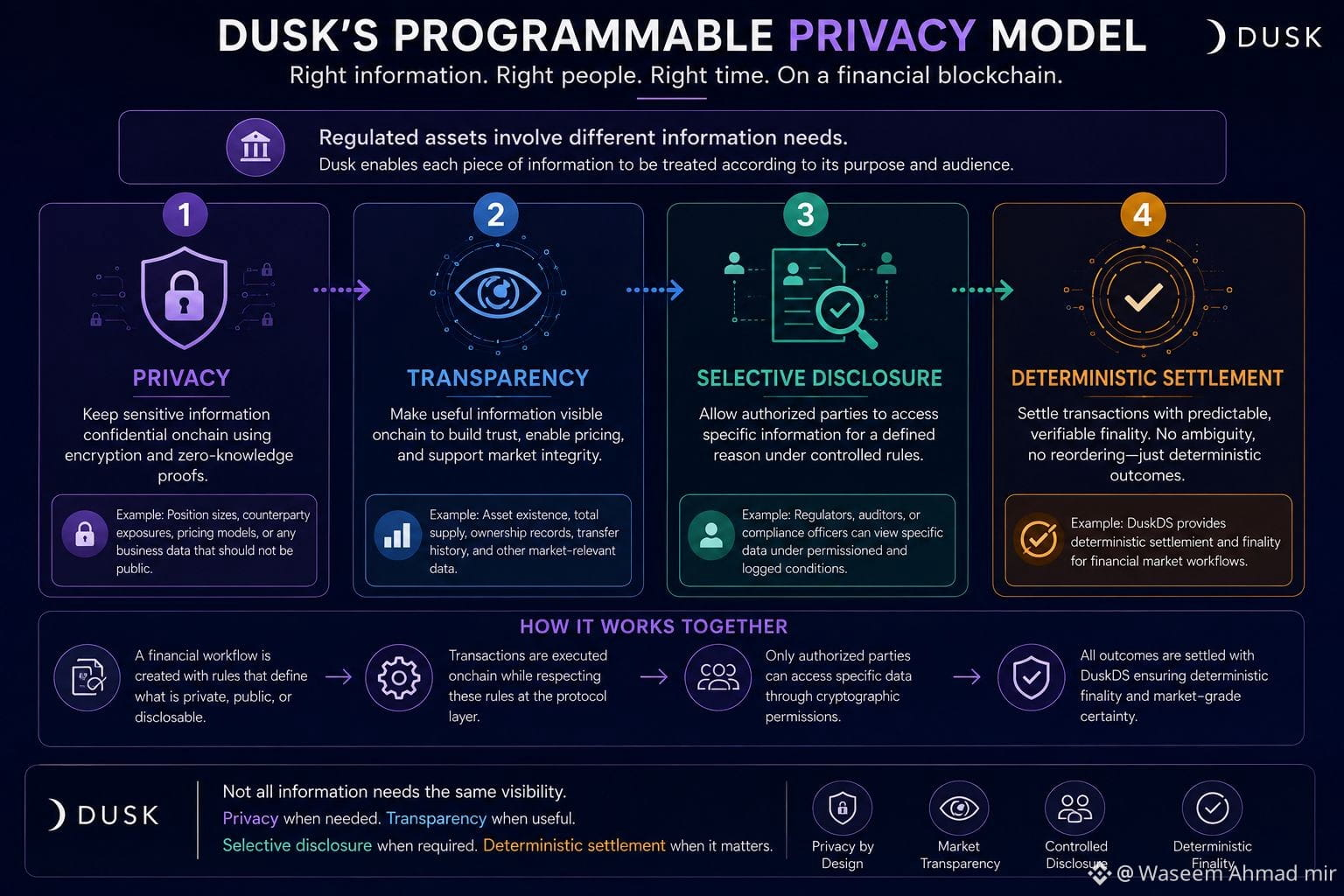
So I see four pieces working together:
Privacy where it is needed.
Transparency where it is useful.
Selective disclosure when authorized review requires it.
Deterministic settlement when the transaction needs a predictable final outcome.
That combination is what makes Dusk's approach to regulated markets worth following for me. It's less about choosing between a completely public or completely private blockchain, and more about giving financial workflows different ways to handle information.
#dusk
$DUSK
@Dusk
That's the part of Dusk's privacy model I keep coming back to.
Think about a regulated asset. There may be information that the market should be able to see. At the same time, some details may need to stay confidential. And in another situation, an authorized institution might need access to specific information for a defined reason.
Dusk's approach is built around those different requirements rather than forcing one visibility setting onto everything. Its documentation describes privacy with selective disclosure alongside public and transparent flows.
For me, that makes the word “programmable” important.
The idea isn't simply that transactions are private. It's that the financial workflow can determine what should be visible, what should remain confidential, and when particular information should be available to an authorized party.
Then there is settlement.
Dusk describes deterministic settlement as a core requirement for market infrastructure, with DuskDS providing deterministic finality for financial workflows.
So I see four pieces working together:
Privacy where it is needed.
Transparency where it is useful.
Selective disclosure when authorized review requires it.
Deterministic settlement when the transaction needs a predictable final outcome.
That combination is what makes Dusk's approach to regulated markets worth following for me. It's less about choosing between a completely public or completely private blockchain, and more about giving financial workflows different ways to handle information.
#dusk
$DUSK
@Dusk