#dusk $DUSK @Dusk
Today, I was thinking about one of the biggest contradictions in crypto.
We want privacy.
But we also want mass adoption, institutional money, regulated markets, and real-world assets moving on-chain.
Can all of these things actually exist together?
This is where Dusk becomes interesting.
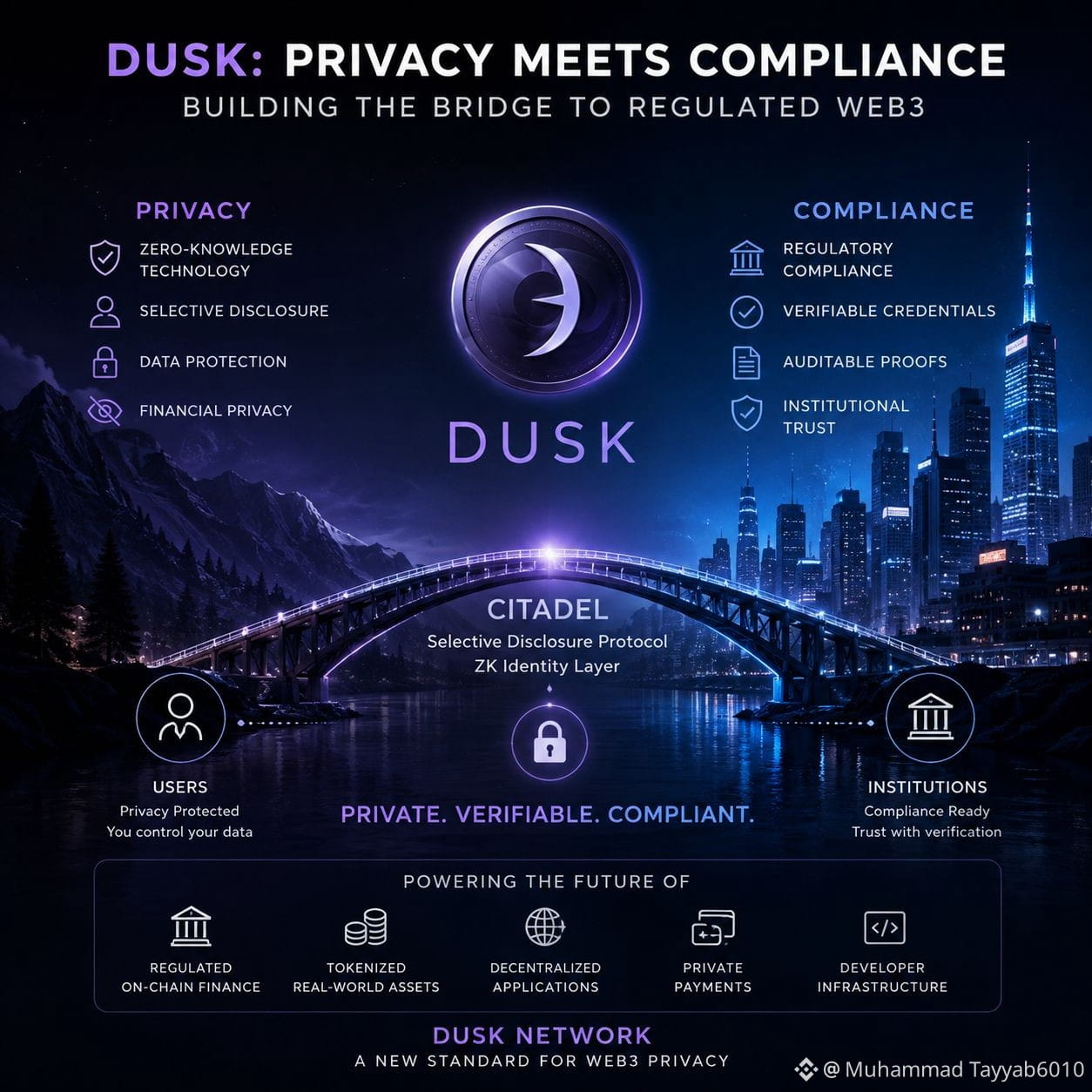
Most people still look at $DUSK simply as another crypto token. But the bigger idea behind Dusk is much more ambitious: building blockchain infrastructure where **privacy and compliance can exist at the same time.**
That sounds almost impossible at first.
Regulators need verification.
Businesses need compliance.
Users want privacy.
And institutions cannot operate in an environment where every sensitive transaction is visible to everyone.
Dusk is approaching this problem through zero-knowledge technology and selective disclosure. Its Citadel system is designed to let users prove that they meet certain requirements without exposing unnecessary personal information.
And this creates an interesting question:
What if the future of Web3 isn't completely anonymous?
What if the future is **private, but verifiable?**
Imagine being able to prove that you passed a required compliance check without handing your entire identity and financial history to every platform.
That is a very different vision of regulation.
Instead of privacy being the enemy of compliance, privacy could actually become part of the solution.
Dusk is also positioning its infrastructure around regulated on-chain finance and tokenized real-world assets — an area that could become increasingly important as traditional financial assets move onto blockchain networks.
But there is still a major question.
Will the crypto community accept a blockchain that embraces compliance?
Some people believe regulation destroys the original spirit of crypto.
Others believe regulation is exactly what is needed before billions of dollars of traditional capital can enter Web3.
Maybe the answer is somewhere in between.
Today, I was thinking about one of the biggest contradictions in crypto.
We want privacy.
But we also want mass adoption, institutional money, regulated markets, and real-world assets moving on-chain.
Can all of these things actually exist together?
This is where Dusk becomes interesting.
Most people still look at $DUSK simply as another crypto token. But the bigger idea behind Dusk is much more ambitious: building blockchain infrastructure where **privacy and compliance can exist at the same time.**
That sounds almost impossible at first.
Regulators need verification.
Businesses need compliance.
Users want privacy.
And institutions cannot operate in an environment where every sensitive transaction is visible to everyone.
Dusk is approaching this problem through zero-knowledge technology and selective disclosure. Its Citadel system is designed to let users prove that they meet certain requirements without exposing unnecessary personal information.
And this creates an interesting question:
What if the future of Web3 isn't completely anonymous?
What if the future is **private, but verifiable?**
Imagine being able to prove that you passed a required compliance check without handing your entire identity and financial history to every platform.
That is a very different vision of regulation.
Instead of privacy being the enemy of compliance, privacy could actually become part of the solution.
Dusk is also positioning its infrastructure around regulated on-chain finance and tokenized real-world assets — an area that could become increasingly important as traditional financial assets move onto blockchain networks.
But there is still a major question.
Will the crypto community accept a blockchain that embraces compliance?
Some people believe regulation destroys the original spirit of crypto.
Others believe regulation is exactly what is needed before billions of dollars of traditional capital can enter Web3.
Maybe the answer is somewhere in between.