$SPK is up more than 30% today, but understanding Spark requires looking at what the protocol actually does with capital.
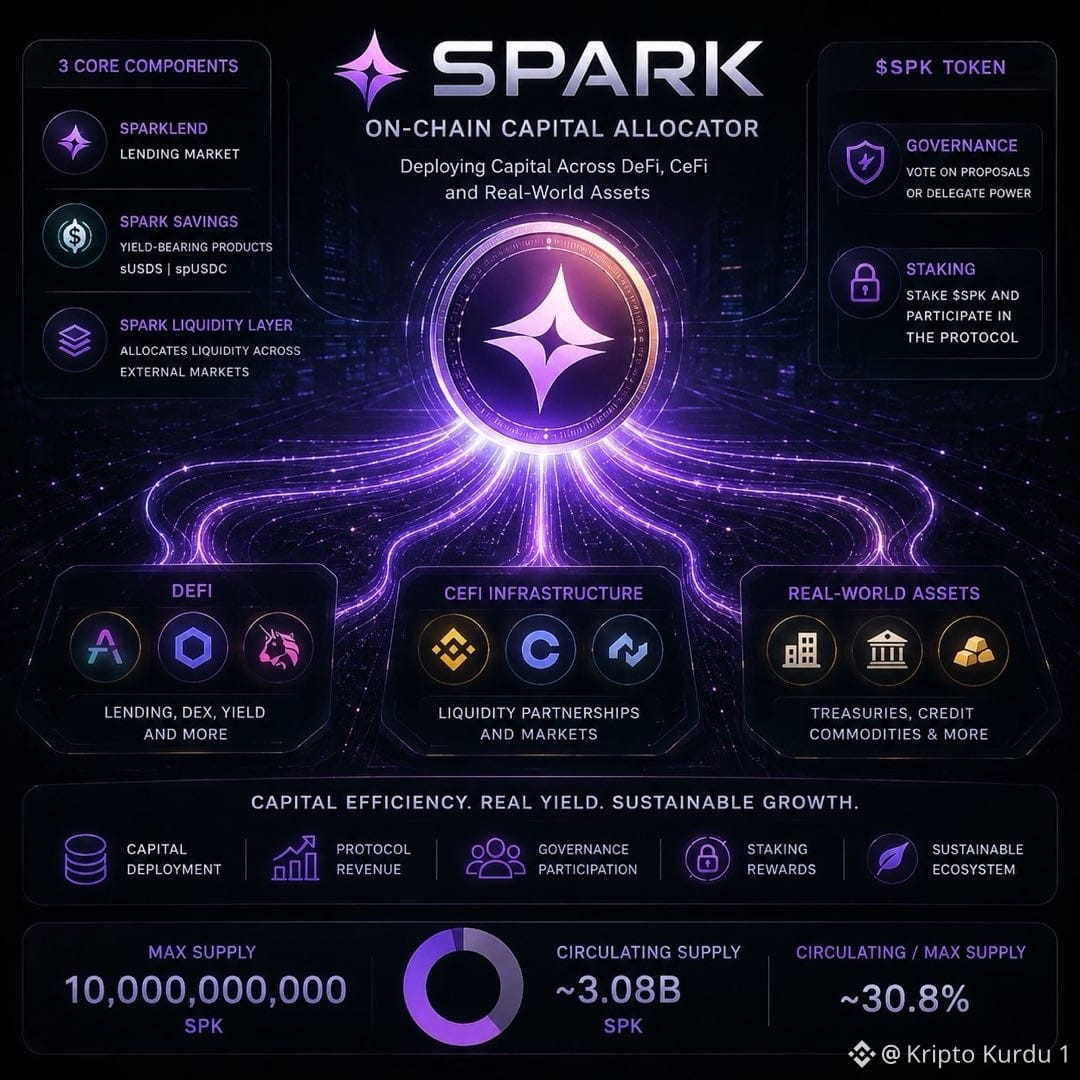
Spark operates as an on-chain capital allocator. Instead of keeping liquidity inside a single lending market, it deploys capital across DeFi, centralized finance infrastructure and real-world assets.
Its ecosystem currently has three main components.
SparkLend is a lending market. Spark Savings provides access to yield-bearing products such as sUSDS and spUSDC. The Spark Liquidity Layer allocates liquidity across external markets and protocols where capital can be used.
$SPK is the native token of this system and is used for governance and staking. Holders can vote directly on governance proposals or delegate their voting power.
There is also a supply-side detail worth understanding: SPK has a maximum supply of 10 billion tokens, while roughly 3.08 billion are currently circulating.
So when analyzing $SPK, price alone gives an incomplete picture. Protocol capital deployment, revenue, governance participation, staking, token emissions and the relationship between circulating and total supply are all useful metrics to follow.
Spark operates as an on-chain capital allocator. Instead of keeping liquidity inside a single lending market, it deploys capital across DeFi, centralized finance infrastructure and real-world assets.
Its ecosystem currently has three main components.
SparkLend is a lending market. Spark Savings provides access to yield-bearing products such as sUSDS and spUSDC. The Spark Liquidity Layer allocates liquidity across external markets and protocols where capital can be used.
$SPK is the native token of this system and is used for governance and staking. Holders can vote directly on governance proposals or delegate their voting power.
There is also a supply-side detail worth understanding: SPK has a maximum supply of 10 billion tokens, while roughly 3.08 billion are currently circulating.
So when analyzing $SPK, price alone gives an incomplete picture. Protocol capital deployment, revenue, governance participation, staking, token emissions and the relationship between circulating and total supply are all useful metrics to follow.