I learned a long time ago not to give every app more permission than it needs.
It usually starts innocently.
“Connect wallet.”
Then:
“Sign this.”
Then another pop-up appears and I'm already wondering what exactly I just approved.
I've become much more suspicious of signing prompts because of that.
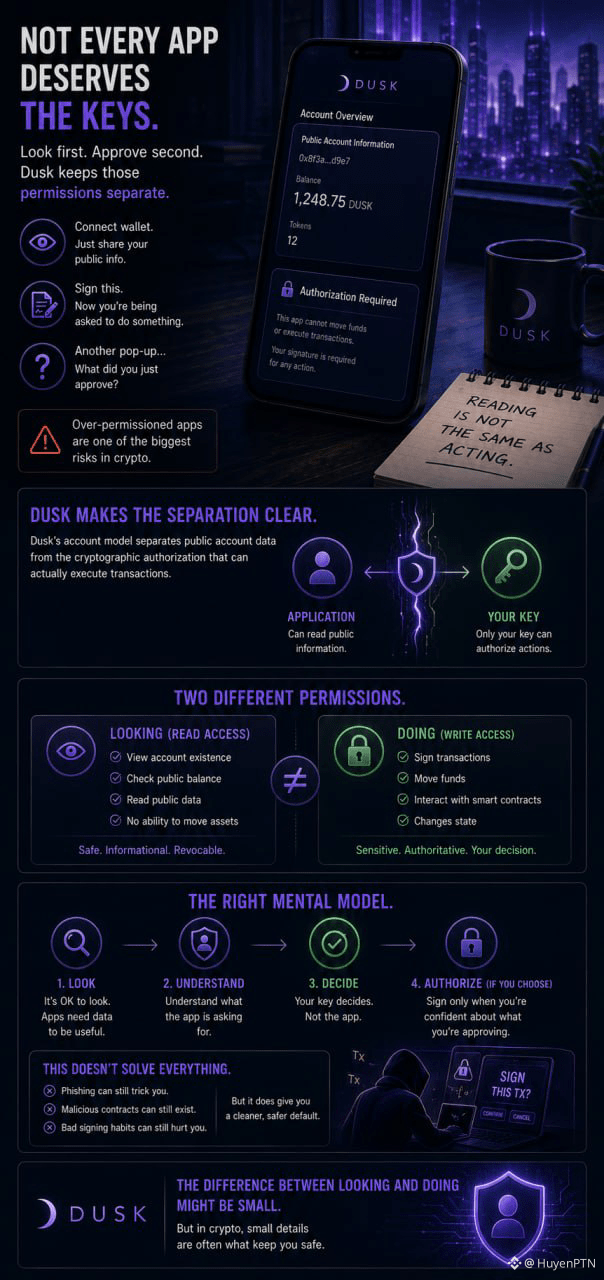
So I was curious about something in Dusk that I hadn't paid much attention to before: the separation between simply interacting with an account and actually authorizing an action.
Dusk's account model distinguishes between public account information and the cryptographic authorization needed to execute transactions. Applications can query account information without automatically gaining the ability to spend or move assets.
That sounds obvious.
But crypto has a funny way of making obvious things feel complicated.
A website should be able to know that an account exists.
It should be able to check a balance if the information is public.
That doesn't mean it should be able to sign something on my behalf.
Those are different permissions.
And I think Dusk gets something important right here.
The blockchain shouldn't have to trust the application just because I opened it.
The application can ask.
My key decides.
That separation doesn't eliminate phishing, malicious contracts or bad signing habits. Nothing does.
But it creates a cleaner mental model for me.
“Reading my account” and “acting as my account” shouldn't feel like the same permission.
Maybe that's a small detail.
I've started thinking small details matter a lot in crypto.
Because when something goes wrong, it is usually not the fancy cryptography that confuses the user.
It's the little button they clicked without really understanding what it meant.
And that's the part of Dusk I find myself appreciating more.
Not another feature.
Just a clearer line between looking and doing.
#dusk $DUSK @Dusk
It usually starts innocently.
“Connect wallet.”
Then:
“Sign this.”
Then another pop-up appears and I'm already wondering what exactly I just approved.
I've become much more suspicious of signing prompts because of that.
So I was curious about something in Dusk that I hadn't paid much attention to before: the separation between simply interacting with an account and actually authorizing an action.
Dusk's account model distinguishes between public account information and the cryptographic authorization needed to execute transactions. Applications can query account information without automatically gaining the ability to spend or move assets.
That sounds obvious.
But crypto has a funny way of making obvious things feel complicated.
A website should be able to know that an account exists.
It should be able to check a balance if the information is public.
That doesn't mean it should be able to sign something on my behalf.
Those are different permissions.
And I think Dusk gets something important right here.
The blockchain shouldn't have to trust the application just because I opened it.
The application can ask.
My key decides.
That separation doesn't eliminate phishing, malicious contracts or bad signing habits. Nothing does.
But it creates a cleaner mental model for me.
“Reading my account” and “acting as my account” shouldn't feel like the same permission.
Maybe that's a small detail.
I've started thinking small details matter a lot in crypto.
Because when something goes wrong, it is usually not the fancy cryptography that confuses the user.
It's the little button they clicked without really understanding what it meant.
And that's the part of Dusk I find myself appreciating more.
Not another feature.
Just a clearer line between looking and doing.
#dusk $DUSK @Dusk