


1/13
Can LUNC actually become a blockchain for tokenization?
I looked at the full picture: bridges, fees, speed, liquidity, institutional trust, RWA adoption and partnerships.
The answer is more complicated than “yes” or “no.” 🧵👇
2/13
The short answer: technically yes. Practically? Not yet.
LUNC has more of the infrastructure needed for tokenization than many people realize.
But infrastructure alone doesn’t create an institutional-grade tokenization ecosystem.
Here’s where the gap is.
3/13
First: LUNC can already move across major chains.
WLUNC exists on Ethereum, BNB Chain and Polygon, using established lock-and-mint bridging mechanisms.
So the basic cross-chain infrastructure is not theoretical.
It’s already live.
4/13
And the underlying chain isn’t stuck in 2022.
LUNC runs on Cosmos SDK v0.53, supports IBC, and has Hyperlane connectivity.
For issuing and moving digital assets, the technical plumbing is there.
The problem is what sits on top of that plumbing.
5/13
Fees? Competitive.
Speed? Usable.
LUNC transactions can cost well below $0.01, with block times around a few seconds.
It doesn’t need to be the fastest blockchain on Earth.
It needs to be reliable, liquid and trusted.
That’s where things get difficult.
6/13
Liquidity is the first major weakness.
WLUNC on Ethereum is only around the low-single-digit millions in market cap.
On BNB Chain, the figure is dramatically smaller.
For serious tokenization, thin liquidity creates friction for trading, settlement and institutional participation.
7/13
Then there’s the elephant in the room:
Institutional trust.
LUNC is still strongly associated with the 2022 Terra/LUNA collapse and the legal fallout surrounding its founder.
A technical upgrade can change code.
It cannot instantly change market perception.
8/13
Then look at the RWA/tokenization market.
Billions of dollars of real-world assets are already being tokenized across multiple blockchain ecosystems.
Yet LUNC currently has no meaningful measurable presence in that market.
That tells you something.
9/13
Look at the chains attracting serious institutional attention.
Solana: major payments integrations.
Ethereum: BlackRock’s BUIDL fund and billions in tokenized assets.
BNB Chain: deep liquidity, massive user base and established infrastructure.
LUNC currently lacks a comparable flagship integration.
10/13
And this is the key distinction:
LUNC’s problem isn’t primarily technical.
It has:
✅ Low fees
✅ Fast confirmations
✅ IBC
✅ Bridges
✅ Modern Cosmos infrastructure
What it lacks is:
❌ Deep liquidity
❌ Institutional trust
❌ Major RWA adoption
❌ A flagship institutional partner
11/13
The leading tokenization chains didn’t win simply because they were cheap or fast.
They built liquidity + credibility + developers + users + institutions over years.
That network effect is incredibly difficult to manufacture overnight.
12/13
And no governance proposal, bridge or Cosmos SDK upgrade can instantly create that.
Technology can open the door.
Capital, institutions and trust are what make people walk through it.
That is the real challenge facing LUNC.
13/13
Final verdict:
LUNC CAN be used for tokenization.
Technically, the infrastructure already exists.
But today, $LUNC is not yet positioned as a serious destination for large-scale asset tokenization.
The opportunity is real.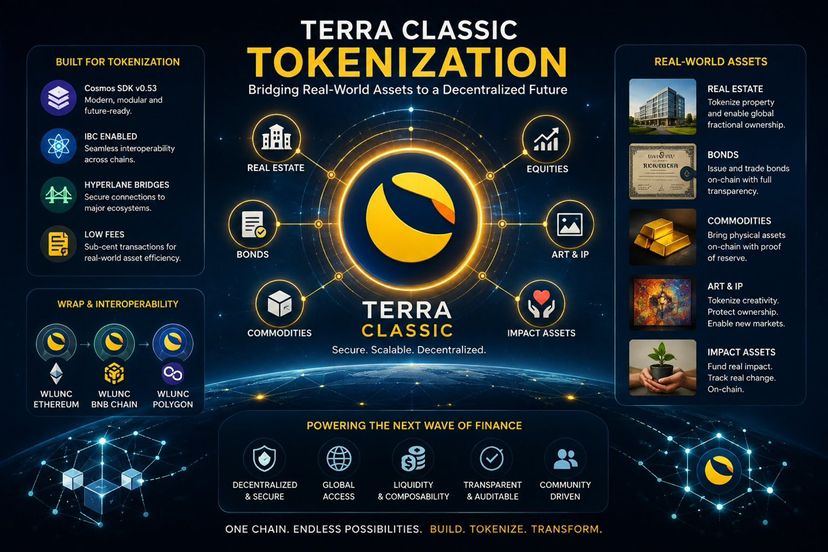
So is the gap.