Tariq and I were talking about @Dusk when we stopped at an interesting question: can a financial transaction settle, yet different systems still disagree about what actually happened?
A financial transaction can settle correctly and still leave different systems disagreeing about what happened.
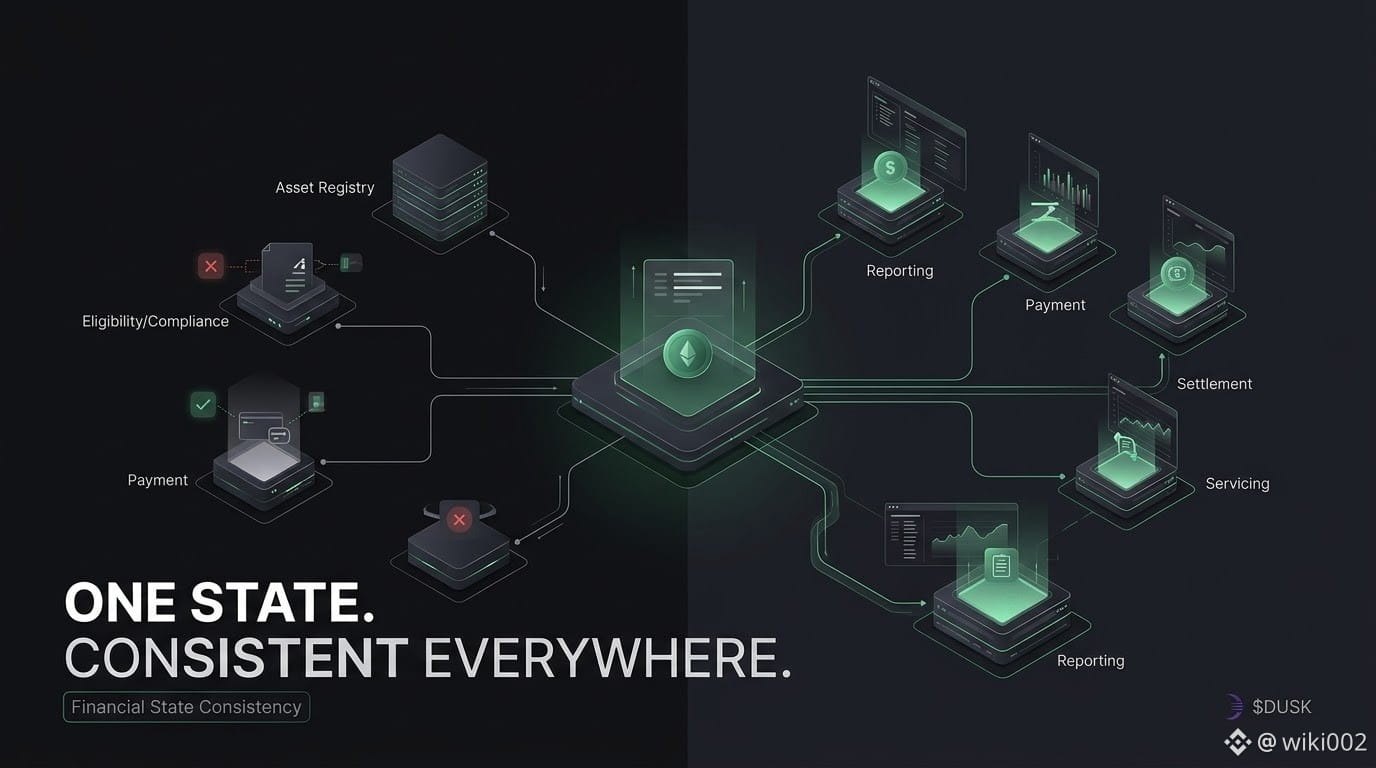
Take a tokenized security. The transfer is only one step. Eligibility, payment, servicing, reporting, corporate actions, and later transfers can all depend on the resulting ownership state.
That is the part I find more interesting about @Dusk
Dusk’s market infrastructure design is relevant here because it connects the rules and actions around a financial asset instead of leaving each application to define those transitions on its own. Its documentation also points to reconciliation and Off-chain coordination as problems when these processes are split across separate systems.
That creates a deeper question. Can different financial applications maintain the same meaning for the same state change?
Imagine an ownership transfer. One application could treat it as complete once the asset moves. Another could still be waiting for an eligibility check or payment leg. Both may process their own part correctly, yet the systems can disagree about the financial state that now exists.
That disagreement is where reconciliation starts becoming an architecture problem.
This is where I think Dusk’s workflow approach matters: the related asset, payment, access and settlement steps can be coordinated as parts of the same financial process, giving applications a shared reference for what the transaction is supposed to produce.
There is a Trade-off. Shared rules can make state easier for applications to interpret consistently, but too much standardization can make different markets harder to model.
So the question I would watch around $DUSK is simple
Can a financial network make the meaning of a state change consistent enough that reconciliation becomes the exception, rather than something applications have to design around? 🤔
#dusk $DUSK
A financial transaction can settle correctly and still leave different systems disagreeing about what happened.
Take a tokenized security. The transfer is only one step. Eligibility, payment, servicing, reporting, corporate actions, and later transfers can all depend on the resulting ownership state.
That is the part I find more interesting about @Dusk
Dusk’s market infrastructure design is relevant here because it connects the rules and actions around a financial asset instead of leaving each application to define those transitions on its own. Its documentation also points to reconciliation and Off-chain coordination as problems when these processes are split across separate systems.
That creates a deeper question. Can different financial applications maintain the same meaning for the same state change?
Imagine an ownership transfer. One application could treat it as complete once the asset moves. Another could still be waiting for an eligibility check or payment leg. Both may process their own part correctly, yet the systems can disagree about the financial state that now exists.
That disagreement is where reconciliation starts becoming an architecture problem.
This is where I think Dusk’s workflow approach matters: the related asset, payment, access and settlement steps can be coordinated as parts of the same financial process, giving applications a shared reference for what the transaction is supposed to produce.
There is a Trade-off. Shared rules can make state easier for applications to interpret consistently, but too much standardization can make different markets harder to model.
So the question I would watch around $DUSK is simple
Can a financial network make the meaning of a state change consistent enough that reconciliation becomes the exception, rather than something applications have to design around? 🤔
#dusk $DUSK