

Most Layer-1 chains introduce themselves through numbers. Throughput, latency, TPS, finality times. Those metrics matter, but they rarely answer the question that actually decides whether a blockchain survives: will normal people ever want to use this? Not traders chasing volatility, not developers experimenting with new primitives, but everyday users who expect apps to work smoothly, predictably, and without friction.
@Vanarchain starts from that question instead of ending there. Its positioning is not built around impressing the crypto-native crowd with complexity. It’s built around making Web3 feel closer to Web2 in the ways that actually matter to users: onboarding, cost stability, reliability, and invisible infrastructure.
That shift in starting point is subtle, but it changes everything about how the platform is designed.
Vanar does not frame itself as “just another chain.” It frames itself as a platform stack where the chain is only the base layer, and the real ambition lives above it. The goal is not to create an ecosystem that exists for its own sake, but to support consumer-facing products that can scale without forcing users to learn crypto mechanics just to participate. Gaming, entertainment, brand engagement, AI-powered tools these are the verticals Vanar keeps returning to, not because they sound exciting, but because they are where mainstream adoption actually happens.
The “next 3 billion users” line is easy to dismiss as marketing. But if you strip away the slogan, the product intention underneath is clear: reduce friction until blockchain becomes background infrastructure rather than foreground complexity.
That intention is visible in how Vanar talks about its architecture. Instead of focusing only on transaction execution, the platform leans into a layered model designed to handle data, context, and automation, not just state changes. Publicly, this is expressed through components like Neutron and Kayon. Neutron is positioned as a memory layer, a way to store structured data in forms machines can actually work with. Kayon is framed as a reasoning layer logic that can operate on that data and turn it into actionable outcomes.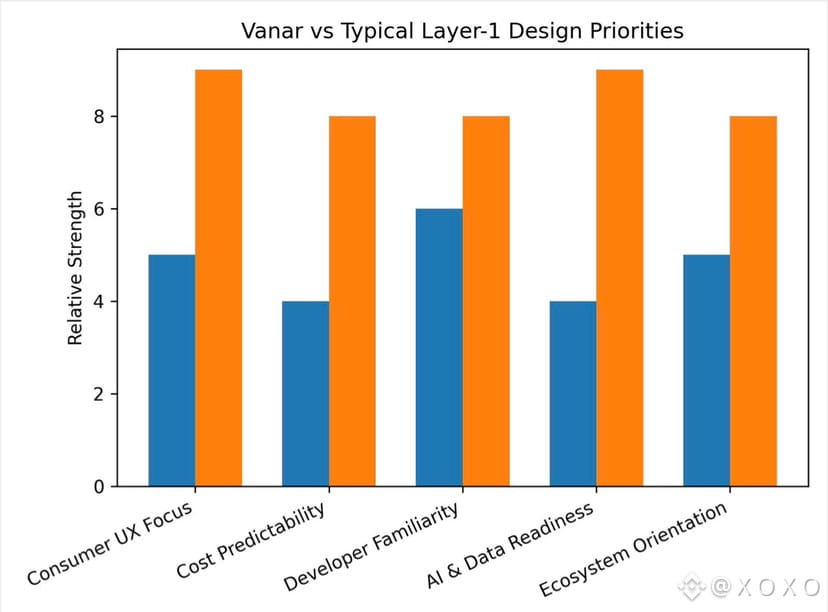
In simpler terms, Vanar is trying to move beyond the idea that blockchains are only good at recording events. The direction is toward systems that can remember, reason, and act in ways that support real workflows. That matters if you want to build applications that feel intelligent rather than transactional. AI-driven products, adaptive games, and consumer platforms that personalize experiences all depend on this kind of architecture.
This is also where Vanar’s AI-native narrative fits in. Not as a buzzword, but as an acknowledgment that future applications will not be static. They will respond to data over time, adapt to users, and automate decisions. A chain that cannot handle structured data and reasoning cleanly becomes a bottleneck rather than an enabler.
Another core design choice that reveals Vanar’s consumer-first thinking is its approach to cost predictability. Crypto users are often conditioned to accept fee volatility as normal. Mainstream users are not. Neither are businesses. No product team wants to explain why an in-app action cost $0.02 yesterday and $2 today. That kind of unpredictability breaks pricing models, user trust, and adoption.
Vanar’s design philosophy leans toward fixed-fee or highly stable cost structures. This is not glamorous, but it is foundational. Predictable costs make it possible to design user journeys that feel safe and familiar. They allow developers to think in terms of product economics rather than gas management. Over time, this becomes one of the strongest differentiators between chains that attract experiments and chains that host real businesses.
The same pragmatic thinking shows up in Vanar’s relationship with builders. Adoption does not happen because users magically appear. It happens because developers choose to build and stay. Vanar has consistently emphasized compatibility with familiar tooling, particularly within the EVM ecosystem. That choice lowers the barrier to entry for teams that already know how to ship. It reduces friction, shortens development cycles, and increases the likelihood that applications actually reach users.
Many chains underestimate this dynamic. They invest heavily in novel architectures but forget that complexity slows ecosystems down. Vanar’s approach suggests an understanding that progress is often incremental, not revolutionary. Making it easier to build can be more powerful than making something theoretically superior but practically inaccessible.
When Vanar talks about its ecosystem, the emphasis keeps returning to consumer-facing use cases. Games, entertainment platforms, product networks spaces where onboarding large audiences is normal, not exceptional. These industries already know how to scale users. What they need is infrastructure that does not get in the way.
This is where Vanar’s positioning becomes clearer. It wants to be the chain that consumer products happen to use, not the product users are forced to think about. That distinction separates chains that exist primarily for crypto-native audiences from platforms that quietly become infrastructure.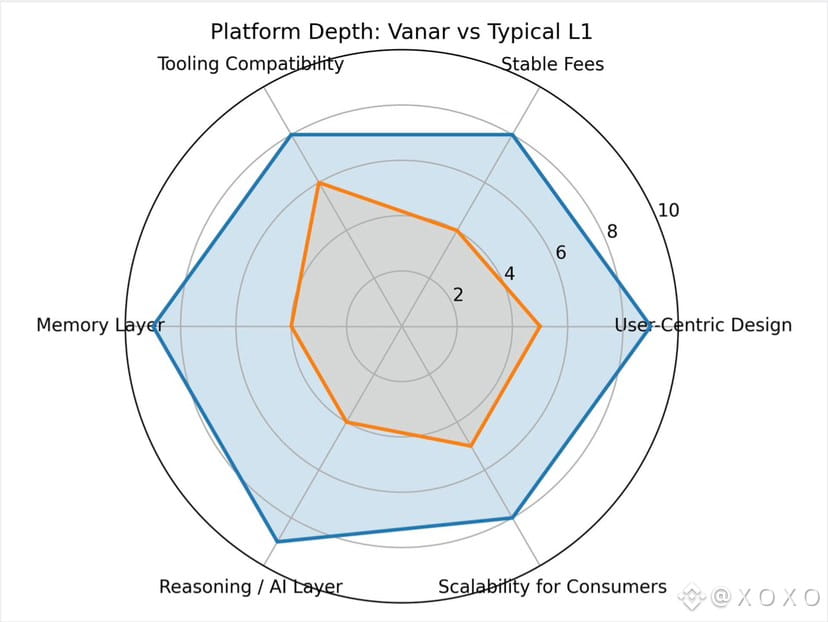
At the center of this ecosystem sits VANRY. The cleanest way to understand the token is not as a speculative vehicle, but as a usage-aligned asset. VANRY functions as the transactional backbone of the network and an alignment mechanism for participation. As platform activity grows applications launching, users interacting, systems running the token’s role becomes more tangible because it is consumed by real usage.
This is where transparency matters. Unlike narratives that rely on future promises, token mechanics are visible on-chain. Supply limits, minting history, contract behavior, and transfer activity can all be verified independently. That makes VANRY one of the most concrete signals of whether Vanar’s platform story is becoming real. Watching on-chain activity often tells a more honest story than watching price alone.
Vanar’s public direction has increasingly centered around AI-native infrastructure, memory and reasoning layers, and turning data into something systems can work with over time. That direction does not guarantee success. But it does signal that the project is attempting to build a stack, not just a chain. Historically, ecosystems that last tend to be those that offer complete environments rather than isolated components.
The way to evaluate Vanar going forward is not through single announcements or short-term excitement. It is through proof points that accumulate quietly. Do the platform layers move from conceptual architecture into tools developers actually use? Do consumer-facing applications continue to launch and retain users? Does the predictable-cost narrative hold up as usage scales?
Those are the moments where consumer-first chains either validate their design or expose their limits.
Viewed this way, Vanar is not a one-off story. It is a gradual process of making Web3 feel easier, more stable, and more usable for people who do not care about chains at all. If that trajectory continues, Vanar does not need to dominate headlines. It only needs to become infrastructure the kind people rely on without thinking about it.
That is often how real adoption looks. Quiet. Incremental. And difficult to reverse once it takes hold.