Spent the past few days clicking through TermMax's various pages, and what's bothering me isn't the rate, it's whether a first-time user actually understands what they're signing up for when they click deposit.
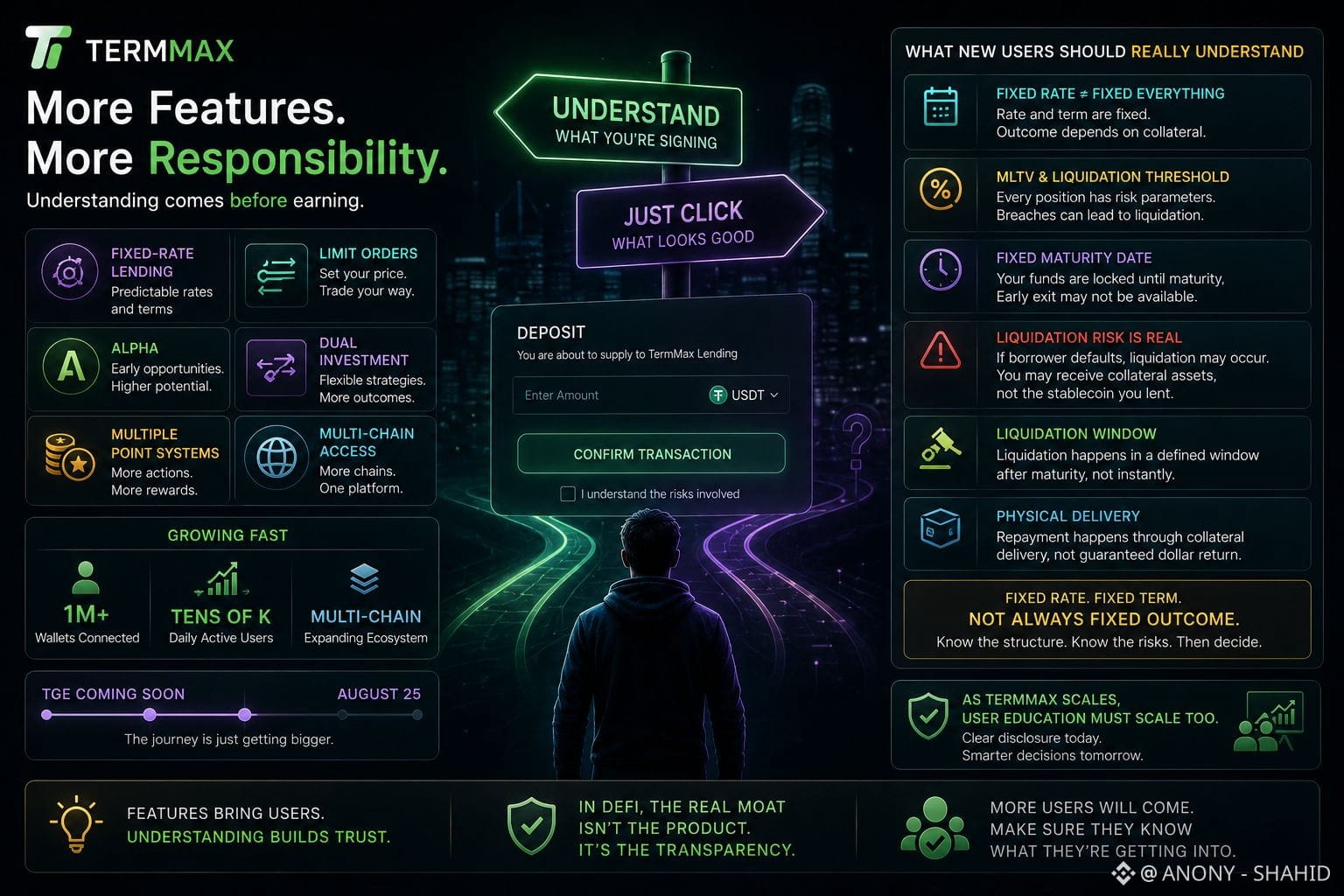
The homepage now stacks fixed-rate lending, limit orders, Alpha, dual investment, multiple point systems, and multi-chain switching all in one view. Experienced DeFi users can parse that fine. A first-time visitor is more likely to just click whatever number looks biggest.
One detail specifically deserves more attention than it's getting. TermMax lending isn't simply deposit-and-collect-at-maturity. There's an MLTV, a liquidation threshold, and a fixed maturity date running underneath it. If a borrower defaults and the position goes through liquidation, documentation is clear that lenders may end up holding collateral assets, not the stablecoin they originally lent out. Liquidation runs through a defined window after maturity, and works through physical delivery, meaning what comes back to you depends on collateral behavior, not a guaranteed dollar figure.
That's worth sitting with, because "fixed rate" and "fixed term" naturally read as "fixed everything" to someone new. What's actually fixed is the rate and the timeline, not necessarily the form your principal comes back in in every scenario.
With @TermMax scaling fast, wallet connections climbing, activity spread across chains, TGE approaching, the user base only grows from here. Risk disclosure, maturity reminders, and plain-language explanations of edge-case outcomes need to scale just as fast as the feature list does.
The real product moat in DeFi was never just building more trading options. It's whether users understand the failure modes before they're in one.
#termmax #Binance
The homepage now stacks fixed-rate lending, limit orders, Alpha, dual investment, multiple point systems, and multi-chain switching all in one view. Experienced DeFi users can parse that fine. A first-time visitor is more likely to just click whatever number looks biggest.
One detail specifically deserves more attention than it's getting. TermMax lending isn't simply deposit-and-collect-at-maturity. There's an MLTV, a liquidation threshold, and a fixed maturity date running underneath it. If a borrower defaults and the position goes through liquidation, documentation is clear that lenders may end up holding collateral assets, not the stablecoin they originally lent out. Liquidation runs through a defined window after maturity, and works through physical delivery, meaning what comes back to you depends on collateral behavior, not a guaranteed dollar figure.
That's worth sitting with, because "fixed rate" and "fixed term" naturally read as "fixed everything" to someone new. What's actually fixed is the rate and the timeline, not necessarily the form your principal comes back in in every scenario.
With @TermMax scaling fast, wallet connections climbing, activity spread across chains, TGE approaching, the user base only grows from here. Risk disclosure, maturity reminders, and plain-language explanations of edge-case outcomes need to scale just as fast as the feature list does.
The real product moat in DeFi was never just building more trading options. It's whether users understand the failure modes before they're in one.
#termmax #Binance