
 Blockchain was built around transparency, but when it comes to financial applications, complete transparency is not always a feature. Banks, institutions, investors, and businesses often need to verify transactions without exposing sensitive information such as balances, positions, counterparties, or business logic.
This is where Dusk Network takes an interesting approach.
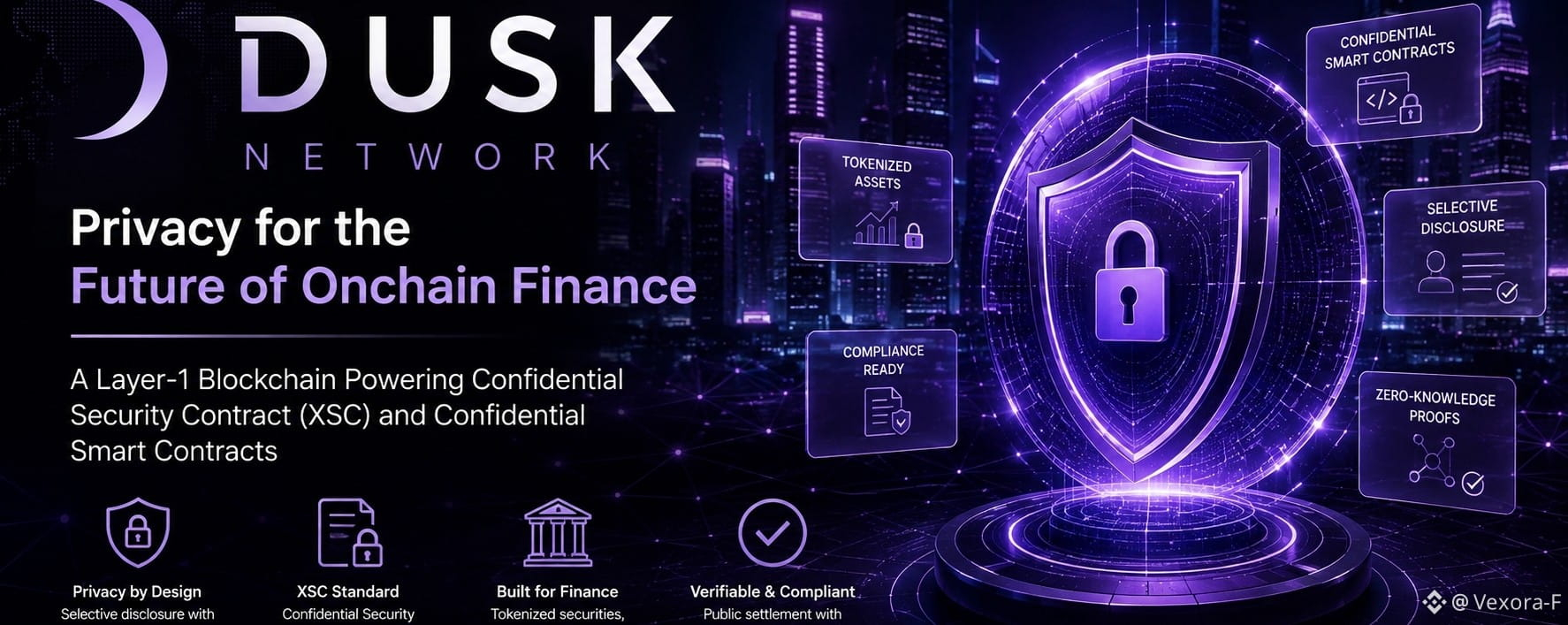
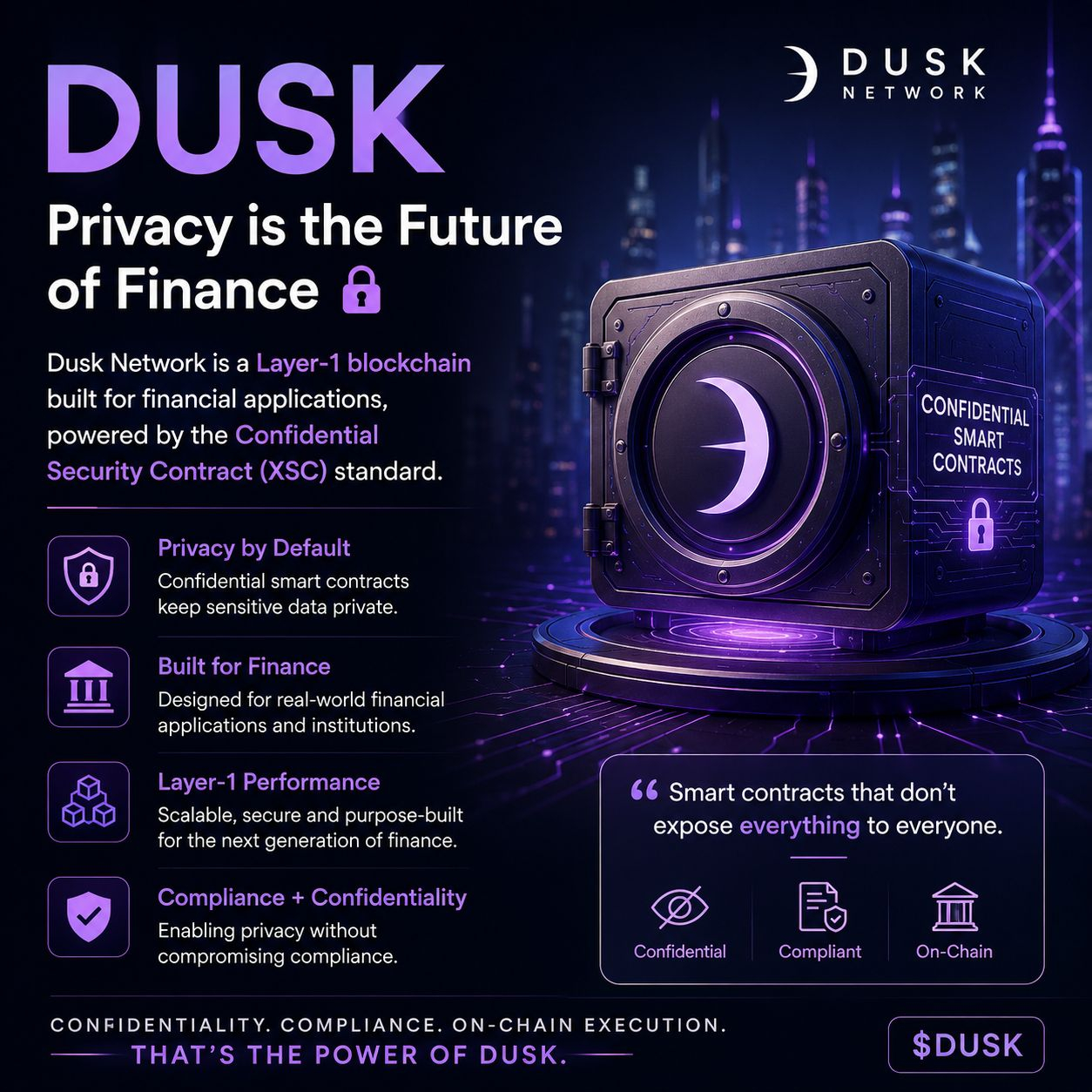
Dusk is a Layer-1 blockchain designed for regulated onchain finance, with privacy, selective disclosure, and deterministic settlement built into its infrastructure.
Privacy Without Giving Up Verifiability
The core idea behind Dusk is not simply to hide everything.
Instead, the network is designed around confidentiality with selective disclosure. Sensitive financial information can remain private while authorized participants can still receive the information or proof they need.
This is particularly relevant for financial markets, where making every balance, position, or transaction detail publicly visible can create serious problems. Dusk uses zero-knowledge technology and privacy-preserving transaction models to address this challenge.
The Role of XSC
One of the most interesting parts of the Dusk ecosystem is its Confidential Security Contract (XSC) standard.
XSC is designed for confidential smart contracts and can be adapted to business requirements such as privacy and compliance rules. This makes it particularly relevant to tokenized securities and regulated financial assets.
The idea is powerful:
Smart contracts + financial assets + privacy + compliance
Instead of forcing financial applications to choose between blockchain transparency and confidentiality, Dusk aims to bring both into the same infrastructure.
Why This Matters for Financial Applications
Imagine a tokenized security where ownership needs to be verified, transfers need to follow certain rules, and regulators may need access to specific information.
A completely public blockchain could expose more information than necessary.
A completely private system, on the other hand, could lose some of the benefits of shared blockchain infrastructure.
Dusk is designed around the middle ground: public settlement and verifiable execution, while sensitive information can remain confidential. Its current use cases include regulated securities, confidential financial applications, compliance and identity, and tokenized markets.
More Than Just a Privacy Chain
What makes Dusk interesting is that privacy is only one part of its broader architecture.
The network combines privacy-preserving transactions with deterministic settlement and infrastructure designed for regulated digital assets. Its documentation describes Dusk as a Layer-1 where developers can build financial applications using native privacy and zero-knowledge capabilities, while also providing EVM-compatible development options.
This creates an interesting proposition for developers and institutions:
You don't necessarily have to choose between blockchain accessibility and financial privacy.
The Bigger Picture
The next phase of blockchain adoption may not be about making every financial transaction visible to everyone.
It could be about making transactions verifiable when they need to be verified, private when they need to remain private, and compliant when regulation requires it.
That is the space Dusk is targeting.
If tokenized securities, institutional DeFi, private financial applications, and regulated digital assets continue moving onchain, infrastructure that can combine privacy, compliance, and blockchain settlement could become increasingly important.
Dusk Network's approach is therefore worth watching—not because privacy alone is new, but because applying privacy directly to regulated financial infrastructure could solve a very real problem for the next generation of onchain finance.
Dusk is essentially asking a simple question:
Can financial markets move onchain without putting every piece of sensitive information on public display?
Its technology is built around answering that question with privacy-preserving, programmable, and regulation-aware blockchain infrastructure.