Eu continuava vendo Moonlight e Phoenix mencionados separadamente.
Então comecei com uma pergunta:
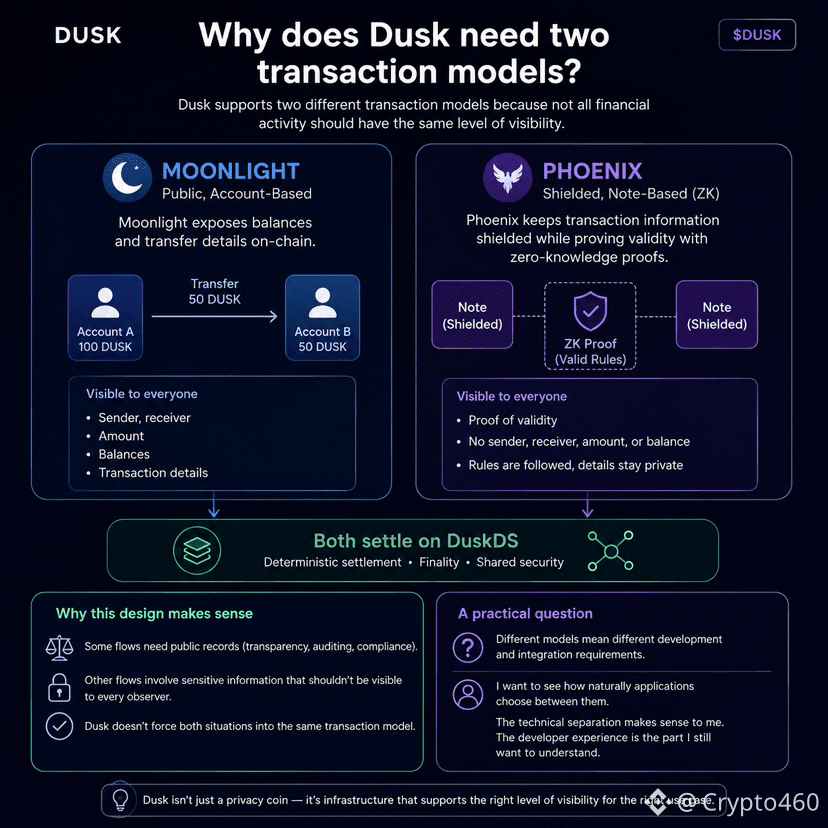
Por que @Dusk precisa de dois modelos de transação?
Moonlight usa transferências públicas baseadas em conta.
Phoenix usa transferências blindadas baseadas em notas com provas de conhecimento zero.
Ambas chegam em DuskDS.
A diferença é que tipo de informação fica visível.
Moonlight expõe saldos e detalhes das transferências.
Phoenix mantém as informações da transação ocultas, ao mesmo tempo em que prova que a transação segue as regras exigidas.
Essa distinção faz mais sentido quando você pensa em atividades financeiras.
Alguns fluxos precisam de registros públicos.
Outros envolvem informações que não devem ficar visíveis para qualquer observador da rede.
O Dusk não força que essas duas situações caibam no mesmo modelo de transação.
Eu acho esse design mais interessante do que simplesmente chamar $DUSK de uma moeda de privacidade. #dusk
Há também uma questão prática.
Modelos de transação diferentes significam requisitos diferentes de desenvolvimento e integração.
Então eu quero ver como naturalmente as aplicações escolhem entre eles.
A separação técnica faz sentido para mim.
A experiência do desenvolvedor é a parte que eu ainda quero entender.
@Dusk $DUSK #dusk
Então comecei com uma pergunta:
Por que @Dusk precisa de dois modelos de transação?
Moonlight usa transferências públicas baseadas em conta.
Phoenix usa transferências blindadas baseadas em notas com provas de conhecimento zero.
Ambas chegam em DuskDS.
A diferença é que tipo de informação fica visível.
Moonlight expõe saldos e detalhes das transferências.
Phoenix mantém as informações da transação ocultas, ao mesmo tempo em que prova que a transação segue as regras exigidas.
Essa distinção faz mais sentido quando você pensa em atividades financeiras.
Alguns fluxos precisam de registros públicos.
Outros envolvem informações que não devem ficar visíveis para qualquer observador da rede.
O Dusk não força que essas duas situações caibam no mesmo modelo de transação.
Eu acho esse design mais interessante do que simplesmente chamar $DUSK de uma moeda de privacidade. #dusk
Há também uma questão prática.
Modelos de transação diferentes significam requisitos diferentes de desenvolvimento e integração.
Então eu quero ver como naturalmente as aplicações escolhem entre eles.
A separação técnica faz sentido para mim.
A experiência do desenvolvedor é a parte que eu ainda quero entender.
@Dusk $DUSK #dusk