Dusk came up again this afternoon, and this time I went and pulled the transaction model docs instead of trusting a summary someone else wrote.
Small detail that stopped me:
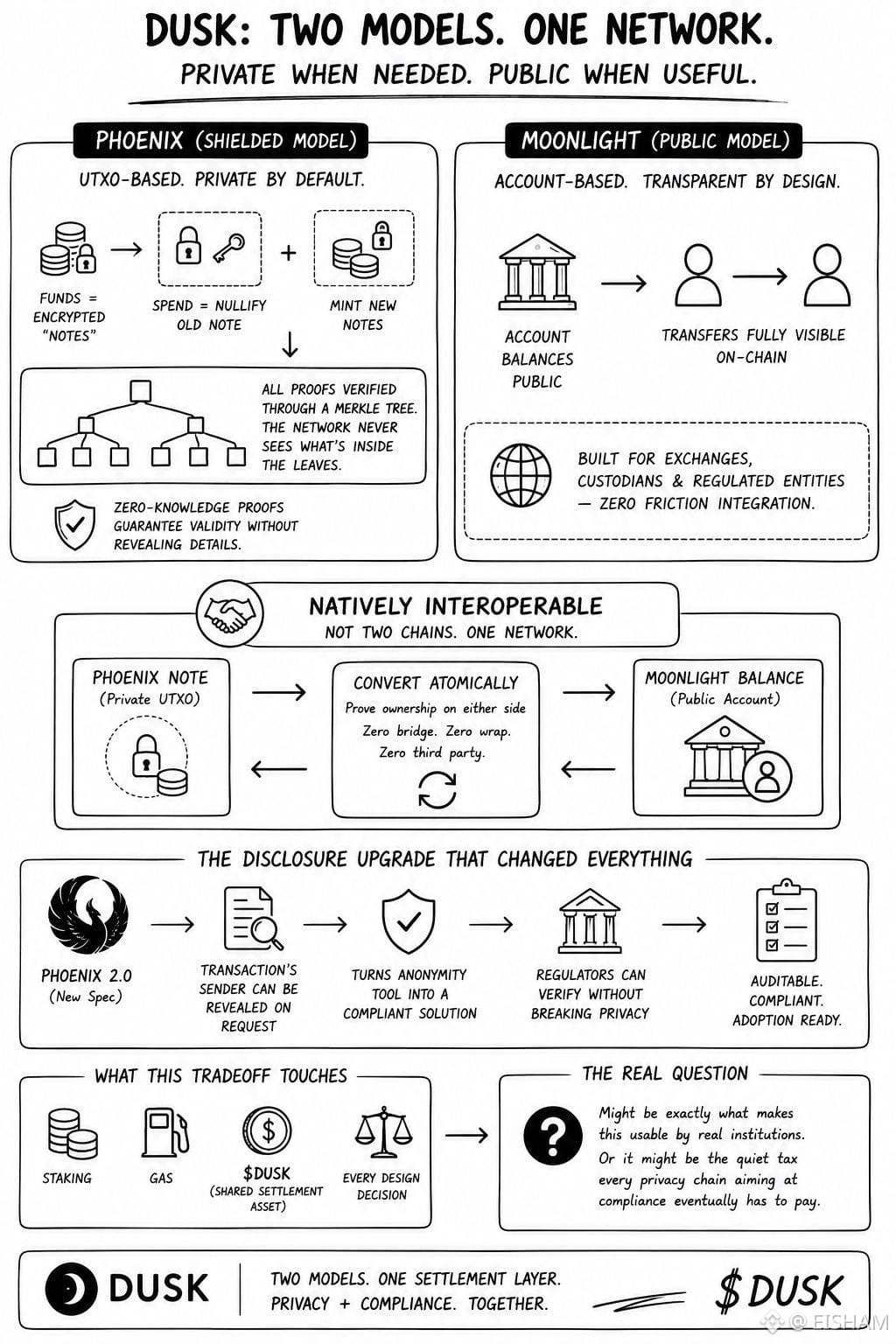
Phoenix, Dusk's shielded model, isn't account-based at all, it's UTXO-based. Funds exist as encrypted "notes," and every spend has to nullify an old note and mint new ones under a zero-knowledge proof, tracked through a Merkle tree the network maintains without ever seeing what's inside the leaves. Moonlight, by contrast, is a plain account model, balances public, transfers fully visible, built specifically so exchanges could integrate without regulatory friction.
Here's the part that actually made me pause. These aren't two separate chains bolted together, they're natively interoperable. A user can convert Phoenix notes into a Moonlight balance and back, atomically, proving ownership on either side without a bridge, a wrapped token, or a third party in between. That's a real engineering commitment, not a marketing line — @Dusk Foundation apparently rewrote Phoenix itself (the 2.0 spec) specifically so a transaction's sender could be provably revealed to its receiver on request, which quietly turns it from an anonymity tool into something regulators can actually sign off on.
I keep wondering what that tradeoff costs in practice, though. Full anonymity protocols never had to build a disclosure path because they were never trying to satisfy an auditor. Dusk built one in from the start, which means every design decision downstream, staking, gas, even $DUSK role as the shared settlement asset between both models, inherits that same constraint. Might be exactly what makes this usable by real institutions. Or it might just be the quiet tax every privacy chain aiming at compliance eventually has to pay.
#dusk $DUSK @Dusk
Small detail that stopped me:
Phoenix, Dusk's shielded model, isn't account-based at all, it's UTXO-based. Funds exist as encrypted "notes," and every spend has to nullify an old note and mint new ones under a zero-knowledge proof, tracked through a Merkle tree the network maintains without ever seeing what's inside the leaves. Moonlight, by contrast, is a plain account model, balances public, transfers fully visible, built specifically so exchanges could integrate without regulatory friction.
Here's the part that actually made me pause. These aren't two separate chains bolted together, they're natively interoperable. A user can convert Phoenix notes into a Moonlight balance and back, atomically, proving ownership on either side without a bridge, a wrapped token, or a third party in between. That's a real engineering commitment, not a marketing line — @Dusk Foundation apparently rewrote Phoenix itself (the 2.0 spec) specifically so a transaction's sender could be provably revealed to its receiver on request, which quietly turns it from an anonymity tool into something regulators can actually sign off on.
I keep wondering what that tradeoff costs in practice, though. Full anonymity protocols never had to build a disclosure path because they were never trying to satisfy an auditor. Dusk built one in from the start, which means every design decision downstream, staking, gas, even $DUSK role as the shared settlement asset between both models, inherits that same constraint. Might be exactly what makes this usable by real institutions. Or it might just be the quiet tax every privacy chain aiming at compliance eventually has to pay.
#dusk $DUSK @Dusk