
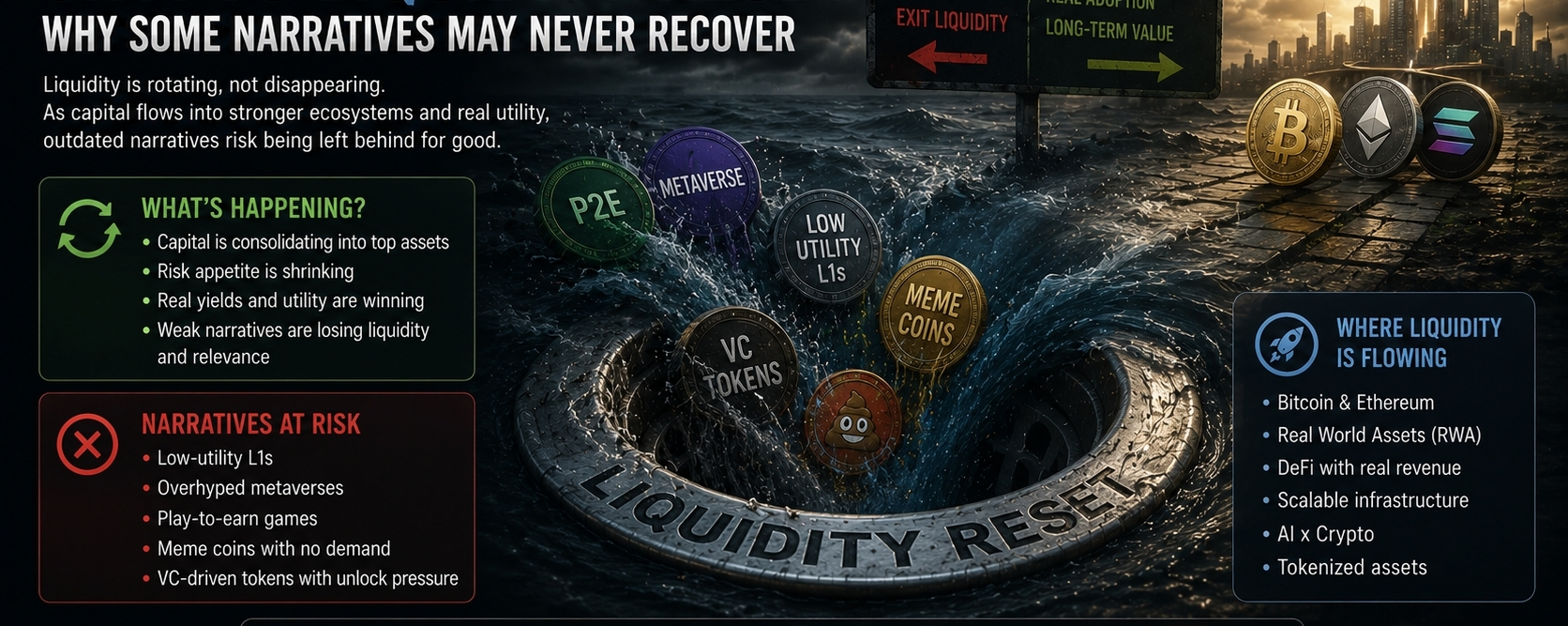

Crypto is going through more than another market correction. I think we are watching a liquidity reset that could permanently change which sectors attract capital.
In previous cycles, a strong narrative could send an entire category higher. Today, investors are becoming more selective. Recent 2026 research suggests the market is increasingly rewarding real demand, revenue and infrastructure rather than narrative alone.
That could be bad news for some old crypto narratives.
Liquidity Is Becoming More Selective
The biggest change I see is that capital is no longer spreading equally across the market.
CryptoRank's Q2 2026 review found broad weakness across liquid altcoins. Among assets with more than $1 million in daily volume, none of the eight narratives it tracked produced a positive median return. Layer 2, DePIN and Layer 1 categories were among the weakest.
This tells me something important.
The market isn't automatically rewarding a project simply because it belongs to a popular sector anymore.
The Era of “Narrative First, Product Later” May Be Ending
Previous crypto cycles created enormous valuations around ideas that were still years away from meaningful adoption.
That approach becomes much harder when liquidity is limited.
I think investors are increasingly asking different questions: Does the network have users? Is it generating fees? Is capital actually staying inside the ecosystem? Does the token capture any of that value?
Research covering the first half of 2026 similarly argues that crypto is shifting away from one dominant narrative toward projects finding genuine product-market fit.
That could create a huge separation between projects that sound valuable and projects that actually create value.
Stablecoins Are Winning a Different Game
One sector that looks structurally stronger to me is stablecoin infrastructure.
Stablecoins have developed into a much deeper liquidity layer than during previous cycles. CoinDesk Research reported that the market reached approximately $320 billion in May, even while broader digital-asset prices were under pressure.
And this trend is becoming increasingly institutional.
Recent U.S. regulatory developments continue to show stablecoins moving closer to mainstream financial infrastructure rather than remaining purely crypto trading instruments.
I think that distinction matters enormously.
RWA Is Competing for the Same Capital
Real-world assets are another major part of this liquidity reset.
Tokenized Treasuries, funds, stocks and other financial assets give investors more places to deploy on-chain capital without taking the same risks associated with smaller altcoins.
CoinGecko's updated 2026 analysis estimates that tokenized RWAs excluding stablecoins grew from roughly $5.4 billion in January 2025 to around $34 billion by July 2026.
Tokenization is also attracting increasing attention from traditional financial institutions as infrastructure for blockchain-based stocks, bonds and other assets develops.
For me, this creates a major question for altcoins:
Why should capital chase another speculative token when it has more productive on-chain alternatives?
Some Layer-1s Could Face a Reality Check
Every cycle seems to produce new blockchains claiming they will become the next major ecosystem.
But there is only so much liquidity, developer attention and user activity available.
I don't think dozens of Layer-1 networks can all maintain massive valuations indefinitely without meaningful economic activity.
The networks that survive may be those that can attract stablecoins, applications, developers and persistent users rather than temporary incentive-driven activity.
The rest could struggle to regain their previous relevance even when the broader market improves.
Layer-2s May Need More Than Cheap Transactions
I see a similar challenge developing for Layer-2 networks.
Scaling Ethereum was once a powerful narrative by itself. But as more L2s entered the market, cheap transactions became less unique.
CryptoRank's Q2 data showed Layer-2 tokens among the weakest narrative groups during the downturn.
That doesn't mean Layer 2 technology is failing.
Instead, I think the market may begin separating useful technology from valuable tokens.
A network can provide excellent infrastructure without automatically making every associated token valuable.
AI Crypto Could Face the Same Test
AI remains one of the biggest technology stories globally, but attaching AI to a crypto project doesn't guarantee lasting demand.
I’m much more interested in projects where blockchain actually solves a problem for AI—such as payments, computing resources, data or verification—than projects using AI primarily as marketing.
CoinGecko still identifies AI-related infrastructure among the major 2026 crypto narratives, but the broader market's shift toward measurable utility means the bar is becoming higher.
The AI narrative probably isn't disappearing.
The weaker versions of it might.
DeFi Could Survive by Becoming Useful Again
DeFi is different because it already provides financial services people actively use.
Trading, lending, borrowing and liquidity infrastructure have survived multiple crypto cycles.
But I think DeFi's next phase needs stronger economics.
Protocols generating sustainable fees and connecting with stablecoins and tokenized real-world assets could become increasingly important as crypto develops into broader financial infrastructure.
Recent market research also points toward infrastructure continuing to expand even while token prices remain weak.
That could make mature DeFi very different from purely narrative-driven altcoins.
Wall Street Is Entering the Liquidity Competition
Perhaps the biggest change is happening outside traditional crypto circles.
Major financial institutions are increasingly exploring blockchain for tokenization, settlement and other financial infrastructure. Recent reporting describes growing interest from established financial firms in bringing stocks, bonds and currencies onto blockchain rails.
This means crypto projects aren't only competing against each other anymore.
They could increasingly compete with tokenized traditional financial products for the same digital capital.
I think that changes the entire game.
The Next Altseason Could Be Much More Selective
This is why I wouldn't automatically expect the next major market recovery to lift every altcoin.
Capital has more choices now.
Bitcoin, stablecoins, tokenized assets, established DeFi applications and institutional blockchain products all compete for liquidity that once had fewer places to go.
That could create a market where a handful of sectors perform extremely well while large portions of the altcoin market remain behind.
What I’m Watching During the Reset
I’m watching where real liquidity remains during weakness rather than simply looking at which narrative is getting the most attention.
Stablecoin activity, RWA growth, sustainable protocol revenue, real users and institutional adoption tell me more than hype alone.
Some old narratives could eventually return stronger.
Others may never recover their previous valuations because the market itself has changed.
The Great Crypto Liquidity Reset isn't just moving money from one token to another. I think it is redefining what deserves liquidity in the first place.
And that may become one of the most important stories of the next crypto cycle.