Bitcoin (BTC) has transformed from an experimental digital currency into one of the most discussed financial assets in the world. Since its launch in 2009, Bitcoin has challenged traditional ideas about money, banking, ownership, and investment. Unlike government-issued currencies, Bitcoin operates on a decentralized network, allowing people to transfer value without relying on a traditional bank as the central authority.
What Is Bitcoin?
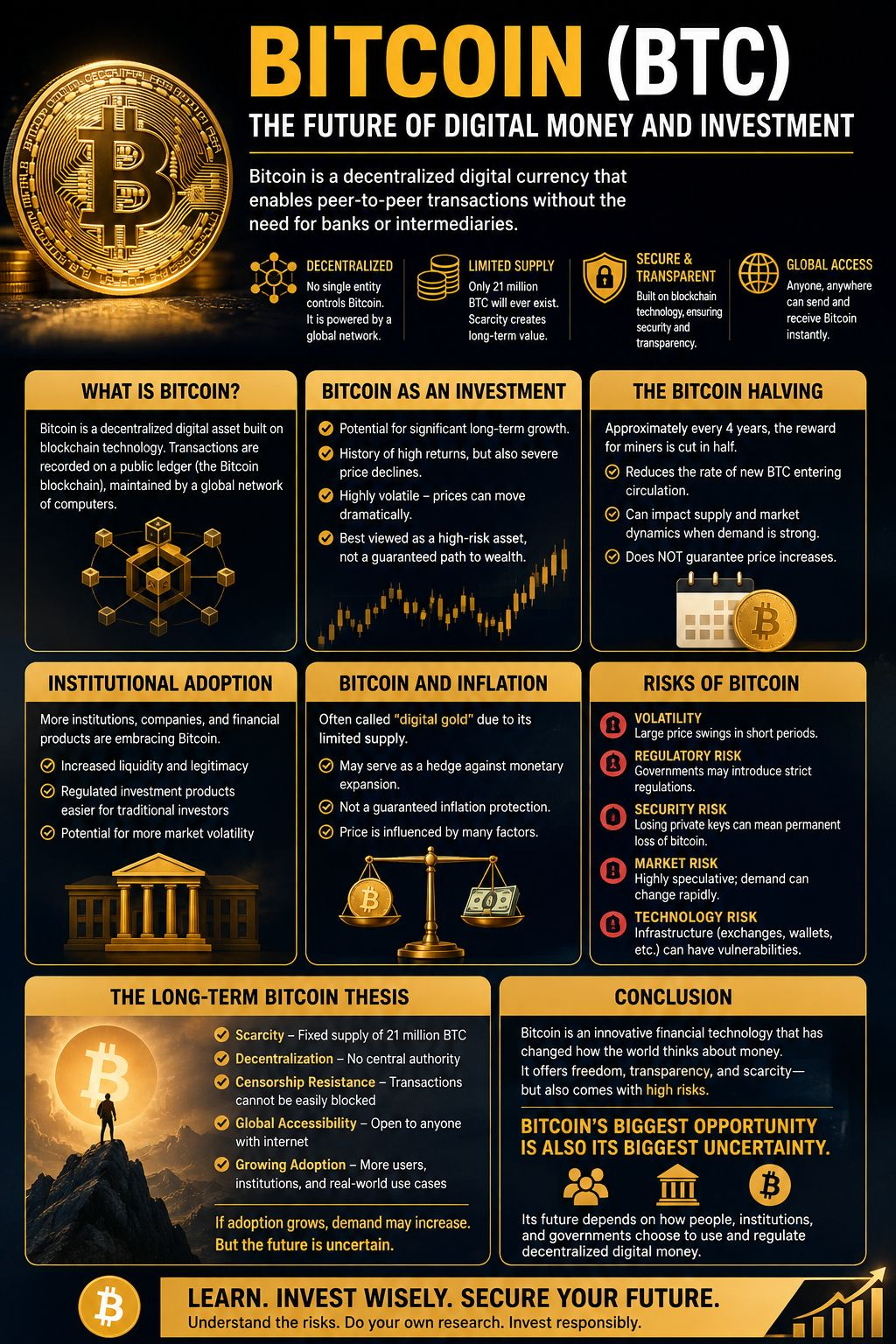
Bitcoin is a decentralized digital asset built on blockchain technology. Transactions are recorded on a public ledger called the Bitcoin blockchain, which is maintained by a distributed network of computers around the world.
Bitcoin has a maximum supply of 21 million coins. This limited supply is one of the main reasons investors compare Bitcoin to scarce assets such as gold. New bitcoins are introduced into circulation through a process called mining, in which computers help secure the network and process transactions.
Why Is Bitcoin Important?
The most important feature of Bitcoin is decentralization. No single government, bank, or company controls the Bitcoin network. Instead, its rules are enforced by software and a global network of participants.
Bitcoin also allows people to hold and transfer an asset directly. Depending on how it is used, this can reduce dependence on traditional financial intermediaries and provide an alternative form of digital ownership.
Another important characteristic is scarcity. Because the protocol limits the total supply to 21 million BTC, Bitcoin cannot simply be printed in unlimited quantities.
Bitcoin as an Investment
Bitcoin has attracted investors because of its potential for significant long-term growth. Historically, BTC has experienced periods of extraordinary appreciation, but it has also suffered severe price declines.
This volatility is one of Bitcoin's biggest characteristics—and risks. The price can move dramatically because of changes in investor sentiment, regulation, liquidity, institutional demand, macroeconomic conditions, and developments within the cryptocurrency industry.
For investors, Bitcoin may therefore be better viewed as a high-risk asset rather than a guaranteed path to wealth.
The Bitcoin Halving
One of Bitcoin's most important events is the halving. Approximately every four years, the amount of new BTC awarded to miners is reduced by half.
The halving decreases the rate at which new bitcoins enter circulation. Investors often pay close attention to these events because reduced new supply can affect market dynamics when demand remains strong.
However, a halving does not guarantee that Bitcoin's price will rise. Market conditions remain unpredictable, and past performance should not be treated as a promise of future results.
Institutional Adoption
Bitcoin has increasingly entered mainstream financial markets. Large financial institutions, asset managers, payment companies, and publicly traded businesses have shown growing interest in Bitcoin and blockchain technology.
The development of regulated investment products has also made it easier for some traditional investors to gain exposure to Bitcoin without directly managing cryptocurrency wallets.
Institutional participation can potentially increase liquidity and legitimacy, but it can also introduce new sources of market volatility.
Bitcoin and Inflation
Bitcoin is sometimes described as "digital gold" because of its limited supply. Supporters argue that an asset with a fixed maximum supply can serve as a hedge against monetary expansion and currency debasement.
The reality is more complicated. Bitcoin has not behaved like a stable inflation hedge over every period. Its price is influenced by many factors, and it can fall sharply even when inflation is high.
Therefore, Bitcoin's scarcity is an important part of its investment thesis, but it should not be considered a guaranteed protection against inflation.
Risks of Bitcoin
Bitcoin offers potential opportunities, but investors should understand the risks.
Volatility: BTC can experience large price movements in short periods.
Regulatory risk: Governments around the world continue to develop rules concerning cryptocurrencies, taxation, exchanges, custody, and financial products.
Security risk: Losing private keys can result in permanent loss of access to bitcoin. Investors must take custody and security seriously.
Market risk: Bitcoin remains a speculative asset, and demand can change rapidly.
Technology risk: Although the Bitcoin network has demonstrated significant resilience, cryptocurrency infrastructure—including exchanges, wallets, and other services—can have vulnerabilities.
The Long-Term Bitcoin Thesis
The long-term argument for Bitcoin is based on several ideas: scarcity, decentralization, censorship resistance, global accessibility, and growing adoption.
If Bitcoin continues to gain acceptance as a store of value or digital asset, demand could potentially increase over time. On the other hand, Bitcoin faces competition from other digital assets, changing regulations, technological developments, and uncertainty about its role in the global financial system.
The future is therefore not guaranteed.
Conclusion
Bitcoin is much more than a cryptocurrency price chart. It represents an alternative approach to digital ownership and monetary technology. Its fixed supply, decentralized architecture, and global network have created an entirely new asset class.
At the same time, Bitcoin remains highly volatile and carries substantial risk. Anyone considering BTC should understand the technology, market conditions, security requirements, and possibility of significant losses before investing.
Bitcoin may ultimately become an important component of the global financial system—or its role may evolve in ways that are difficult to predict today. What is clear is that BTC has already changed the conversation about money, digital scarcity, and financial sovereignty.
Bitcoin's biggest opportunity is also its biggest uncertainty: its future depends on how people, institutions, and governments choose to use and regulate decentralized digital money.#BTC走势分析