
What if the real problem with blockchain transparency is not that too little information is available, but that too much of it is exposed?
I started looking into DUSK while exploring projects built around financial infrastructure, and one design choice kept pulling me back: it does not treat every transaction as needing the same level of visibility.
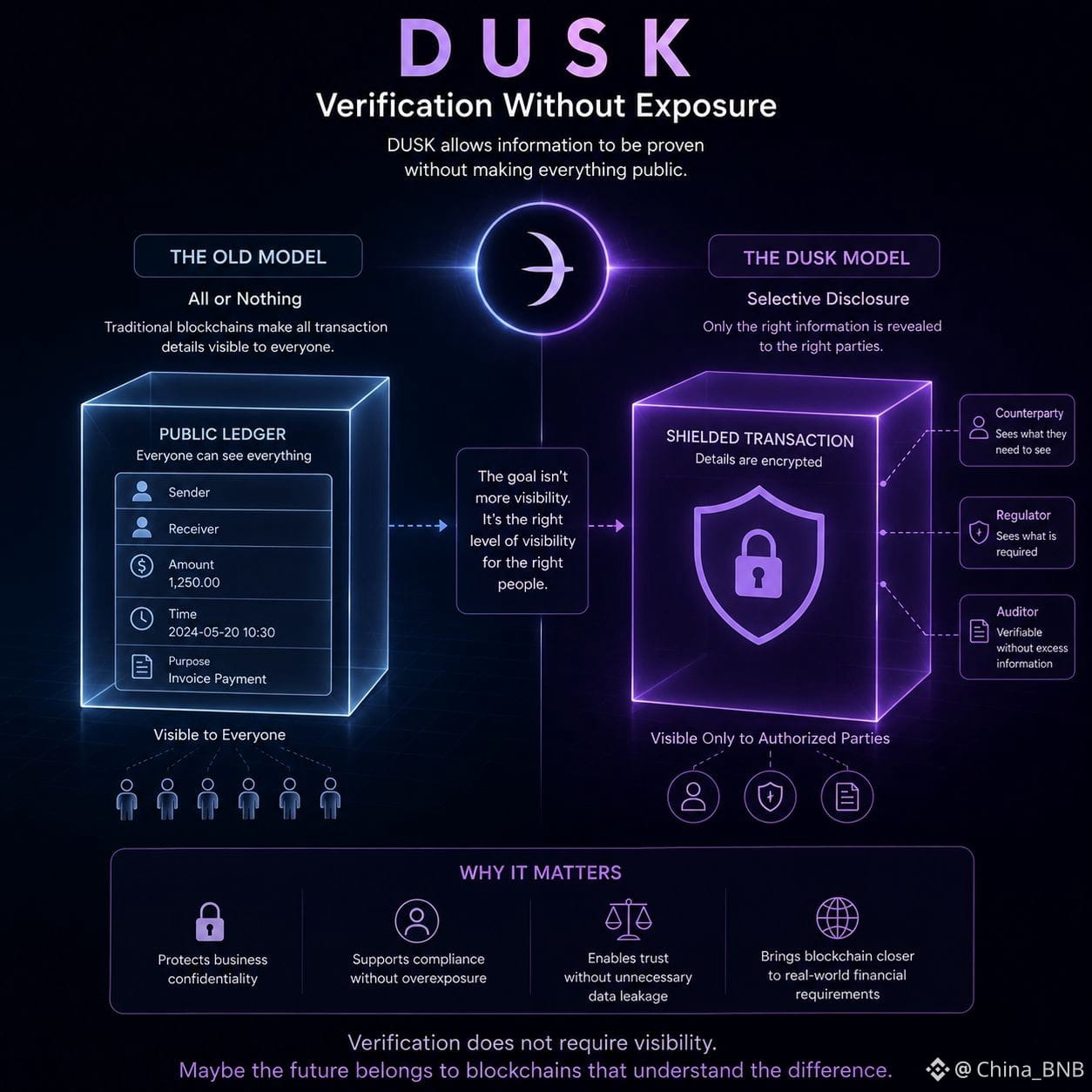
DUSK separates public and shielded transaction flows, while also allowing information to be disclosed selectively when a particular party needs evidence.
That sounds like a small architectural decision until I think about how financial markets actually work.
A company may need to prove that a transfer is legitimate without revealing its entire position. An investor might need to satisfy an eligibility rule without publishing every detail of their identity. A regulator may need an audit trail without turning every commercial relationship into public data.
What interests me is the underlying assumption being challenged: verification does not necessarily require visibility.
While researching DUSK, I found myself questioning how often blockchain systems confuse “anyone can inspect this” with “this can be independently verified.” Those ideas overlap, but they are not identical.
Maybe the more useful design question is not whether a network should be transparent or private. It is whether visibility can become conditional, purposeful, and reversible depending on who actually needs the information.
That distinction feels increasingly important as blockchain moves closer to financial systems where confidentiality is not optional.
@Dusk #dusk $DUSK
I started looking into DUSK while exploring projects built around financial infrastructure, and one design choice kept pulling me back: it does not treat every transaction as needing the same level of visibility.
DUSK separates public and shielded transaction flows, while also allowing information to be disclosed selectively when a particular party needs evidence.
That sounds like a small architectural decision until I think about how financial markets actually work.
A company may need to prove that a transfer is legitimate without revealing its entire position. An investor might need to satisfy an eligibility rule without publishing every detail of their identity. A regulator may need an audit trail without turning every commercial relationship into public data.
What interests me is the underlying assumption being challenged: verification does not necessarily require visibility.
While researching DUSK, I found myself questioning how often blockchain systems confuse “anyone can inspect this” with “this can be independently verified.” Those ideas overlap, but they are not identical.
Maybe the more useful design question is not whether a network should be transparent or private. It is whether visibility can become conditional, purposeful, and reversible depending on who actually needs the information.
That distinction feels increasingly important as blockchain moves closer to financial systems where confidentiality is not optional.
@Dusk #dusk $DUSK