#dusk $DUSK @Dusk
I initially saw XSC as a simple privacy play: keep balances and transaction details away from public eyes.
The more I looked into it, the less I think that is the main story.
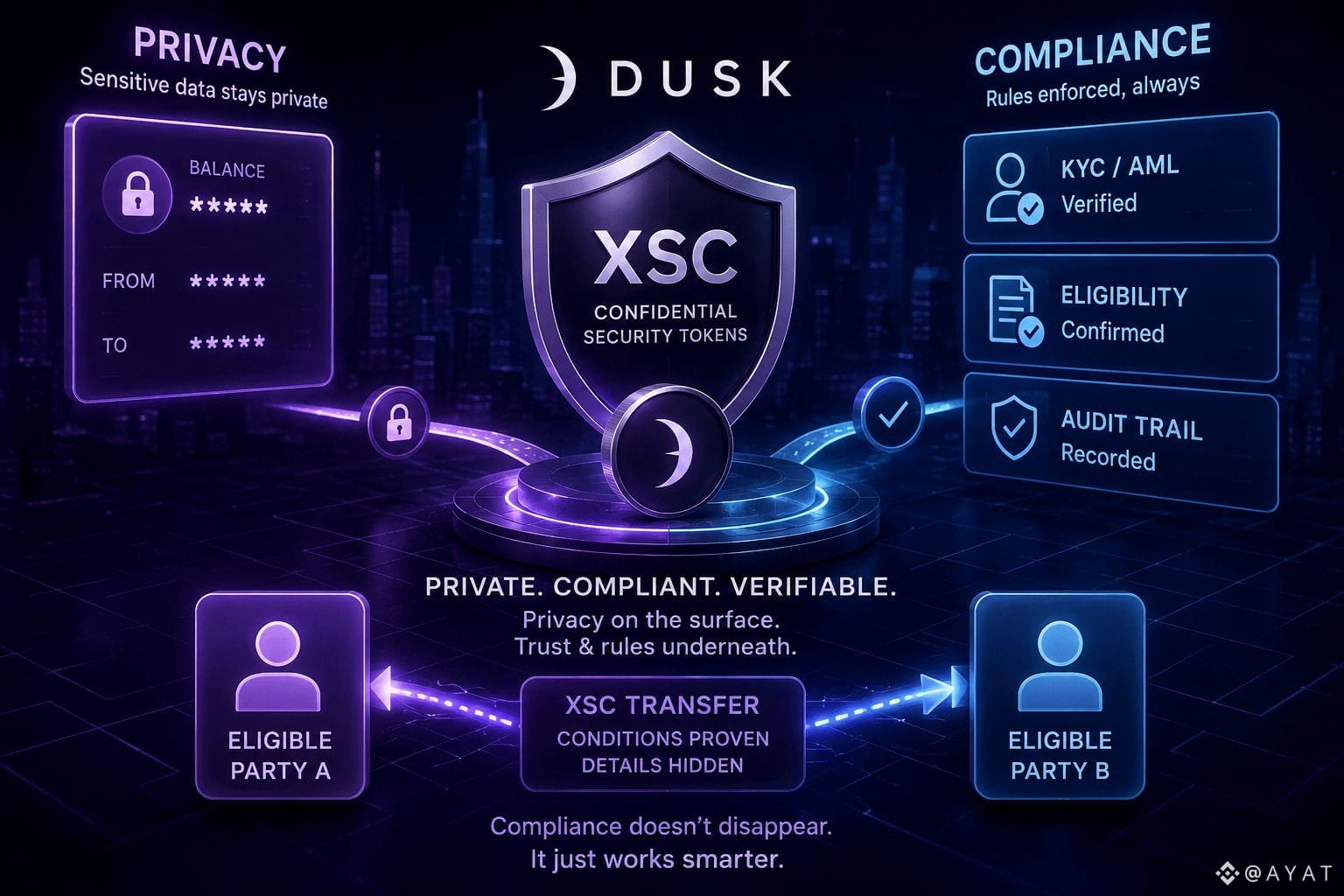
What really caught my attention is the balance between privacy and control. XSC is designed for regulated assets, so privacy does not mean removing KYC, AML, or eligibility requirements. Instead, the idea is to prove that the right conditions are met without exposing every sensitive detail to everyone.
That feels much more practical for tokenized securities.
Institutions usually want two things that seem difficult to combine: strong compliance and financial confidentiality. Public blockchains are great at transparency, but putting every detail in the open is not exactly how serious financial markets operate.
This is where Dusk becomes interesting to me.
The goal isn't simply to hide information. It is to make sensitive information private while keeping the rules enforceable and the activity verifiable when necessary.
If tokenized securities really move toward mainstream adoption, that balance could matter more than flashy transaction numbers.
Maybe the bigger innovation isn't privacy itself.
Maybe it is compliance without unnecessary exposure.
That is the part of XSC I’ll be watching most closely.
Do you think privacy is Dusk’s biggest advantage, or is its compliance architecture even more important?
I initially saw XSC as a simple privacy play: keep balances and transaction details away from public eyes.
The more I looked into it, the less I think that is the main story.
What really caught my attention is the balance between privacy and control. XSC is designed for regulated assets, so privacy does not mean removing KYC, AML, or eligibility requirements. Instead, the idea is to prove that the right conditions are met without exposing every sensitive detail to everyone.
That feels much more practical for tokenized securities.
Institutions usually want two things that seem difficult to combine: strong compliance and financial confidentiality. Public blockchains are great at transparency, but putting every detail in the open is not exactly how serious financial markets operate.
This is where Dusk becomes interesting to me.
The goal isn't simply to hide information. It is to make sensitive information private while keeping the rules enforceable and the activity verifiable when necessary.
If tokenized securities really move toward mainstream adoption, that balance could matter more than flashy transaction numbers.
Maybe the bigger innovation isn't privacy itself.
Maybe it is compliance without unnecessary exposure.
That is the part of XSC I’ll be watching most closely.
Do you think privacy is Dusk’s biggest advantage, or is its compliance architecture even more important?