

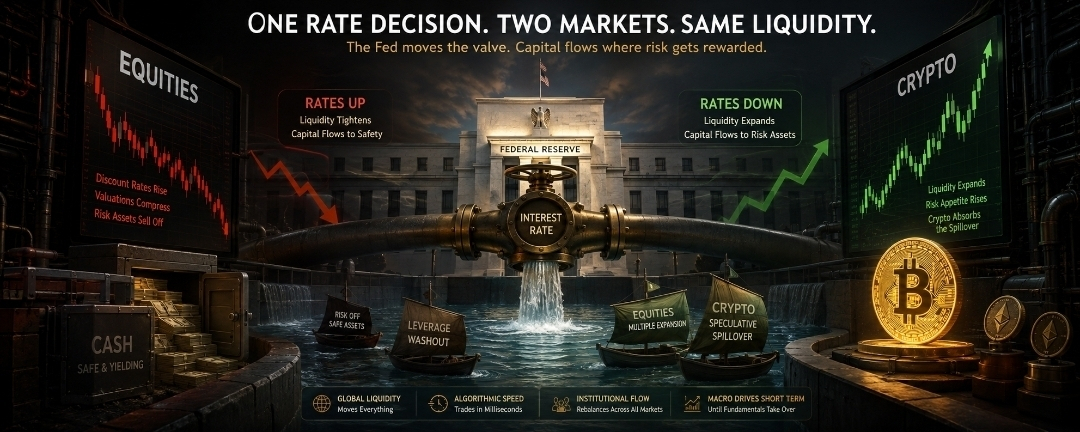

Quando os oficiais do Federal Reserve ajustam as taxas de juros, os mercados de risco se movem juntos como nadadores sincronizados em resposta ao mesmo apito.
Os traders que monitoram as entradas e saídas de liquidez entendem que os bancos centrais controlam o custo global do capital. Uma decisão de taxa não é apenas um dado de política; é a válvula-mestra que determina se o capital flui livremente ou se fica preso em cofres de dinheiro. Quando as taxas de juros permanecem elevadas, tomar dinheiro emprestado fica caro, então o capital recua em direção a instrumentos de caixa mais seguros. Quando o Fed corta as taxas, ele injeta uma liquidez barata na engrenagem bancária, e o dinheiro se espalha rapidamente para as ações junto com os ativos de cripto. Vemos isso com clareza sempre que a rentabilidade do Treasury dos EUA de 10 Anos muda, causando uma reprecificação imediata entre as mesas macro.
Um estrategista macro cuja estrutura acompanha os ciclos de taxa de juros sabe que tanto ações quanto Bitcoin estão no mesmo espectro geral de ativos de risco. Investidores que alocam capital em diversas carteiras institucionais veem ações de tecnologia e Bitcoin por lentes semelhantes durante grandes mudanças macroeconômicas. Taxas de juros altas elevam as taxas de desconto para empresas de crescimento, o que comprime a avaliação de lucros futuros. Esse mesmo mecanismo afeta os ativos digitais, pois os investidores avaliam tokens sem rendimento em relação ao rendimento de títulos do Tesouro sem risco. Consequentemente, quando os rendimentos dos títulos sobem, ambos os mercados vendem juntos.
Considere o sistema financeiro global como um enorme reservatório de água no qual o capital circula continuamente entre os mercados ao redor do mundo. A taxa de juros de referência atua como a comporta principal do reservatório, controlando a saída total de capital. Quando o Fed abaixa essa comporta, a liquidez transborda, e cada barco no porto sobe. Os mercados de ações passam por uma expansão imediata de múltiplos, enquanto o cripto absorve o transbordamento especulativo. às vezes, o mercado reage imediatamente à própria decisão sobre a taxa de juros; em outras, os traders passam algum tempo analisando a declaração de política que a acompanha para adivinhar o que vem a seguir.
Muitos analistas tratam equivocadamente o Bitcoin como totalmente desacoplado das ações tradicionais, mas a realidade do mercado conta uma história diferente. As instituições de Wall Street que compraram ETFs à vista agora tratam o cripto como uma posição de alta volatilidade dentro de carteiras macro. Um gestor institucional respeitado pelos traders irá rebalancear posições de risco instantaneamente ao ouvir os bancos centrais falarem. Portanto, uma mudança brusca para um tom mais hawkish força um desalavancamento imediato tanto nas mesas de ações quanto nos pools de liquidez de cripto.
A mecânica dessa correlação depende da liquidez global, cuja arquitetura central determina como o risco é precificado em todos os mercados financeiros. Quando os custos de empréstimo caem, os investidores buscam maior rendimento em ações de crescimento, e ao mesmo tempo aumentam as apostas na escassez digital. Por outro lado, quando o dinheiro aperta, a alavancagem evapora, então ambas as classes de ativos recuam para as avaliações de referência.
A alocação de capital nas finanças modernas depende de modelos algorítmicos de liquidez que executam negociações entre classes de ativos em milissegundos. Uma mesa de operações que gerencia carteiras de bilhões de dólares vai retirar a alavancagem dos locais de derivativos de cripto no mesmo momento em que reduz a exposição a ações. Um gestor de fundos experiente, com histórico que atravessa múltiplos ciclos de mercado, sabe que mudanças na liquidez não discriminam entre ações tradicionais e tokens digitais.
Entender essa dinâmica exige paciência, então os participantes do mercado devem esperar que a política macro domine a ação de curto prazo por algum tempo. Em algum momento no futuro, o Bitcoin pode desacoplar completamente à medida que sua maturação monetária avança, mas hoje ele ainda está atrelado ao balanço do Fed.
A percepção final para os traders modernos é que o Bitcoin não negocia contra moedas fiduciárias em um vácuo, mas sim contra a disponibilidade total de liquidez dos bancos centrais globais.