
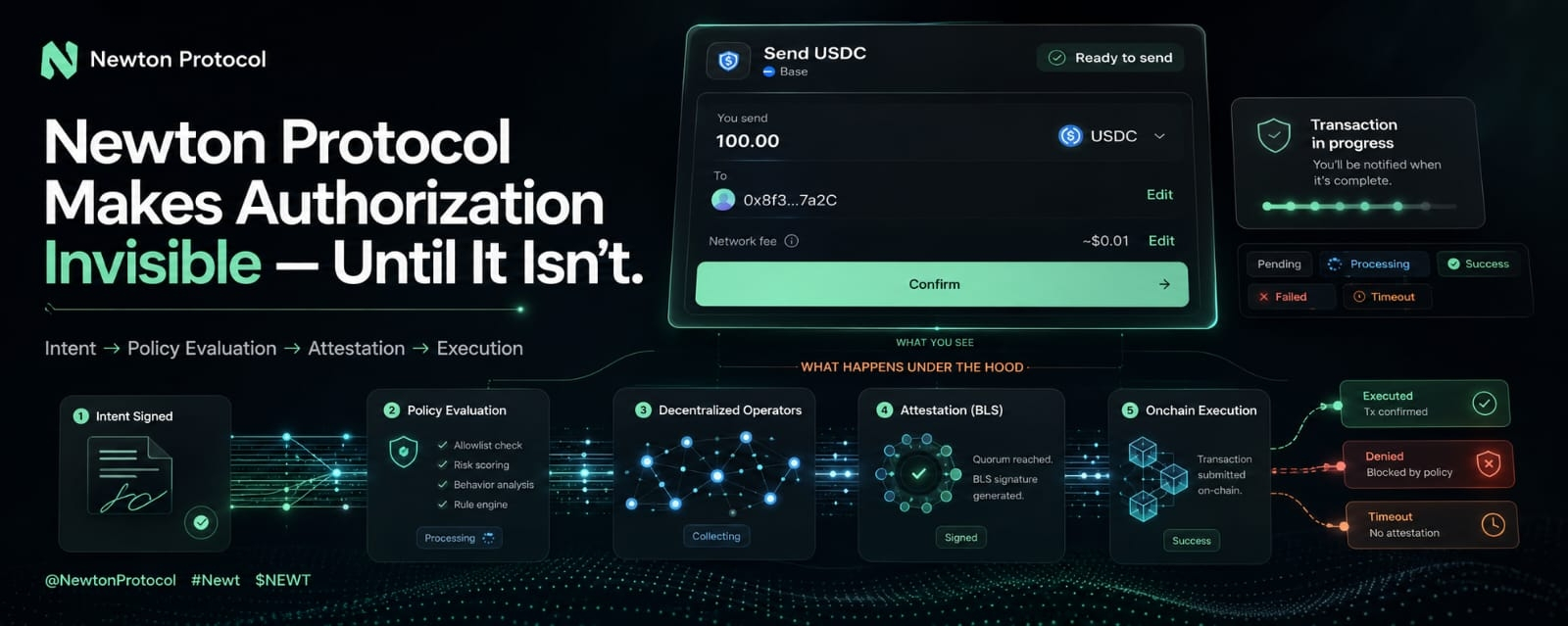
Market was doing absolutely nothing again, so I ended up clicking through Newton’s developer docs instead of watching another candle move half a percent and reverse.
Wasn’t looking for anything specific. I just kept seeing the same promise on Newton’s site: transactions get checked before settlement, but supposedly with “no UX changes.” The policy runs in the background, compliant actions go through, and the user carries on like the extra security layer was never there.
Clean pitch.
But then I opened the frontend integration flow, and… the word “no” started doing more work than I expected.
Because a Newton-protected transaction does not simply move from wallet confirmation to blockchain execution. The application first constructs an intent describing what the user wants to do. The user signs that intent using EIP-712. The app sends it for policy evaluation. Newton operators evaluate the request and produce an attestation. Only after the policy approves it does the application submit the actual onchain transaction together with the task data, operator response, and BLS signature.
That is not one action.
It is an authorization sequence designed to feel like one.
Here’s the thing that stuck.
When I originally read “no UX changes,” I assumed Newton was adding a verification step that behaved almost like an ordinary contract check — something deterministic, immediate, and invisible once integrated.
But Newton’s authorization layer depends on an offchain operator network completing work before the protected transaction can execute. The synchronous RPC method waits for BLS aggregation, with a documented default timeout of 30 seconds. The frontend example uses a 60-second timeout. Tasks can move through pending, processing, success, failed, or timeout states.
Most transactions probably will not sit there for 30 or 60 seconds.
That is not the point.
The point is that the application has to be designed for the possibility that they might.
Newton’s own troubleshooting section tells developers to handle situations where the operator network is slow or unavailable by increasing the timeout or retrying. Its RPC documentation includes WebSocket subscriptions and webhook callbacks so applications can surface task updates and respond to failures such as timeouts, insufficient quorum, failed onchain submission, policy-evaluation errors, or signature-verification problems.
So the authorization layer may be invisible to the user when everything works.
But keeping it invisible is developer labor.
Someone still has to design the loading state. Someone has to decide what the interface says while operators are evaluating the request. Someone has to distinguish “your transaction was rejected by policy” from “the authorization network did not answer.” Someone has to prevent a user from clicking again and accidentally creating a second request because the first one looked frozen.
That gap is the thing.
Newton is not removing friction. It is asking the application to absorb it.
And honestly, that might be completely reasonable. A compliance or risk check happening before capital moves is probably worth more than shaving a second from the interface. For an institutional vault, stablecoin issuer, or autonomous agent wallet, a brief authorization delay is likely preferable to discovering after execution that the transaction violated a policy.
Security usually costs something.
Newton’s architecture just tries to make sure the end user is not the one thinking about the cost.
Even the onchain validation choice carries a trade-off. Newton documents a standard route that waits for the aggregator to submit the response onchain and a direct route that verifies the BLS proof immediately inside the transaction. The standard route is estimated at roughly 50,000–100,000 gas, while direct validation is estimated at around 200,000–500,000 gas. The faster path avoids waiting for the aggregator, but pushes more verification cost into execution.
That feels more honest than the slogan.
You can reduce visible waiting, but you may pay more gas.
You can reduce gas, but you may depend more heavily on the aggregator completing its part first.
You can hide the entire sequence behind a clean button, but the app still has to manage signatures, operator responses, policy decisions, retries, expiration, and transaction execution underneath.
None of this means the design is bad. Actually, the separation is probably the whole product: authorization becomes its own phase rather than being mixed into the transaction after something has already gone wrong.
But “no UX changes” and “no additional UX complexity” are not the same claim.
The first might be achievable.
The second clearly is not.
I think the real test for Newton will not be whether a demo transaction feels normal while the network is healthy. It will be what users experience when an oracle is slow, quorum is temporarily unavailable, an attestation expires, or a request is denied for a reason the interface has to explain in plain language.
That is when invisible infrastructure becomes visible.
And maybe that is the better way to judge the authorization layer anyway — not by how little users notice when everything works, but by how clearly the application behaves when authorization does not.
Does Newton preserve the familiar transaction experience under real load, or does the extra security step eventually become one more delay the user has to understand?