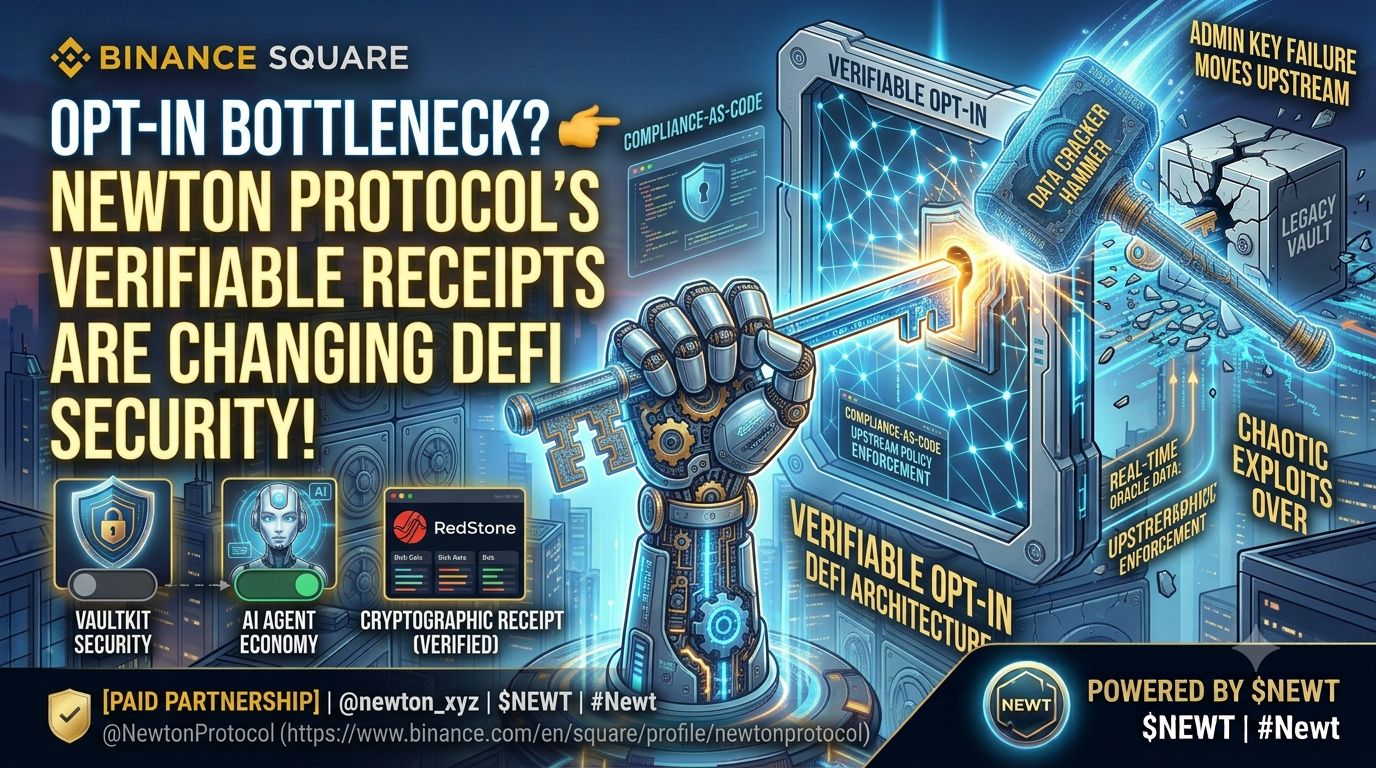

When infrastructure platforms talk about security, they almost always default to talking about encryption, auditable code, or multi-signature setups. While these primitives are essential, they all operate under a shared, flawed assumption: that a smart contract's role is strictly to execute a transaction once permissions are granted. They treat security as a lock on the door, but offer nothing to govern behavior once a user or an autonomous system is inside the room.
The arrival of the Newton Mainnet Beta on Base and Ethereum marks a clear departure from this thinking. By building out what can be described as a modular "Constraint Layer," @NewtonProtocol isn’t creating a new blockchain to compete on execution speed. Instead, they are shipping an upstream policy framework that redefines the relationship between code execution and operational boundaries.
The Architecture of a "Constraint Box"
The core piece of this framework is Newton VaultKit. Rather than operating as a generic software development kit (SDK) to spin up template vaults faster, VaultKit functions as a custom sandbox for distinct types of capital.
Consider the three distinct forces currently driving value movement on-chain: Institutional Allocators, Autonomous AI Agents, and High-Net-Worth Whales. These groups share almost no operational overlap, yet they face the exact same bottleneck—how to delegate authority without losing control:
Institutional Frameworks (Compliance Boxes): For enterprise capital, VaultKit functions as an unalterable compliance barrier. Capital can move fluidly through automated strategies, but it is architecturally blocked from touching unsanctioned pools or bypassing strict corporate multi-approval workflows.
AI Agents (Behavior Boxes): When an autonomous agent manages capital, human speed auditing is impossible. VaultKit wraps the agent in a hardcoded behavior profile—setting strict spending velocity caps, mandatory token whitelists, and sudden slippage circuit breakers.
DeFi Capital Pools (Trust Boxes): For standard liquidity providers depositing into managed vaults like Euler, VaultKit strips away the risk of a manager key change. A vault curator cannot quietly shift funds into speculative, unvetted strategies because the upstream layer automatically voids any transaction outside the original contract mandate.
Verifiable Off-Chain Compute via EigenLayer AVS
A common critique of active authorization systems is that checking multiple risk conditions during a transaction cycle creates crippling network latency. Newton bypasses this bottleneck by executing complex policy logic off-chain inside Trusted Execution Environments (TEEs).
To keep this process entirely decentralized and secure, the network operates as an EigenLayer Actively Validated Service (AVS). The computing nodes that process these transaction intents inside the TEE boundaries must actively stake and coordinate using the network's core asset.
Every time a rule is evaluated, the system outputs an undeniable cryptographic receipt proving the transaction satisfied every set boundary. This architecture ensures that security is no longer an administrative afterthought; it is woven directly into the flow of capital.
Staking and Economic Utility of $NEWT
The structural necessity of the $NEWT token is built straight into this node architecture. As institutional integrations scale across automated vault setups, the demand for deterministic, verifiable compute expands alongside it. Within the Mainnet Beta environment, $NEWT acts as the primary tool across multiple core layers:
Staking Capital: Securing the consensus of TEE node validation.
Permission Handling Gas: Fueling the compute cycles needed to check complex risk rules before execution.
Malicious Risk Protection: Requiring autonomous strategy operators to post backing collateral against erratic behavior loops.
The launch of the Mainnet Beta signals that Web3 infrastructure is maturing past simple asset transfers. By providing flexible, programmatic constraint systems rather than a single rigid mold, the ecosystem is laying down the practical groundwork needed to handle complex, automated capital distribution safely.