
What struck me about Newton Protocol was not its attempt to make AI-driven finance more autonomous. It was the decision to place rules before autonomy. My thesis is that Newton’s most important design choice is not enabling machines to act faster, but forcing them to operate inside a constitution that exists before their preferences begin to change.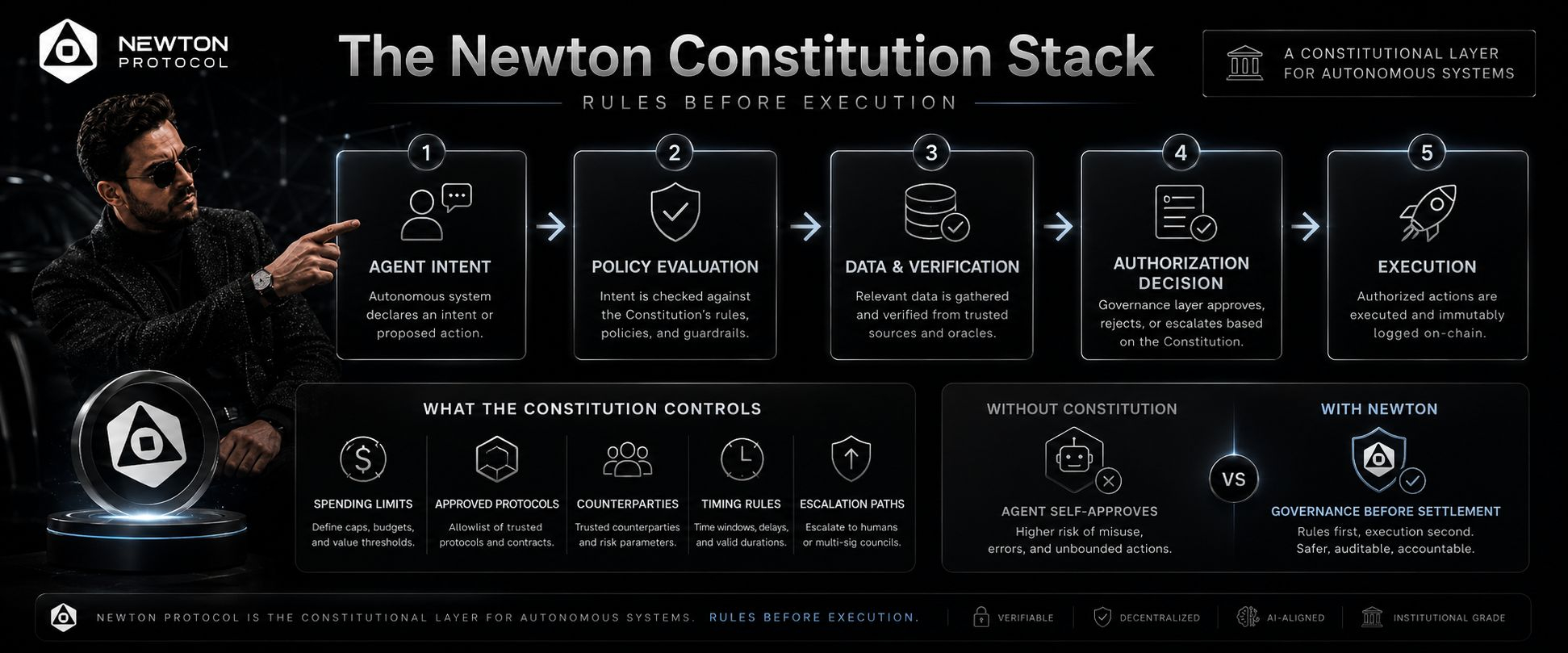 Most autonomous systems are introduced through capability: an agent can trade, rebalance a portfolio, move liquidity, pay for services, or interact with multiple protocols. That framing assumes intelligence is the difficult part. I think the harder problem appears after the system becomes capable: who decides what the agent must never do?
A human trader can pause when conditions feel wrong, recognize an unusual counterparty, or ignore an instruction that conflicts with a broader responsibility. An autonomous agent cannot safely depend on instinct. It needs explicit boundaries covering spending limits, approved protocols, counterparties, transaction sizes, timing, data conditions, and escalation paths.
This is where Newton Protocol begins to resemble constitutional infrastructure rather than another automation layer. Policies are not merely preferences attached to an agent. They function more like higher-order rules that determine whether the agent’s intended action is permitted to reach execution.
That distinction changes the power structure.
Without a policy layer, the agent’s internal logic effectively becomes the government. Its model, developer, prompt, strategy, or operator decides what happens. When authorization is separated from decision-making, the agent may propose an action, but it does not possess the final authority to approve itself.
Execution therefore follows governance rather than preference.
Newton’s policy-first architecture makes this separation technically meaningful. A strategy can produce an intent, but that intent can be evaluated against programmable rules before settlement. The authorization decision can also be made inspectable, giving users and institutions evidence of why an action was accepted or rejected.
What initially looks like a restriction on autonomy may actually be what makes serious autonomy possible.
An institution is unlikely to delegate capital to an AI system merely because the model performs well in simulations. It needs confidence that the system cannot quietly exceed its mandate when market conditions, data inputs, or internal reasoning change. A profitable strategy with weak boundaries is not institutional automation. It is discretionary risk hidden behind software.
The constitutional model also exposes a tradeoff that is easy to ignore. Stronger rules can make autonomous finance more trustworthy, but they can also make it less adaptive. A rigid policy may reject an unusual transaction that would have protected the portfolio. A flexible policy may create enough ambiguity for an agent to exploit or misinterpret it.
More governance does not automatically produce better governance.
Policy authors gain considerable influence because they define the boundaries inside which machine behavior is considered legitimate. Data providers gain influence when external information determines whether a condition has been met. Operators and verification mechanisms gain influence because users depend on policy evaluations being correct, timely, and available.
Trust has not disappeared. It has moved from the agent’s intelligence toward the quality of the constitution and the infrastructure enforcing it.
That shift matters now because autonomous systems are moving from recommendation toward execution. A chatbot suggesting a trade creates limited direct risk. An agent controlling a treasury, vault, or automated strategy can create irreversible consequences before a human understands what happened.
The market may therefore begin evaluating AI systems less by how many actions they can perform and more by how reliably their authority can be constrained. Performance will still matter, but constitutional credibility could become the entry requirement for managing meaningful capital.
I am not completely sure that users will tolerate the additional policy design, verification cost, and operational complexity. Technical capability does not guarantee that developers will build careful constitutions or that users will understand the rules governing their agents. Poorly written policies can be enforced perfectly and still produce harmful outcomes. 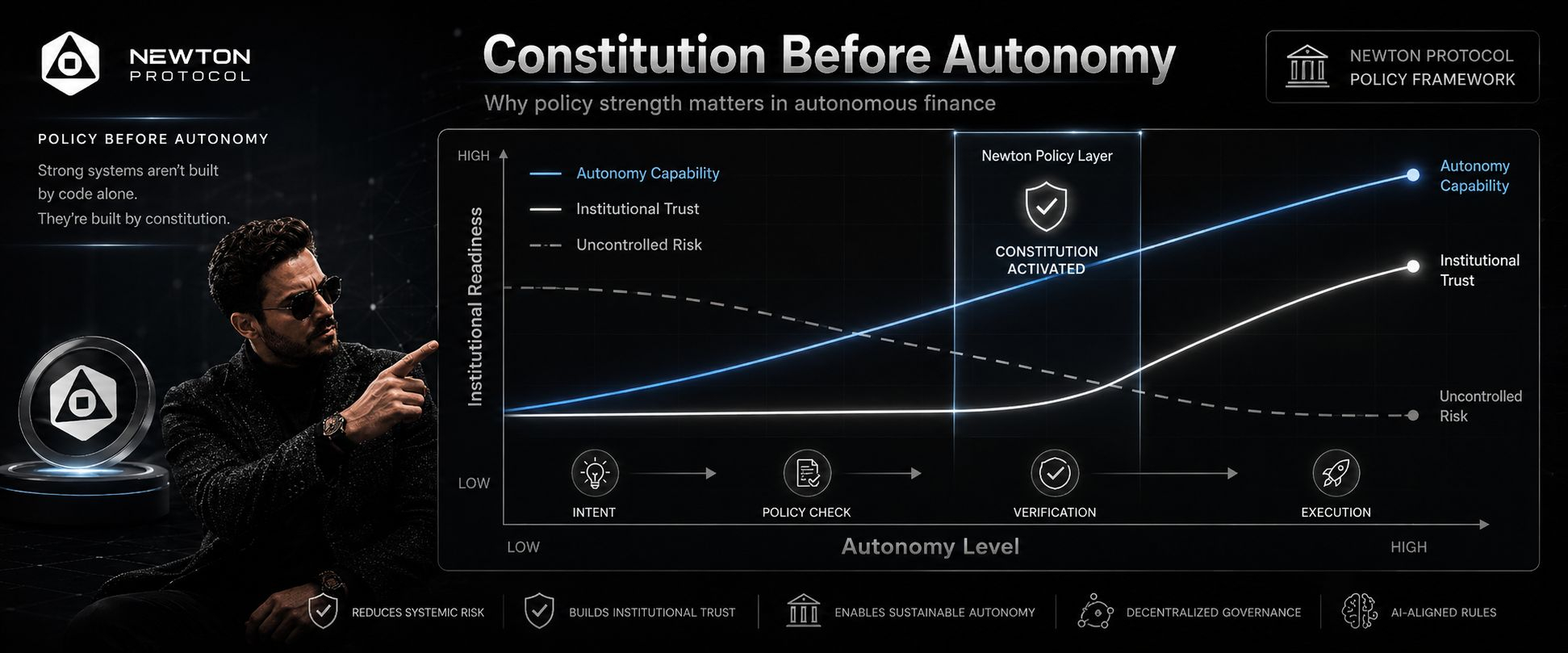
The open question is whether Newton Protocol can make policy governance practical enough to become routine rather than an expert-only security exercise.
If this holds, the next phase of AI finance will not be defined only by smarter agents. It will be defined by which systems can prove that intelligence remains subordinate to legitimate authority.Autonomy scales capability, but constitutions decide who remains in control
@NewtonProtocol $NEWT #Newt