
Trump's Oil Swings: How the US President Manipulates the Market and Why Traders Keep Falling for It
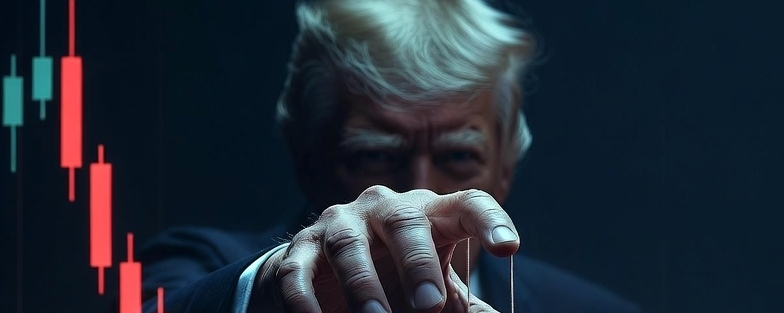
For two weeks now, Donald Trump has been setting the tone at the opening of the stock market. With enviable regularity, he makes loud statements: "Iran is on its knees!", "They are begging for negotiations," or "I am extremely positive about a deal." Why is he doing this? The answer lies not so much in geopolitics as in the desire to knock down oil prices. The problem is that traders—or rather, their trading algorithms—still fall for this spectacle, even though Tehran has learned to make the US President look like a laughingstock.
The Deception Mechanism: How Words Turn into Candles
The classic scheme works flawlessly. Trump makes a "dovish" statement about imminent peace and talks. News terminals instantly blast out the headlines. Trading robots, programmed to read the sentiment of the news, perceive this as a de-escalation signal. Risk goes down—algorithms begin a massive sell-off of oil futures.
This is how the US President leads the market by the nose, using the crude but effective tool of verbal intervention. It is crucial to understand: this is neither an insider leak nor real diplomacy. This is a short-selling game where the main goal is to cool inflation expectations through cheaper raw materials.
The market is slowly learning. Iran, seeing this simple manipulation, has begun to respond harshly and publicly. When Trump speaks of Tehran's "pleas," Iranian officials go on air and explicitly deny the very possibility of negotiations under conditions of blackmail. The Republican is made to look like a fantasist, yet the algorithms still react to the word "negotiations," albeit with slightly less amplitude.
The Myth of the Blockade: Oil Flows Despite the Rhetoric
The White House is trying to convince the public that the sanctions pressure works like a noose. In reality, the situation is ambiguous: a blockade seems to exist, but de facto, the volume of Iranian exports suggests otherwise. According to Tehran's own statements, more oil was sold in April than in March. And most interestingly, confirmation of this occasionally leaks out through the American media themselves.
In reality, the US is currently interested in allowing certain volumes of Iranian oil to reach the market. This curbs the global deficit and prevents prices from skyrocketing to stratospheric levels. It results in a classic "come here—go away" scenario: for the public, Trump is a hawk; for the market, he secretly plays the dove, regulating supply.
Trump Card with No Value: Why Bombing Iran is a Death Sentence for the US
In Trump's militant rhetoric, threats to destroy Iranian infrastructure often flash by: bridges, power plants, and oil facilities. However, this trump card is fake, and the White House understands this perfectly.
Iran's retaliatory measures have long been planned and are absolutely asymmetrical. In the event of an attack on its territory, Tehran officially hints at the implementation of at least two nightmare scenarios for the West:
1. Destruction of the neighbors' oil sector. Missile strikes on Saudi Arabian, UAE fields, and terminals in the Persian Gulf would instantly collapse the global energy supply.
2. Attacks on submarine internet cables. Damaging the trunk lines in the Strait of Hormuz would become a "digital doomsday" for global finance.
In such a situation, the average American will not go en masse to volunteer to "deal with the ayatollahs." They will go en masse to deal with the Republicans in Congress. The price of an adventure in the style of "Operation Persian Freedom" will turn out to be so high that it will destroy any economic achievements by Trump and crash the stock market.
Bitcoin and the "Feast in the Time of Plague"
Against the backdrop of these dangerous games, the current rise of Bitcoin looks frankly unhealthy. Crypto enthusiasts try to elevate it to the status of a safe-haven asset, but reality is cruel: Bitcoin is not one.
If the geopolitical conflict enters a hot phase, classic capital will flee into the dollar, cash, and gold. The number one cryptocurrency, on the contrary, will react among the first—with a huge red candle down, pulling the entire market with it. It’s not even worth mentioning altcoins, which will burn to ashes. Today's growth is a classic "feast in the time of plague" or a "Bull Trap," where the market ignores mounting risks for the sake of immediate speculation.
Survival Rules for the Trader
The main thing you must remember: when Trump claims that "Iran is already on its knees," do not run to open longs on risky assets or short oil. Right now, he is doing this for a PR game, to calm the public and paint a victorious picture before the trading session opens. Believing the statements of a man who can change his position five times in one day is comparable to financial suicide.
The real signal will not be a word, but an action. As soon as the Strait of Hormuz truly opens for free navigation—not just in the words of a National Security Advisor—then you can safely reconsider your portfolio structure. Until then, skepticism must be your main strategy. Although it should be admitted: even realizing the destructive consequences of a full-scale war, Trump is capable of taking this desperate step, and then the game will truly be over.