

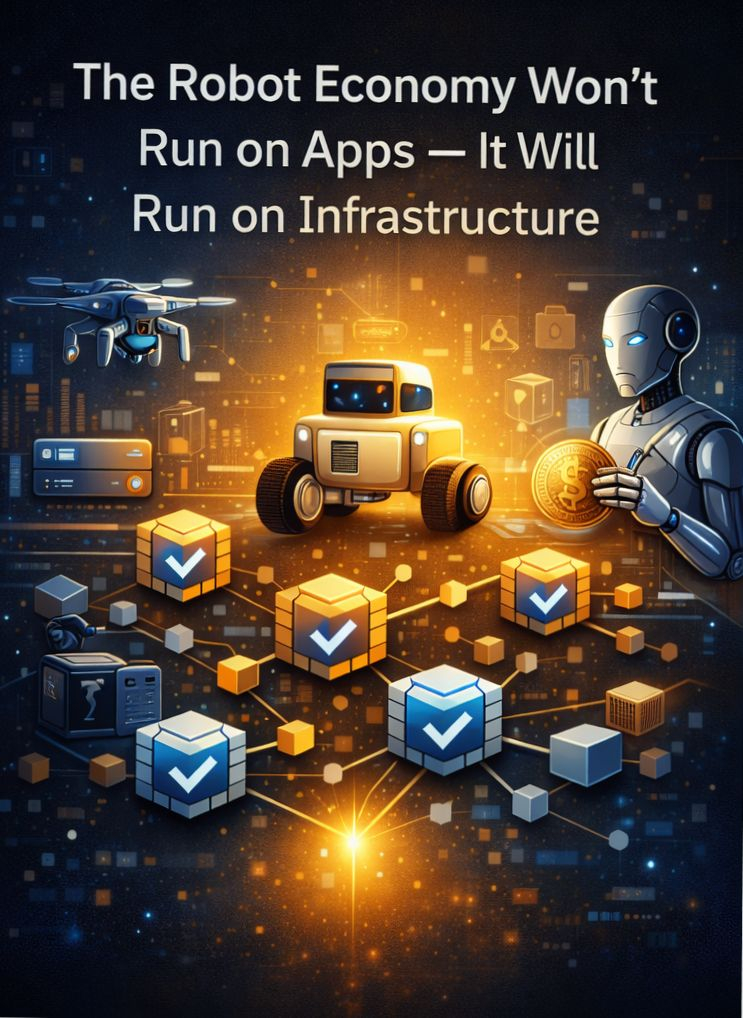
Over the last few years, most conversations about robotics have focused on intelligence.
New models appear. Sensors improve. Machines learn to interpret environments more accurately than before. Each new breakthrough pushes the conversation in the same direction: smarter robots.
But the more I watch how machines actually operate in the real world, the more I start thinking the real challenge may lie somewhere else. @Fabric Foundation
It’s not intelligence.
It’s infrastructure.
A robot can be incredibly capable on its own. It can analyze data, move through physical environments, and complete complex tasks with minimal supervision. But the moment that machine needs to interact with other systems, the situation becomes more complicated.
Not because the robot lacks intelligence.
Because the environment around it was never designed for machines to coordinate with each other.
The Missing Layer in the Robot Economy
Most digital infrastructure today was designed with humans in mind.
Accounts belong to people or companies.
Permissions are assigned by administrators.
Payments move through financial systems that assume a human operator somewhere in the process.
Even when machines perform work autonomously, the coordination behind the scenes still depends on human-managed systems.
That works when robots operate inside a single organization.
But the moment machines need to interact across different networks, platforms, or services, the limitations become obvious.
Imagine a delivery robot needing to pay for charging at a third-party station.
Or an industrial robot requesting data from an external monitoring service.
Or autonomous machines coordinating tasks across logistics networks.
Suddenly the problem is no longer robotics.
It becomes coordination.
Why Intelligence Alone Isn’t Enough
People often assume that once robots become intelligent enough, everything else will fall into place.
But intelligence alone doesn’t create an economy.
Economies depend on coordination between participants.
For machines to participate in economic systems, several basic questions need answers:
How does a machine prove its identity?
How do other systems verify that identity?
How do machines establish trust over time?
How do they exchange value for work performed?
Without those foundations, robots remain isolated tools rather than participants in a broader economic network.
And that’s where infrastructure starts to matter more than intelligence.
Fabric’s Approach to the Problem
This is the direction Fabric Protocol Foundation is exploring.
Instead of focusing only on robotics capabilities, the project is trying to build infrastructure that allows machines to operate inside digital economies.
The idea is relatively simple, but the implications are large.
Machines need identities.
They need a way to authenticate themselves when interacting with networks.
They need mechanisms to establish reputation based on behavior.
And they need economic rails that allow them to exchange value for work performed.
Rather than treating robots as temporary infrastructure components, Fabric treats them as identifiable participants in a network.
Once machines have verifiable identities, a new layer of coordination becomes possible.
Machines can recognize each other.
They can verify requests.
They can establish trust through reputation and historical behavior.
At that point, robots begin to function less like isolated tools and more like actors inside an economic system.
Why Infrastructure Matters Before Scale
What makes this interesting is that infrastructure usually appears before the market fully exists.
The internet built communication protocols before social networks appeared.
Blockchains built settlement layers before decentralized finance emerged.
In the same way, the robot economy may require coordination infrastructure long before millions of machines begin interacting economically.
Without those foundations, growth becomes chaotic.
Machines may be intelligent, but they still need systems that allow them to coordinate safely.
The Real Question for the Robot Economy
When people imagine the future of robotics, they often picture more capable machines.
Smarter algorithms.
Better hardware.
Faster decision-making.
But capability alone does not create an economy.
Economies require identity, trust, coordination, and incentives.
In other words, they require infrastructure.
That’s why projects like Fabric are interesting to watch.
Not because robots suddenly became dramatically smarter.
But because someone is asking a deeper question:
If machines eventually become economic actors, who builds the infrastructure that allows them to coordinate?
Because the robot economy may not be defined by how intelligent machines become.
It may be defined by the systems that allow those machines to interact with each other in the first place. #ROBO $ROBO